Choosing an acoustic panel is not simply about finding a product that looks right for the space. If you are comparing different acoustic materials, one of the first technical specifications you are likely to encounter is the NRC rating . But what does that number actually tell you, and how useful is it when selecting acoustic panels?
The NRC rating , or Noise Reduction Coefficient, is a commonly used measure of a material's sound absorption performance. It can help buyers compare acoustic materials, but it should never be treated as the only factor when evaluating an acoustic solution. Panel thickness, material construction, mounting conditions, treated surface area, frequency response, and the characteristics of the room all influence the final acoustic outcome.
For architects, interior designers, acoustic consultants, contractors, and project owners, understanding NRC makes it easier to interpret acoustic panel specifications and make informed decisions. Thermofriz approaches acoustic product selection from this broader perspective, helping project teams identify solutions based on the actual requirements of the space rather than relying on a single number.
What Is an NRC Rating?
NRC stands for Noise Reduction Coefficient. It is a single-number rating used to describe the sound absorption performance of an acoustic material or product. In simple terms, NRC helps indicate how effectively a material absorbs sound rather than allowing sound energy to reflect back into a room. A higher NRC generally indicates greater sound absorption within the frequency range represented by the rating.
For example, an acoustic panel with a higher NRC may be more effective at controlling reflected sound than a panel with a substantially lower NRC when the products are tested under comparable conditions. However, an NRC value should not be interpreted as meaning that a panel blocks or eliminates the same percentage of all sound.
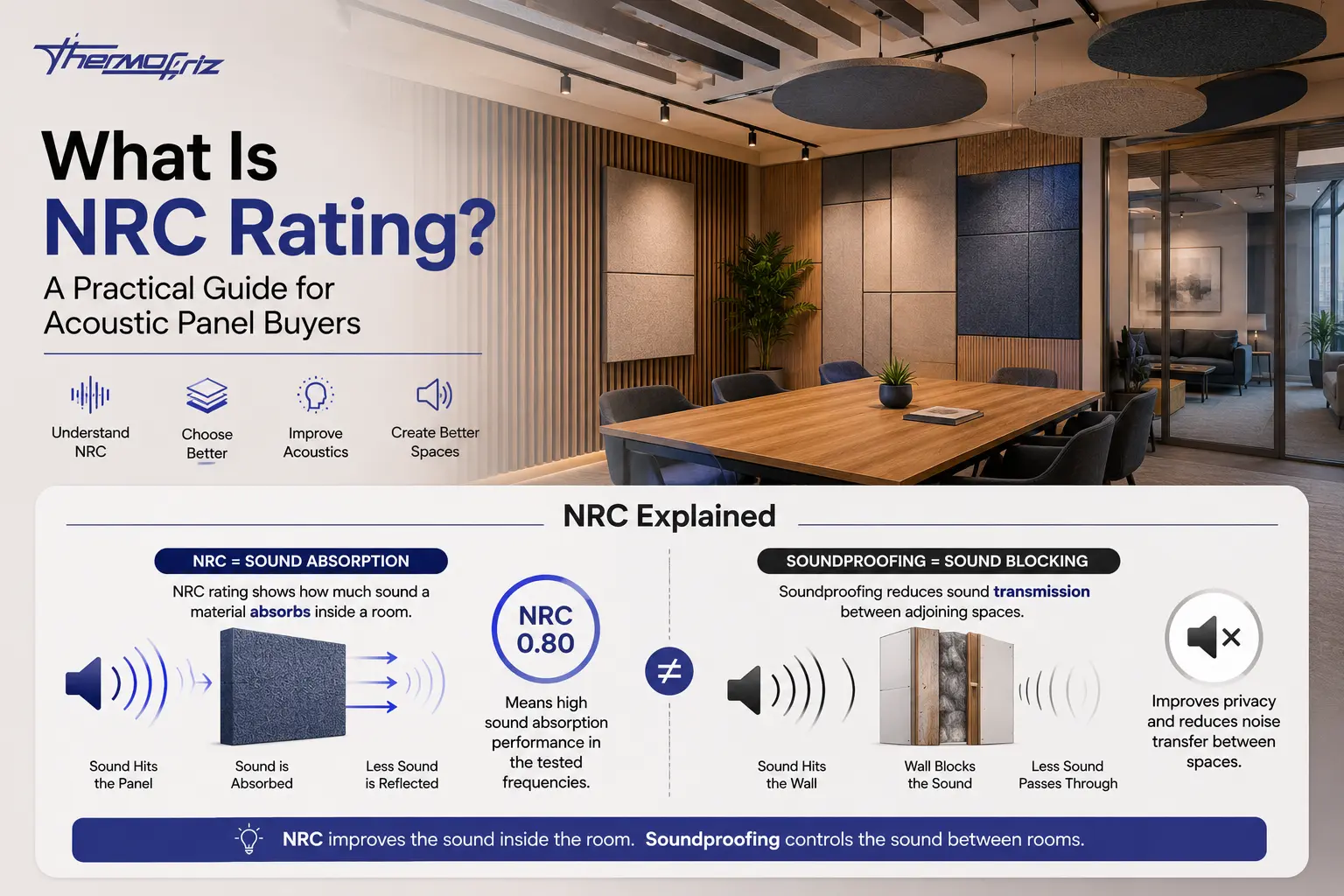
NRC is an averaged representation based on sound absorption measurements at selected frequencies. It does not describe every aspect of a product's acoustic performance. This distinction is particularly important when buyers are searching for acoustic panels for soundproofing. Sound absorption and sound isolation are different acoustic functions.
A panel can be highly absorbent without necessarily preventing sound from passing through a wall or partition.
What Does NRC Stand For?
NRC stands for Noise Reduction Coefficient . It is used primarily to provide a simplified indication of how much sound a material absorbs within a defined frequency range.
What Does an NRC Value Mean?
An NRC value provides a convenient way to compare the general sound absorption characteristics of acoustic materials. For example, an NRC of 0.80 generally indicates stronger sound absorption than an NRC of 0.40 when comparing products tested under equivalent conditions. But the number alone does not tell you:
- How the material performs at every frequency
- How much of the room has been treated
- How the panel is mounted
- How the room itself affects sound
- Whether the product provides sound isolation
- Whether the acoustic environment is appropriate for the intended application. That is why professional acoustic specification should look beyond the headline NRC figure
How Is NRC Calculated?
NRC is derived from measured sound absorption coefficients at specific octave-band centre frequencies. The traditional calculation uses the absorption coefficients at 250 Hz, 500 Hz, 1000 Hz, and 2000 Hz , which are averaged and rounded to the nearest 0.05. The underlying absorption coefficient is frequency-dependent. This means a material does not necessarily absorb sound equally across the entire audible range.
A panel might therefore demonstrate strong absorption at certain frequencies while performing differently at lower or higher frequencies. Understanding this distinction is important because real rooms contain a broad range of sounds. Human speech, music, mechanical equipment, footsteps, HVAC systems, and other noise sources do not occupy exactly the same frequency range.
The Four Frequencies Used for NRC
The conventional NRC calculation considers absorption performance at: 250 Hz – represents a relatively lower frequency range. 500 Hz – moves into an important range for many speech and room-acoustic conditions. 1000 Hz – represents a mid-frequency range relevant to many common interior acoustic applications. 2000 Hz – represents a higher portion of the frequency range used in the NRC calculation.
The four values are averaged to produce the NRC figure.
Why Does Frequency Matter?
Sound absorption is not uniform across frequencies. A material that performs strongly at mid and high frequencies may not provide the same level of absorption at lower frequencies. This is one reason experienced acoustic professionals do not select a panel simply because its NRC number appears high. The acoustic objective of the room matters.
A classroom, conference room, auditorium, recording studio, restaurant, and home theatre may have very different acoustic requirements even when all of them need sound absorption.
NRC vs Sound Absorption Coefficient
The sound absorption coefficient describes absorption at a particular frequency, while NRC provides a simplified single-number representation based on selected frequencies. For professional specification, frequency-by-frequency absorption data can therefore provide more useful information than NRC alone. This becomes particularly important when designing spaces where low-frequency behaviour, speech clarity, music reproduction, or precise acoustic response matters.
What Do Different NRC Ratings Actually Mean?
NRC values can help buyers develop a general understanding of the relative absorption characteristics of acoustic products. However, practical interpretation should always consider the testing conditions and intended application.
| Approximate NRC | General interpretation |
|---|---|
| 0.00 | Very little sound absorption |
| 0.30–0.50 | Limited to moderate absorption |
| 0.55–0.70 | Moderate to useful absorption |
| 0.75–0.85 | High absorption for many applications |
| 0.90+ | Very high absorption |
These ranges should be treated as a general buyer's guide rather than universal performance classifications.
A product's suitability cannot be determined from NRC alone. Two panels with similar NRC values may perform differently in a real room because of their construction, thickness, mounting arrangement, coverage, frequency response, and surrounding surfaces. For this reason, project specifications should consider the complete acoustic requirement rather than selecting a product solely because it has the highest advertised NRC.
Is a Higher NRC Always Better?
No. A higher NRC can indicate greater sound absorption, but greater absorption is not automatically the correct solution for every room. The objective of acoustic treatment is to create an appropriate acoustic environment—not simply to absorb as much sound as possible.
The Room Determines What "Better" Means
Consider an auditorium designed for both speech and musical performances. It needs controlled reverberation, but completely eliminating reflected sound would not necessarily create the desired acoustic environment. A conference room has different priorities. Clear speech and reduced reflections may be more important. A recording studio has another set of requirements, including predictable acoustic behaviour and controlled reflections.
Similarly, a restaurant may need to reduce excessive conversational noise without making the room acoustically lifeless. This is why the question should not simply be: "Which acoustic panel has the highest NRC?" A better question is: "Which acoustic panel, coverage level, mounting arrangement and acoustic strategy are appropriate for this room?" That shift from product comparison to application-specific acoustic design is what separates professional specification from simple product selection.
Can Too Much Absorption Be a Problem?
Yes, depending on the room and its intended use. An acoustically balanced environment requires an appropriate relationship between absorption, reflection, diffusion, room volume, occupancy, and the intended use of the space. The goal may be to reduce excessive reverberation and unwanted reflections rather than eliminate all reflected sound.
For this reason, acoustic treatment should be designed around the room's performance requirements rather than a universal NRC target.
NRC Rating vs STC Rating: What's the Difference?
NRC and STC measure different acoustic properties and should not be used interchangeably.
| NRC | STC |
|---|---|
| Noise Reduction Coefficient | Sound Transmission Class |
| Describes sound absorption | Relates to sound transmission through building assemblies |
| Primarily concerned with room acoustics | Primarily concerned with sound isolation |
| Useful when evaluating sound-absorbing materials | Used when considering walls, partitions, doors and other separating assemblies |
| Helps control reflected sound | Helps evaluate resistance to sound transmission |
This distinction is especially important for buyers searching for soundproof acoustic panels.
An acoustic panel with a high NRC can help reduce reflected sound within a room, but that does not automatically mean it will prevent sound from travelling through a wall. If the problem is noise entering or leaving a room, a broader sound isolation strategy may be required. Depending on the project, this could involve wall construction, insulation, ceiling assemblies, doors, sealing, and other sound-control measures.
For a broader explanation of this distinction, readers can explore Thermofriz's Acoustic Panels for Soundproofing guide.
What Factors Affect an Acoustic Panel's NRC Rating?
Although NRC provides a useful starting point for comparing sound-absorbing materials, the number does not exist in isolation. The construction of the panel, its thickness, the way it is installed, the distance from the wall, and the amount of surface area treated can all influence how an acoustic system performs. For buyers comparing acoustic panel NRC specifications, understanding these factors is essential.
A panel with an attractive laboratory rating may not deliver the expected result if it is selected without considering the actual room and installation conditions.
Panel Thickness
Panel thickness can influence sound absorption, particularly at lower frequencies. In general, thicker absorptive constructions provide greater opportunity for sound energy to interact with the absorbing material. However, thickness should not be treated as a universal indicator of performance. The core material, density, construction, facing, mounting configuration, and frequency range all matter.
Therefore, when comparing two acoustic panels with different thicknesses, look at their complete test data rather than assuming that the thicker product will automatically perform better in every situation.
Material and Panel Construction
The material used inside an acoustic panel plays an important role in its absorption characteristics. Different acoustic products—including wood wool, glasswool, fabric-wrapped systems, and other specialised constructions—can behave differently across the frequency spectrum. The visible finish is also only one part of the system.
An acoustic panel should be evaluated as a complete assembly, including its core, facing, thickness, edge construction, and mounting method. This is why architects and acoustic consultants should consider the complete technical specification when selecting high NRC acoustic panels , rather than comparing headline numbers alone.
Mounting Method
The way an acoustic panel is installed can influence its measured acoustic performance. A panel installed directly against a hard surface can behave differently from the same panel installed with a space between the panel and the wall. Laboratory test results therefore need to be considered alongside the mounting configuration under which the product was tested.
This is particularly important when specifying acoustic products for large commercial projects. The installation method used on site should be consistent with the intended acoustic design wherever possible.
Air Gap Behind the Panel
An air gap between an absorptive panel and a hard wall can change the way sound interacts with the system. Depending on the panel construction and frequency range, the additional depth can improve absorption performance, particularly at lower frequencies. However, there is no universal air-gap dimension that is optimal for every panel.
The appropriate configuration depends on the product, room, acoustic objectives, and available installation space. Buyers should therefore follow the manufacturer's tested or recommended installation configuration rather than assuming that a larger gap will always produce better results.
Panel Coverage
One of the most overlooked considerations when evaluating acoustic panel specifications is how much of the room will actually be treated. A panel may have a high NRC, but if only a very small portion of the room is covered, its overall effect can be limited. Think about it this way: the NRC describes the absorption characteristics of the material, while the amount of treated surface determines how much absorptive area is actually introduced into the room.
Consequently, acoustic design should consider both the performance of the selected panel and the amount and location of treatment.
Why Panel Coverage Matters as Much as NRC
Imagine a large conference room with extensive glass walls, a hard floor, a solid ceiling, and minimal furniture. Installing a few high-NRC panels may improve the acoustics around those locations, but it may not be enough to adequately control the room's overall reverberation. The same panels installed across an appropriately planned portion of the room can have a much greater impact.
This is why professional acoustic treatment considers: Panel performance + treated area + placement + room characteristics rather than treating NRC as the complete answer.
Why Can a High-NRC Panel Still Underperform?
Several situations can lead to disappointing results even when a high-NRC product has been selected. The panel may cover insufficient surface area. It may be installed differently from the tested configuration. The acoustic problem may involve low-frequency sound that the selected panel is not designed to address effectively.
Or the actual problem may be sound transmission rather than excessive reverberation. This is also why a room should be assessed before products are specified. A good acoustic solution starts with identifying the problem and then selecting the appropriate combination of products, coverage, placement, and installation method.
What Is a Good NRC Rating for Different Spaces?
There is no single NRC value that can be described as ideal for every room. The appropriate level of sound absorption depends on the room's size, function, occupancy, finishes, existing acoustic conditions, and desired reverberation characteristics.
| Space | Primary acoustic objective |
|---|---|
| Office | Reduce distractions and improve speech clarity |
| Conference Room | Improve conversation and conferencing intelligibility |
| Classroom | Help students clearly hear the instructor |
| Auditorium | Control reverberation while maintaining appropriate acoustic character |
| Home Theatre | Control reflections and support an immersive listening environment |
| Recording Studio | Create controlled and predictable acoustic conditions |
| Restaurant | Reduce excessive conversational noise |
| Healthcare Facility | Improve acoustic comfort and support communication |
The table illustrates why simply searching for the best NRC rating can lead to the wrong conclusion.
For example, an auditorium designed for speech and music may require a different acoustic strategy from a small conference room. A recording environment may require carefully controlled absorption at specific frequencies rather than simply maximising overall absorption. The correct approach is to determine the room's acoustic objective first and then select the appropriate acoustic materials and treatment strategy.
How to Read an Acoustic Panel NRC Test Report
For professional buyers, architects, consultants, and procurement teams, a manufacturer's test documentation can be considerably more useful than a product brochure containing only a single NRC number. When reviewing an acoustic panel test report, look beyond the headline value.
Check the Product Tested
Make sure the report corresponds to the exact product, construction, thickness, and configuration being considered for your project. A test result for one panel construction should not automatically be applied to another product simply because they look similar.
Review Frequency-by-Frequency Data
If available, examine the absorption coefficients at individual frequencies rather than relying exclusively on the NRC. This can reveal how the product behaves across the frequency spectrum and whether its performance aligns with the acoustic requirements of your project.
Check the Test Standard
Look for the relevant laboratory test method and standard referenced in the documentation. ASTM C423 and ISO 354 are commonly associated with laboratory measurement of sound absorption. The standard alone, however, does not eliminate the need to examine the specific test configuration and product construction.
Examine the Mounting Condition
Check how the product was installed during testing. If a panel was tested with a particular air space, mounting system, or configuration, the result should be interpreted in that context.
Check Sample Size and Configuration
The size and configuration of the tested specimen can also be relevant when interpreting laboratory data and applying it to a real project. For major projects, architects and acoustic consultants should request appropriate technical documentation rather than making procurement decisions from marketing claims alone.
How to Choose Acoustic Panels Based on NRC
NRC is useful, but it should be one part of a wider selection process.
Start With the Acoustic Problem
First determine what you are trying to solve. Is the room suffering from excessive echo?
Is speech difficult to understand?
Is background noise creating discomfort?
Is the issue sound transmission between spaces?
These are different acoustic problems and may require different solutions.
Define the Space
Consider the room's dimensions, ceiling height, occupancy, furniture, flooring, walls, glazing, and other reflective or absorptive surfaces. A large room with many hard surfaces will behave differently from a smaller furnished space.
Review Complete Acoustic Data
Where available, review frequency-dependent absorption data, test conditions, mounting configuration, and other technical information alongside the NRC value. This gives a more accurate understanding of the product's acoustic characteristics.
Consider Design and Installation
Acoustic treatment must also work within the architectural design. Colour, texture, dimensions, mounting method, accessibility, maintenance, and coordination with lighting and other building systems can all influence product selection. For large projects, the acoustic solution should be considered during the design stage rather than treated as an afterthought.
NRC Ratings Across Different Acoustic Panel Types
Thermofriz offers a broad range of acoustic products, allowing project teams to select solutions based on both acoustic requirements and architectural objectives.
Wood Wool Acoustic Panels
Wood wool boards can provide a combination of sound absorption, durability, and architectural character. They are suitable for a range of commercial, institutional, educational, and other interior applications where acoustic treatment needs to complement the surrounding design.
Glasswool Acoustic Panels
Glasswool acoustic solutions are used where sound absorption is a key consideration. Depending on the configuration and finish, they can be incorporated into offices, auditoriums, educational facilities, commercial interiors, and other acoustically sensitive environments.
Fabric Wrapped Acoustic Panels
Fabric-wrapped systems combine sound absorption with a broad range of decorative finish possibilities. They are particularly useful when acoustic treatment needs to integrate naturally with the interior design. For projects specifically considering this category, Thermofriz's Fabric Wrapped Acoustic Panels provide a dedicated solution within its wider acoustic product portfolio.
Wooden Slat Acoustic Panels
Wooden slat acoustic panels are suited to projects where acoustic treatment and premium architectural aesthetics need to work together. Their appearance makes them particularly relevant to contemporary commercial, hospitality, entertainment, and institutional interiors. The important point is that NRC should not be used to rank these materials universally .
Each product type has different construction characteristics and applications, and the appropriate choice depends on the project's acoustic and architectural requirements.
Common Mistakes Buyers Make When Comparing NRC Ratings
Understanding NRC becomes much more useful when you know what not to do.
Assuming the Highest NRC Is Always the Best
A high NRC can indicate strong absorption, but the correct product depends on the room's acoustic objective.
Confusing NRC With Soundproofing
NRC describes sound absorption. It does not represent the ability of a wall, door, or panel to prevent sound transmission between spaces.
Ignoring Panel Coverage
A high-performing panel cannot compensate indefinitely for inadequate treatment area.
Ignoring Mounting Conditions
Laboratory performance depends on the tested configuration. Installation can influence acoustic behaviour.
Comparing Different Products Without Checking Thickness
Two panels with different thicknesses or constructions should not be compared solely on their headline NRC.
Looking Only at the Single Number
Frequency-specific absorption data can reveal information that a single NRC value cannot.
Buying Without Checking Technical Documentation
For professional projects, product selection should be supported by appropriate technical information and test documentation wherever required.
NRC Rating and Acoustic Panels for Soundproofing
NRC becomes especially important to understand when you're researching acoustic panels for soundproofing . The terms soundproofing and acoustic treatment are often used interchangeably, but they address different problems. Acoustic treatment primarily manages sound within a room by controlling reflections, reverberation, and absorption.
Soundproofing focuses on reducing sound transmission between spaces or between a building and its surroundings. Acoustic panels can therefore play an important role in a sound-control strategy, but a complete soundproofing system may require additional construction elements such as insulated walls, acoustic doors, ceilings, barriers, sealing systems, and other assemblies.
For a broader understanding of how these approaches work together, explore the Thermofriz guide on Acoustic Panels for Soundproofing .
How Should You Use NRC When Selecting Acoustic Panels?
NRC is most useful when it helps you make a better project decision—not when it becomes a number you simply compare between brochures. Once the room's acoustic problem is understood, NRC can help narrow down suitable materials and configurations. For professional projects, the selection process should move from acoustic objective → room characteristics → required absorption → product selection → installation → verification .
A panel with an appropriate NRC, installed over the right amount of surface area and in the right locations, can contribute far more effectively to room acoustics than simply choosing the product with the highest advertised value.
Start With the Purpose of the Space
The first question should always be: What will the room be used for?
An office may prioritise speech clarity and reduced distraction. A classroom may require better teacher-to-student communication. An auditorium may need controlled reverberation for both speech and music. A home theatre may require carefully controlled reflections, while a recording studio demands a more precise acoustic environment.
The same NRC value can therefore have very different implications depending on the application.
Consider the Existing Surfaces
Before selecting an acoustic panel, examine what is already present in the room. Large areas of glass, concrete, stone, ceramic surfaces, exposed ceilings, hard flooring, and other reflective finishes can contribute significantly to reverberation. Conversely, carpets, upholstered furniture, curtains, existing acoustic materials, and other absorptive surfaces already contribute to the room's overall acoustic balance.
The acoustic panel requirement should be considered alongside these existing conditions rather than independently.
Think About Coverage and Placement
Once the room's acoustic characteristics are understood, determine where sound absorption is actually needed. Panels may be installed on walls, ceilings, feature surfaces, or other strategically selected locations. The objective is to control problematic reflections and achieve a balanced acoustic environment. This is particularly important in larger spaces where simply increasing the NRC of the selected material may not compensate for insufficient treatment coverage.
How Thermofriz Approaches Acoustic Panel Selection
At Thermofriz , acoustic product selection is approached as a project requirement rather than a simple product comparison. The appropriate solution can depend on room function, architectural design, acoustic objectives, installation requirements, and the materials already present in the space. That is why our portfolio includes different acoustic systems, including Wood Wool Boards, Glasswool solutions, Fabric Acoustic Panels, Wooden Slat Acoustic Panels, and other specialised acoustic products.
Instead of treating one material as universally superior, the objective is to identify the product and configuration that best fits the application. For example, a project where acoustic performance must coexist with a highly designed interior may require a different approach from an industrial or institutional environment where durability and functional performance are higher priorities.
This application-focused approach also allows architects, interior designers, acoustic consultants, contractors, and project owners to consider acoustic performance alongside architectural requirements.
NRC Is Important—But It Is Only One Part of the Specification
When evaluating acoustic panels, NRC should be considered alongside the complete technical picture. A professional product evaluation may include: Sound absorption data to understand frequency-dependent performance. Panel construction to understand the materials and configuration involved. Thickness because construction depth can influence absorption characteristics.
Mounting arrangement because installation conditions can affect measured performance. Coverage because the amount of treated area influences the overall room response. Room characteristics because dimensions, surfaces and occupancy affect acoustic behaviour. Application requirements because an office, auditorium, recording studio and home theatre have different acoustic objectives.
Design requirements because acoustic products increasingly need to integrate with architectural interiors. This broader evaluation is particularly important for architects and acoustic consultants specifying products for large projects.
When Should You Ask for Acoustic Consultation?
If you're unsure which acoustic material, NRC level, panel configuration, or coverage area your project requires, professional consultation can prevent costly specification mistakes. Consultation becomes particularly valuable when:
- The room has significant echo or reverberation
- The space is large or architecturally complex
- Multiple acoustic materials are being considered
- Speech intelligibility is critical
- The project has both speech and music requirements
- The interior contains extensive hard or reflective surfaces
- The acoustic treatment needs to integrate with a specific design
- Sound absorption and sound isolation are both required
- You are specifying products for an auditorium, theatre, studio, office, educational facility, healthcare project, or other specialised environment. For large-scale projects, acoustic treatment is best considered during the architectural and interior design stages rather than after construction is substantially complete
Frequently Asked Questions About NRC Ratings
What does NRC mean in acoustic panels?
NRC means Noise Reduction Coefficient . It is a single-number representation of sound absorption based on measured absorption coefficients at selected frequencies. It helps compare the general absorption characteristics of acoustic materials but does not describe every aspect of their acoustic performance.
Is a higher NRC rating always better?
No. A higher NRC generally indicates greater sound absorption within the frequencies represented by the rating, but the best acoustic solution depends on the room, its intended use, frequency requirements, treatment area, mounting arrangement, and desired acoustic environment.
What is a good NRC rating for an office?
There is no universal NRC value that is ideal for every office. The appropriate acoustic treatment depends on room size, occupancy, layout, existing surfaces, speech requirements, and the amount of treatment required. NRC should therefore be evaluated alongside the overall acoustic design.
What is a good NRC rating for an auditorium?
The appropriate acoustic performance for an auditorium depends on its size, geometry, seating, intended use, and whether it is primarily designed for speech, music, theatre, or multipurpose events. NRC should be selected as part of a broader reverberation and acoustic treatment strategy.
Does NRC mean an acoustic panel is soundproof?
No. NRC describes sound absorption , not sound transmission through a wall or partition. A high-NRC panel can help control reflected sound inside a room but should not automatically be described as a complete soundproofing solution.
Does acoustic panel thickness affect NRC?
Panel thickness and construction can influence sound absorption, particularly across different frequencies. However, thickness alone does not determine performance. Material, density, mounting arrangement, air gap, and construction also need to be considered.
Does mounting affect NRC?
Yes. Acoustic absorption can vary depending on how a panel is mounted and the configuration used during testing. Buyers should therefore examine the mounting conditions associated with the reported acoustic performance.
Should I choose an acoustic panel based only on NRC?
No. NRC is a useful starting point, but professional selection should also consider frequency-specific absorption, panel construction, thickness, coverage, mounting, room characteristics, aesthetics, and the intended acoustic objective.
Make NRC Part of a Smarter Acoustic Specification
Understanding NRC rating gives acoustic panel buyers an important starting point, but the real value comes from knowing how to interpret that number within the context of an entire room. A high NRC does not automatically make one product the best choice. Effective acoustic treatment depends on how much absorption is required, where it should be positioned, how the product is installed, how the room behaves across different frequencies, and what the space is intended to achieve.
For architects, acoustic consultants, interior designers, contractors, and project owners, this means moving beyond headline specifications and evaluating acoustic products as part of a complete design strategy. Thermofriz combines in-house manufacturing, custom manufacturing capabilities, project consultation, professional installation support, Pan India supply, and more than 65 years of experience to help project teams select acoustic solutions suited to their specific requirements.
Whether you're planning an office, auditorium, home theatre, recording studio, educational facility, healthcare project, hospitality space, or industrial environment, the right acoustic product should be selected based on the actual acoustic challenge—not simply the largest number on a product sheet.
Get Free Consultation
Planning an acoustic project and unsure which panel or acoustic treatment is right for your space?
Get Free Consultation from Thermofriz and discuss your project's acoustic requirements with our team before finalising your product specification.