Acoustic treatment and acoustic design are often used as if they mean the same thing. They do not.
A room can have acoustic panels installed without ever having gone through a complete acoustic design process. At the same time, a professionally designed acoustic space may use wall panels, ceiling clouds, baffles, isolation construction, acoustic doors and other treatments as individual parts of a much larger strategy.
The simplest distinction is this:
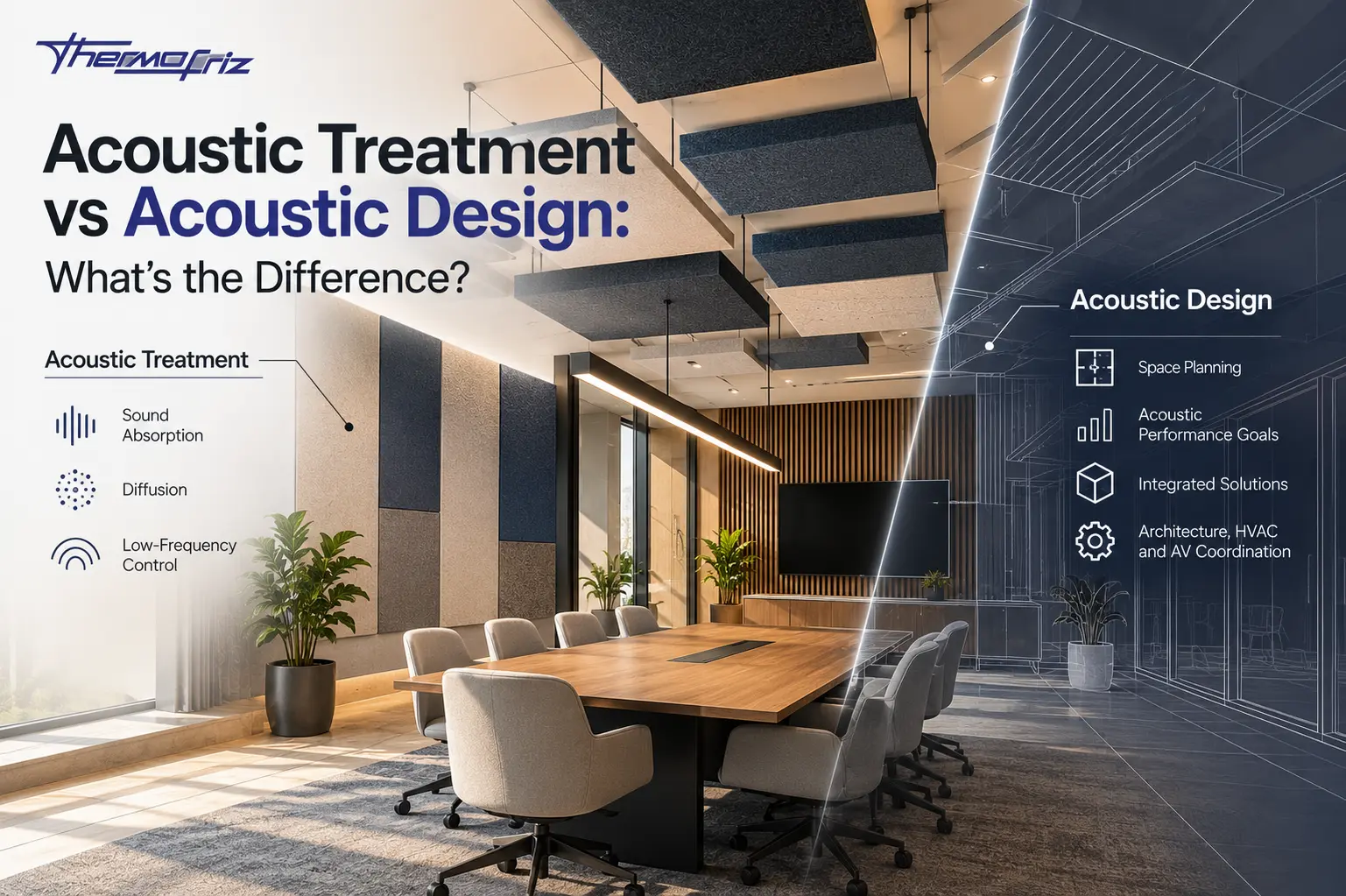
Acoustic treatment controls how sound behaves inside a room. Acoustic design plans how the complete space should perform acoustically.
Treatment may address echo, reverberation, reflections or poor speech clarity. Acoustic design looks more broadly at the room's purpose, dimensions, geometry, sound isolation, background noise, building services, materials, treatment requirements and measurable performance objectives.
Understanding this difference can prevent one of the most common mistakes in acoustic projects: buying materials before identifying the actual acoustic problem.
Acoustic Treatment vs Acoustic Design at a Glance
| Factor | Acoustic Treatment | Acoustic Design |
|---|---|---|
| Primary purpose | Control sound behaviour inside a room | Plan the overall acoustic performance of a space |
| Common problems addressed | Echo, excessive reverberation, reflections, poor clarity | Room acoustics, treatment, noise isolation, background noise, layout and construction |
| Typical stage | Existing rooms or fit-out stage | Ideally begins during planning/design |
| Typical tools | Absorbers, panels, clouds, baffles, diffusers | Calculations, modelling, specifications, construction details, treatment and testing |
| Scope | Usually specific room-acoustic problems | Whole acoustic system |
| Construction changes | Often limited | May involve walls, ceilings, doors, glazing and services |
| Products involved | Yes | Yes, but products are only part of the solution |
In other words, acoustic treatment can be part of acoustic design, but acoustic treatment alone is not automatically a complete acoustic design.
For a wider overview of acoustic materials and how they are selected, see Thermofriz's Complete Guide to Acoustic Panels in India.
What Is Acoustic Treatment?
Acoustic treatment is the process of controlling sound within a room.
When sound reaches hard surfaces such as glass, concrete, gypsum, timber or stone, some of that energy is reflected back into the room. Repeated reflections can cause sound to remain in the space longer than desired.
Depending on the room, this may result in:
- excessive reverberation
- flutter echo
- poor speech intelligibility
- muddy music
- strong early reflections
- excessive sound buildup
- uneven listening conditions
Acoustic treatment aims to control these effects.
It may involve absorption, diffusion, reflection control or low-frequency treatment, depending on the purpose of the room.
Sound Absorption
Absorptive materials reduce the amount of sound energy reflected back into the room.
Common treatment formats include:
- wall-mounted acoustic panels
- fabric-wrapped panels
- ceiling clouds
- acoustic baffles
- PET/polyester products
- glasswool-based absorbers
- wood wool systems
For example, Thermofriz offers fabric acoustic products, glasswool acoustic systems, Sentetic acoustic products and wood wool boards for different project requirements.
Absorption is particularly useful when the problem is excessive reverberation or reflected sound.
Diffusion
Not every reflection needs to be absorbed.
Diffusion redistributes reflected sound energy instead of allowing a strong reflection to return in one direction. This can help create a more balanced acoustic field while preserving some liveliness in the room.
Low-Frequency Control
Low frequencies behave differently from mid and high frequencies.
A thin decorative absorber that improves speech-range reverberation may not solve a low-frequency room-mode problem. Spaces such as studios, cinemas and critical listening rooms may require more specialised treatment.
This is one reason a product should not be selected from NRC alone. See What Is NRC Rating? for more detail.
What Is Acoustic Design?
Acoustic design is the broader planning and engineering process used to establish how a space should perform acoustically and how that performance will be achieved.
It starts before deciding which panel to buy.
A complete acoustic design may consider:
- how the room will be used
- room dimensions and volume
- architectural geometry
- reverberation targets
- speech intelligibility
- sound isolation
- external noise
- HVAC and building-services noise
- doors and glazing
- walls, floors and ceilings
- acoustic materials
- loudspeaker and AV coordination
- noise transmission paths
- treatment placement
- testing and verification
This broader scope is also how leading acoustic-design guidance differentiates design from individual treatment measures: treatment deals primarily with internal room behaviour, while complete design coordinates room acoustics, isolation, construction and services.
A well-designed space therefore does not begin with:
Which acoustic panel should we install?
It begins with:
What acoustic performance does this room need, what is preventing it from achieving that performance, and which combination of design measures will solve the problem?
Is Acoustic Treatment Part of Acoustic Design?
Yes.
A simple hierarchy looks like this:
Acoustic treatment therefore sits within a larger acoustic-design process.
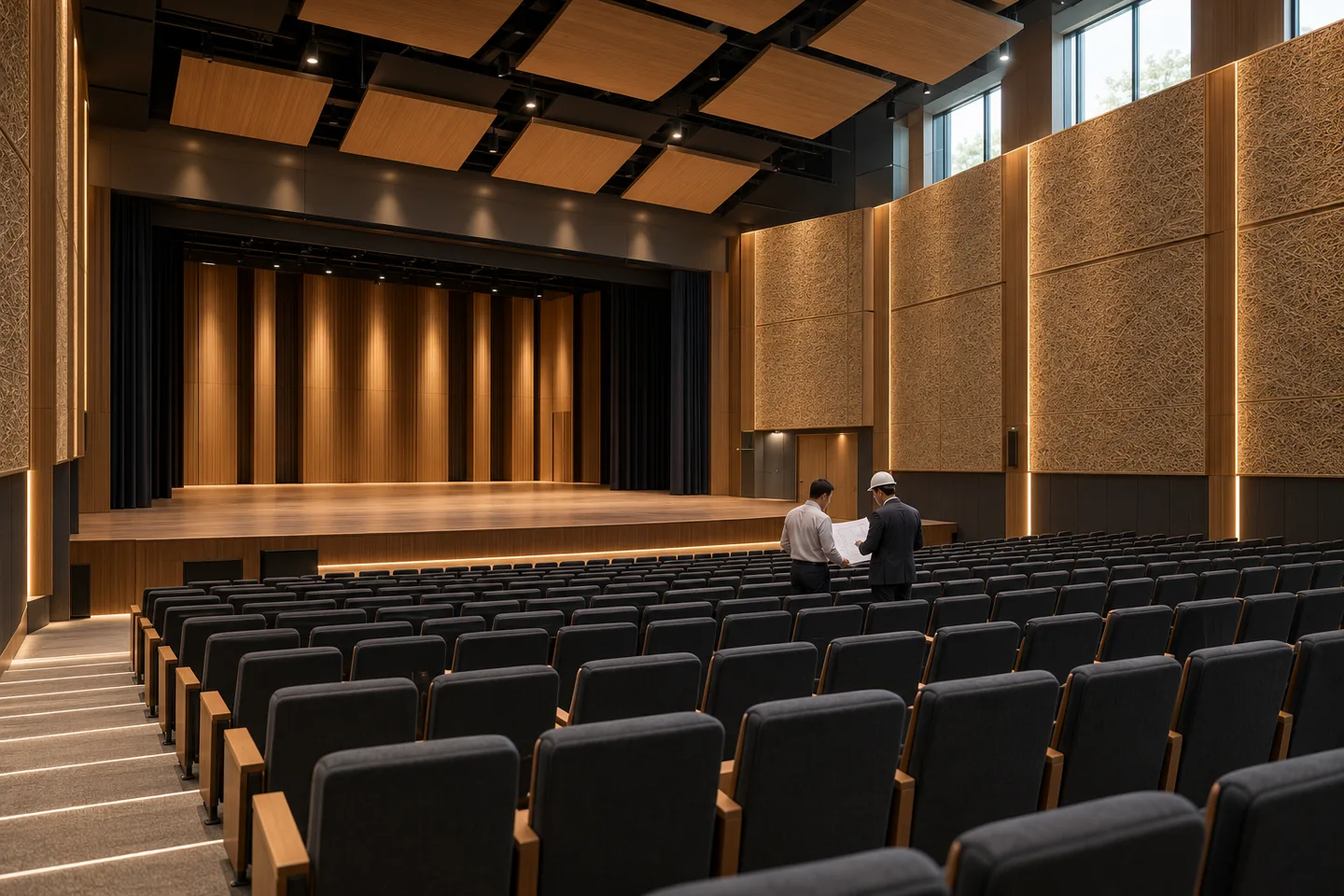
This distinction becomes particularly important in complex environments such as auditoriums, recording studios, cinemas and large commercial facilities.
Thermofriz's Auditorium Acoustic Treatment and Recording Studio Acoustic Design pages illustrate two applications where the overall room requirement matters more than simply installing a product. These solution pages are part of Thermofriz's current site architecture.
Acoustic Treatment vs Soundproofing vs Acoustic Design
Another common source of confusion is soundproofing.
Acoustic treatment, sound isolation and acoustic design address related but different parts of an acoustic problem.
| Acoustic Treatment | Soundproofing / Sound Isolation | Acoustic Design | |
|---|---|---|---|
| Main question | How does sound behave inside the room? | How much sound passes between spaces? | How should the complete space perform? |
| Primary target | Reflections and reverberation | Sound transmission | Overall acoustic performance |
| Typical elements | Panels, clouds, baffles, absorbers, diffusers | Walls, floors, ceilings, seals, doors, barriers | Treatment + isolation + layout + services + specifications |
| Common symptoms | Echo, muddiness, poor clarity | Neighbour noise, leakage between rooms | Multiple interacting acoustic problems |
| Best stage | Existing or new space | Existing or new construction | Ideally early design |
This distinction matters because absorptive panels generally do not soundproof a conventional wall by themselves. Absorption changes how sound behaves within the room; isolation reduces sound transmission between spaces. Vicoustic, Primacoustic and Acoustical Surfaces all make this fundamental distinction in their educational material.
Thermofriz covers this topic in more depth in Acoustic Panels vs Soundproofing and its Soundproofing Services in India page.
A Practical Example: Conference Room
Consider a conference room where people complain that meetings are difficult to follow.
The room contains glass walls, a hard floor and a reflective ceiling.
Acoustic Treatment Approach
If the room is already built and testing or assessment shows excessive reverberation, the solution may involve strategically adding absorption.
That could include:
- wall-mounted fabric panels
- ceiling clouds
- suspended baffles
- other suitable absorptive finishes
The purpose is to control reflected energy and improve speech clarity.
Acoustic Design Approach
Now imagine the conference room has not yet been constructed.
Acoustic design can consider much more:
- Where should the room be located?
- Are neighbouring rooms noise-sensitive?
- What wall construction is required?
- How should the door perform acoustically?
- Is the glazing adequate?
- What background-noise level should the HVAC system achieve?
- What reverberation characteristics are suitable?
- Which interior finishes should remain reflective?
- Where should absorptive treatment go?
- How will the AV system interact with the room?
- How will performance be verified?
The acoustic treatment may ultimately look similar—but it is now part of a coordinated system.
For meeting-space planning specifically, Thermofriz also maintains a dedicated Meeting Room Acoustics Guide.
What Problems Can Acoustic Treatment Solve?
Acoustic treatment is particularly useful when the problem exists inside the room.
Excessive Reverberation
Reverberation is the persistence of sound after the original source has stopped.
Too much reverberation can cause speech or music to overlap with its own reflections, reducing clarity.
Thermofriz explains this measurement more specifically in its guide to RT60 and reverberation time.
Poor Speech Intelligibility
Meeting rooms, classrooms, auditoriums and lecture halls depend heavily on speech clarity.
Reducing unnecessary reflected energy can make spoken communication easier to understand.
Flutter Echo
Repeated reflections between opposing hard surfaces can create a rapid, distinctive echo.
Strategically placed absorptive or diffusive treatment may be used to address it.
Strong Reflections
Studios, home theatres and listening rooms may require control of specific early reflections rather than simply reducing overall reverberation.
Excessive Acoustic Buildup
Restaurants, offices and other occupied interiors can feel increasingly noisy as many voices reflect between hard surfaces.
Absorption can help control this buildup.
What Acoustic Treatment Does Not Automatically Solve
This is equally important.
Acoustic panels are not a universal solution for:
- noise passing through a lightweight wall
- traffic noise entering through glazing
- sound leaking beneath a door
- HVAC cross-talk
- structure-borne vibration
- machinery transmission
- flanking paths around partitions
- poor wall or ceiling isolation
For example, sound travelling around rather than directly through a separating construction may involve flanking transmission. Thermofriz has a dedicated Acoustic Flanking Paths Guide for that problem.
Similarly, noise travelling through ventilation systems may need specific investigation; see the HVAC Cross-Talk Guide.
What Does an Acoustic Design Process Include?
A good acoustic design process usually follows a logical sequence.
1. Define How the Space Will Be Used
An auditorium, classroom, office and recording studio should not all be designed toward the same acoustic condition.
The use determines the objective.
2. Establish Acoustic Performance Goals
Potential requirements may include:
- suitable reverberation
- speech intelligibility
- sound isolation
- background-noise control
- listening accuracy
- privacy
- controlled sound distribution
3. Review the Room and Building
The designer evaluates factors such as:
- dimensions
- volume
- geometry
- construction
- adjacent rooms
- glazing
- doors
- services
- noise sources
For existing buildings, an acoustic site survey can help establish the current condition before treatment decisions are made.
4. Identify the Root Cause
This step is critical.
“Room is noisy” is a symptom, not a diagnosis.
Possible causes include:
- excessive reverberation
- poor sound isolation
- loud HVAC
- external noise
- equipment vibration
- a noisy adjacent space
- insufficient speech privacy
Different causes require different solutions.
5. Plan Sound Isolation Where Required
If the project requires privacy or separation, the design may need to consider:
- partition construction
- door performance
- glazing
- floor/ceiling paths
- junctions
- penetrations
- flanking transmission
Thermofriz's current product architecture also includes acoustic doors, which may form one component of an isolation strategy when appropriate.
6. Design the Room Acoustic Treatment
Only after the problem and objective are understood should the project team determine:
- how much absorption is required
- which surfaces should be treated
- whether diffusion is useful
- whether suspended treatment is appropriate
- whether certain surfaces should remain reflective
7. Coordinate With Architecture, HVAC and AV
A technically good acoustic treatment can still fail if other systems are ignored.
Examples include:
- noisy ventilation
- poorly sealed doors
- loud mechanical equipment
- conflicting light fixtures
- inappropriate speaker locations
- untreated service penetrations
Acoustics should therefore be coordinated rather than added after every other design decision is final.
8. Specify Materials
This is where products finally enter the process.
A design might select, depending on the requirement:
- Fabric Wrapped Glasswool Panels
- Wooden Grooved Acoustic Panels
- Sentetic Clouds
- Sentetic Baffles
- Fibtex Clouds
These products are all present within Thermofriz's current sitemap.
The correct choice depends on the required acoustic function—not simply which product has the highest headline rating.
9. Install According to the Design
Installation can affect acoustic performance.
Panel spacing, air gaps, substrate, fixing system and backing may all matter.
10. Test and Verify
Where project performance is important, completed work may be checked against the original acoustic objectives.
The goal should be verified performance, not just visible acoustic materials.
Why Acoustic Design Should Begin Early
The earlier acoustics are considered, the more options a project usually has.
During architectural design it may still be possible to change:
- room location
- room proportions
- wall construction
- ceiling build-up
- door arrangement
- glazing
- HVAC routing
- equipment locations
- interior finishes
After construction, many of those choices become expensive or impractical to change.
This is why complete acoustic design is particularly valuable for:
- auditoriums
- cinemas
- studios
- theatres
- lecture halls
- major office fit-outs
- hospitality projects
- noise-sensitive institutional spaces
For projects still at the planning stage, Thermofriz's Acoustic Project Brief Guide provides a useful starting point for organising the information needed before solutions are specified.
When Is Acoustic Treatment Alone Enough?
Not every room needs a comprehensive acoustic-design exercise.
Treatment may be sufficient where the problem is clearly understood and limited to internal reflections.
Examples include:
Existing Meeting Room With Excessive Reverberation
If sound isolation and mechanical noise are already acceptable, adding correctly selected absorption may address the main problem.
Restaurant With Excessive Sound Buildup
Hard surfaces and many simultaneous conversations may create excessive reverberant energy.
A treatment strategy involving walls, ceilings or suspended absorbers may be appropriate.
Existing Office With Too Many Reflective Surfaces
Wall panels, ceiling clouds or baffles may help control reverberation without major construction.
Assess first. Select products second.
When Do You Need a More Complete Acoustic Design?
A broader design approach is more appropriate when:
- a new auditorium is being planned
- a recording studio is being constructed
- a cinema or home theatre is under construction
- privacy between rooms is important
- external noise is significant
- HVAC noise is a concern
- vibration needs control
- room geometry is complex
- multiple acoustic problems interact
- measurable performance targets must be achieved
For example, a home theatre may require both internal treatment and isolation from neighbouring rooms. Thermofriz's Home Theater Acoustic Treatment and Home Theatre Acoustic Planning Guide address these complementary aspects of the topic.
Why More Acoustic Panels Are Not Always Better
One of the most common acoustic-treatment mistakes is assuming that more absorption automatically produces a better room.
It does not.
Excessive absorption can make some spaces sound unnaturally dry, while leaving other problems unresolved.
For example:
- adding thin absorbers may reduce high-frequency reflections but leave low-frequency problems
- covering useful reflective surfaces may reduce desirable acoustic energy
- adding wall panels will not fix a poorly isolated door
- absorbers will not necessarily resolve HVAC noise
- treatment cannot compensate for every architectural problem
Good room acoustics require the right balance for the purpose of the room, not the maximum possible absorption. Vicoustic similarly notes that treatment should create an acoustic character suited to the room rather than simply making it acoustically “dead.”
Which Approach Does Your Space Need?
Use the problem as the starting point.
| Problem | Best starting point |
|---|---|
| Room sounds echoey | Acoustic treatment assessment |
| Speech is difficult to understand | Room-acoustic assessment |
| Noise passes through an adjacent wall | Sound-isolation diagnosis |
| Traffic noise enters from outside | Building-envelope / isolation assessment |
| New auditorium is being planned | Complete acoustic design |
| Recording studio is under construction | Complete acoustic design |
| Existing office has excessive reverberation | Acoustic treatment |
| HVAC is too loud | Building-services / acoustic assessment |
| Noise source is unclear | Acoustic site survey / diagnosis |
If the cause is unknown, avoid choosing a product first.
Diagnosis should precede treatment.
Common Mistakes to Avoid
1. Using “soundproofing” and “acoustic treatment” interchangeably They solve different problems.
2. Buying acoustic panels before identifying the problem A product cannot compensate for an incorrect diagnosis.
3. Choosing treatment using NRC alone NRC can be useful, but a single-number rating does not describe the complete behaviour of a room or every frequency. Thermofriz explains this metric in more detail in What Is NRC Rating?.
4. Treating Every Surface Some reflections may be useful. The correct balance depends on the purpose of the room.
5. Ignoring Room Geometry Placement and geometry influence how sound moves around a space.
6. Ignoring Background Noise Reducing reverberation does not necessarily solve noisy air-conditioning or mechanical equipment.
7. Ignoring Sound Isolation A well-treated room can still leak significant sound to adjacent spaces.
8. Waiting Until Construction Is Complete Acoustic options usually become more limited as the project progresses.
9. Assuming Acoustic Design Means Choosing Panels Products are only one component of the process.
Frequently Asked Questions
Is acoustic treatment the same as acoustic design?
No.
Acoustic treatment controls how sound behaves inside a room through measures such as absorption, diffusion and reflection control.
Acoustic design is the broader process of defining and coordinating the complete acoustic performance of the space. Treatment may be one part of that design.
Is acoustic design the same as soundproofing?
No.
Soundproofing or sound isolation focuses on reducing sound transmission between spaces. Acoustic design can include sound isolation, but may also address room acoustics, reverberation, background noise, HVAC, materials and testing.
What does acoustic treatment include?
Depending on the room, treatment may include absorptive wall panels, ceiling clouds, baffles, diffusers, low-frequency treatment and other systems intended to control internal sound behaviour.
Can acoustic panels soundproof a room?
Not by themselves in most cases.
Acoustic panels primarily control reflected sound and reverberation. Reducing sound transmission usually requires appropriate wall, floor, ceiling, door, glazing and sealing construction. This absorption-versus-isolation distinction is consistently emphasized by leading acoustic-education sources.
Do offices need acoustic design?
It depends on the project.
An existing office with a straightforward reverberation issue may need targeted treatment. A large office fit-out involving meeting-room privacy, open-plan acoustics, HVAC noise and room-to-room isolation may benefit from a broader acoustic-design approach.
Do recording studios need both acoustic design and treatment?
Usually, a serious studio project needs more than treatment alone.
Design may involve room geometry, internal acoustic treatment, sound isolation, low-frequency behaviour, HVAC noise and monitoring conditions.
Can acoustic treatment be added after construction?
Yes.
Many acoustic-treatment systems can be retrofitted to existing rooms. However, correcting isolation, geometry or building-services problems after construction may be more difficult.
Is more sound absorption always better?
No.
The appropriate amount and distribution of absorption depend on the room's intended use. The aim is controlled acoustics—not simply eliminating as many reflections as possible.
Acoustic Treatment and Design With Thermofriz
Thermofriz works across acoustic materials, applications and project solutions, which allows projects to be approached from the problem first rather than the product first.
Depending on the requirement, a project may involve:
- fabric acoustic panels
- wood wool systems
- wooden grooved panels
- glasswool solutions
- ceiling clouds
- acoustic baffles
- acoustic doors
- isolation and noise-control systems
Thermofriz's wider Applications and Projects sections show the range of environments where different acoustic requirements may arise.
The correct starting point is therefore not:
“Which acoustic panel should I buy?”
It is:
“What is the acoustic problem, what performance does the space need, and what combination of treatment or design measures will achieve it?”
Conclusion
Acoustic treatment and acoustic design are closely connected, but their scope is different.
Acoustic treatment focuses primarily on controlling sound within a room—reducing excessive reverberation, managing reflections and improving clarity.
Acoustic design looks at the complete acoustic system. It may consider room geometry, treatment, sound isolation, construction, HVAC noise, doors, glazing, AV coordination and measurable performance requirements.
The practical hierarchy is:
For a simple reverberation problem, targeted acoustic treatment may be enough.
For a new auditorium, recording studio, cinema, complex office or noise-sensitive facility, treating individual surfaces without considering the wider acoustic system can leave important problems unresolved.
If you are unsure whether your project requires acoustic treatment, sound isolation or a more complete acoustic design approach, Thermofriz can evaluate the space and project requirements before the material selection begins.
Get Free Consultation
Unsure whether your project needs acoustic treatment, sound isolation or a complete acoustic design approach?
Get Free Consultation with Thermofriz to evaluate the space and project requirements before material selection begins.