Acoustic panels are widely used in offices, auditoriums, studios, classrooms, restaurants, home theatres and commercial interiors to control unwanted sound reflections and improve the acoustic quality of a room.
But choosing an acoustic panel is not as simple as selecting the product with the highest NRC value or the most attractive finish.
Different panel systems behave differently. Fabric-wrapped panels, wood wool boards, grooved wooden panels, polyester panels, glasswool systems, acoustic clouds and baffles can all serve different design and acoustic requirements.
The right solution depends on the room, the problem being solved, the available surfaces, the required acoustic performance and the architectural design.
This guide explains the major types of acoustic panels used in India, where they are commonly applied, what affects their performance and what should be checked before selecting a system for a project.
What Are Acoustic Panels?
Acoustic panels are materials or engineered systems designed primarily to control reflected sound inside a room.
When sound reaches hard surfaces such as concrete, glass, plaster or stone, a significant portion of that energy may be reflected back into the space. Multiple reflections can contribute to:
- excessive reverberation
- echo
- reduced speech clarity
- increased perceived noise
- poor listening conditions
Acoustic panels introduce surfaces that absorb, redistribute or otherwise control part of this sound energy. This can make a room sound clearer and more controlled.
However, acoustic panels should not automatically be treated as soundproofing materials. That distinction is important.
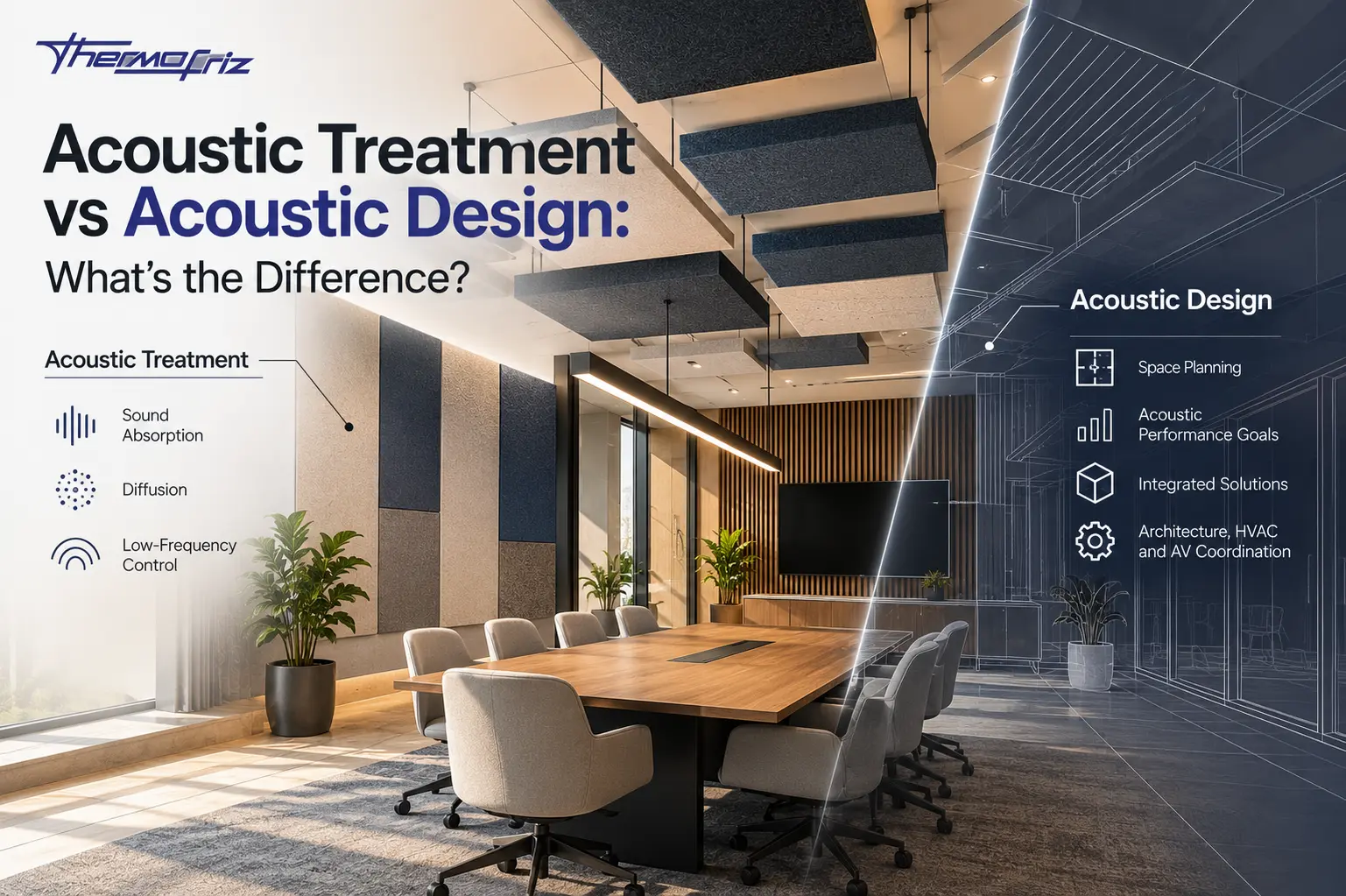
Acoustic Treatment vs Soundproofing
Acoustic treatment and soundproofing solve different problems. For a deeper comparison, see Acoustic Panels vs Soundproofing: What's the Difference?.
| Acoustic treatment | Soundproofing / sound isolation |
|---|---|
| Controls sound inside a room | Controls sound travelling between spaces |
| Reduces unwanted reflections | Reduces sound transmission |
| Helps control reverberation | Helps isolate one room from another |
| Can improve speech clarity | Can reduce external/internal noise intrusion |
| Uses absorbers, diffusers and other treatments | Uses mass, sealing, barriers, decoupling and isolation construction |
For example, if a conference room has excessive echo, acoustic panels may help. If sound from that conference room is travelling through a wall into the adjacent office, the problem is likely to involve sound isolation, not simply additional wall absorption.
This distinction should be established before selecting products.
How Do Acoustic Panels Work?
The basic principle is straightforward.
Without suitable acoustic treatment:
With absorptive treatment:
The result can be:
- reduced reverberation
- improved speech intelligibility
- less acoustic buildup
- better listening conditions
However, not all acoustic panels work in exactly the same way.
Some systems use porous materials such as fibrous cores.
Others use:
- grooves
- slots
- perforations
- cavities
- suspended construction
- absorptive backing
The complete panel construction is therefore more important than appearance alone.
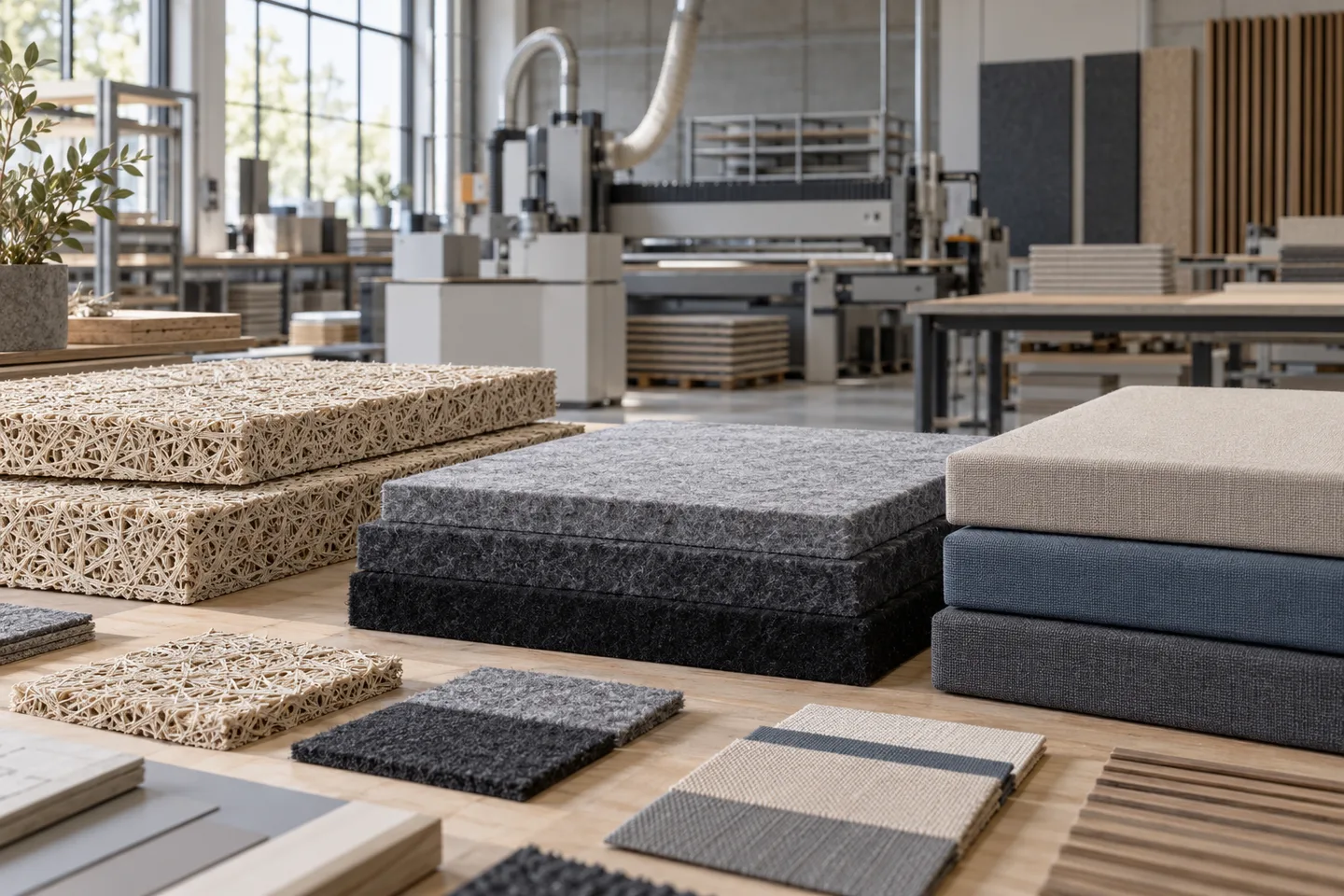
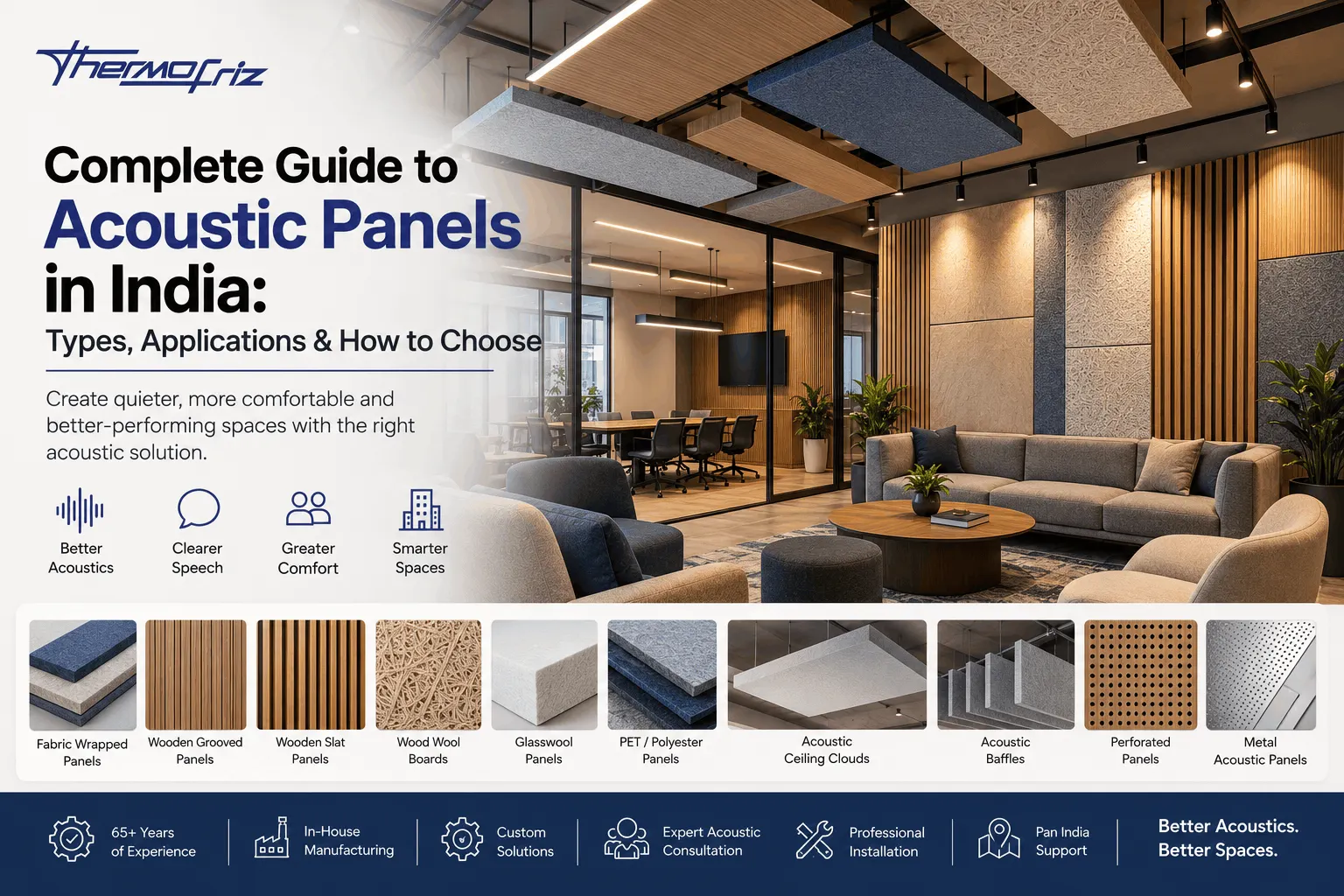
Main Types of Acoustic Panels Used in India
1. Fabric Wrapped Acoustic Panels
Fabric-wrapped acoustic panels typically consist of an absorptive core covered with an acoustically suitable fabric.
They are widely used because they can combine acoustic treatment with interior design. Explore Thermofriz Fabric Acoustic Panels and fabric-wrapped acoustic panels for project options.
Common applications
- offices
- conference rooms
- auditoriums
- studios
- classrooms
- home theatres
- commercial interiors
Main advantages
Fabric systems can offer:
- strong sound absorption
- large colour selection
- different panel sizes
- integration with interior themes
- clean wall finishes
The visible fabric should allow sound to interact effectively with the absorptive core. A decorative fabric that significantly blocks sound can reduce the effectiveness of the system.
Fabric-wrapped panels are particularly useful when designers want acoustic treatment to become part of the visual design instead of appearing purely technical.
2. Wooden Grooved Acoustic Panels
Wooden grooved acoustic panels combine an architectural timber appearance with engineered acoustic performance.
The visible surface normally includes grooves or slots, while the complete acoustic system may also include:
- perforations or slots
- backing materials
- cavities
- absorptive layers
Their acoustic performance depends on the complete construction rather than the timber finish alone.
Common applications
- auditoriums
- boardrooms
- offices
- conference halls
- educational facilities
- hospitality interiors
- performance spaces
Why choose them?
Wooden acoustic panels can be useful when the project requires both:
acoustic treatment + premium architectural finish
For Thermofriz, the Wooden Grooved Acoustic Panel is particularly commercially relevant because it is one of the company's confirmed priority products.
3. Wooden Slat Acoustic Panels
Wooden slat systems use repeated timber or wood-finish elements combined with absorptive backing or acoustic cavities.
Their appearance makes them popular in modern interior design. See Thermofriz Wooden Slat Acoustic Panels.
Common uses
- reception areas
- offices
- meeting rooms
- restaurants
- home theatres
- hospitality spaces
- architectural feature walls
Depending on the system, the gaps between slats allow sound to reach an absorptive layer behind the decorative surface.
The important point is that a decorative slat wall is not automatically an acoustic system. Its performance depends on:
- slat dimensions
- spacing
- backing material
- air cavity
- overall construction
4. Wood Wool Acoustic Boards
Wood wool acoustic boards are fibrous wood-based products typically formed with a binding material.
They can provide both an architectural finish and sound absorption. Learn more in Wood Wool Acoustic Panels: Benefits, Applications & Selection Guide and browse Wood Wool Boards.
Common applications
- schools
- offices
- auditoriums
- commercial buildings
- ceiling systems
- institutional interiors
- selected industrial spaces
Their rough, textured appearance can also become part of the architectural design.
Performance depends on characteristics such as:
- thickness
- density
- mounting
- air cavity
- backing system
A generic NRC value should never be assumed to apply to every wood wool product.
5. Glasswool Acoustic Panels
Glasswool is widely used as an absorptive material because of its porous fibrous structure.
Sound energy enters the material and is partly dissipated through interaction with the fibres. Explore Thermofriz Glasswool systems.
Glasswool may be used:
- behind fabric
- inside wall systems
- above ceilings
- inside acoustic panels
- as part of composite acoustic systems
Common applications
- auditoriums
- studios
- offices
- conference rooms
- theatres
- educational facilities
The performance of a glasswool system depends on more than just the material name.
Important factors include:
- density
- thickness
- facing
- mounting condition
- air cavity
- frequency range
Selecting glasswool only by density is therefore not enough.
6. PET / Polyester Acoustic Panels
Polyester acoustic panels are lightweight absorptive products commonly used in modern interiors.
They are often available in a wide range of:
- colours
- patterns
- shapes
- thicknesses
Common applications
- offices
- schools
- meeting rooms
- coworking spaces
- hospitality environments
- commercial interiors
PET-based products are often chosen where designers want the acoustic material to become part of the visual language of the room.
However, claims such as recycled content or sustainability should only be made when supported by the actual product documentation.
7. Acoustic Ceiling Clouds
Acoustic clouds are suspended acoustic elements installed horizontally below the ceiling.
They can be particularly useful when:
- wall space is limited
- the ceiling is high
- a large open room requires additional absorption
- architectural design calls for suspended elements
Because both faces of a suspended cloud may be exposed to the room, the installed performance can differ from that of a panel mounted directly against a surface.
Common applications
- offices
- meeting areas
- restaurants
- auditoriums
- educational spaces
- large commercial interiors
Thermofriz's Sentetic Cloud and Fibtex Cloud are among the company's commercially important product categories.
8. Acoustic Baffles
Acoustic baffles are typically suspended vertically from ceilings.
They are often used in spaces with large volumes or limited wall space.
Applications include
- commercial interiors
- institutions
- high-ceiling offices
- halls
- public spaces
- selected industrial environments
The total effectiveness of a baffle system depends on:
- number of baffles
- dimensions
- spacing
- suspension height
- room volume
- material performance
Thermofriz's Sentetic Baffle is one of the company's confirmed priority products.
9. Perforated and Micro-Perforated Acoustic Panels
Perforated acoustic panels use small openings in the visible surface to allow sound to interact with a cavity or absorptive layer behind the panel.
Depending on the construction, they can provide:
- acoustic control
- durable surfaces
- architectural integration
They are frequently used where a project needs a harder visible finish than a fabric-covered absorber.
Applications may include:
- auditoriums
- corporate interiors
- educational spaces
- public buildings
- premium architectural projects
Their performance depends on factors such as:
- perforation size
- perforation percentage
- panel thickness
- cavity depth
- absorptive backing
10. Metal Acoustic Panels
Metal acoustic systems may use perforated metal faces with absorptive backing. See Thermofriz Metal acoustic products.
They can be useful in environments where:
- durability is important
- clean architectural lines are required
- impact resistance matters
- wall or ceiling treatment is needed
Potential applications include:
- public buildings
- transport environments
- industrial interiors
- commercial spaces
- institutional facilities
As with wooden or perforated products, the visible metal panel alone does not determine the acoustic performance.
The complete system matters.
Quick Comparison of Acoustic Panel Types
| Panel type | Main strength | Typical applications | Main selection factor |
|---|---|---|---|
| Fabric wrapped | Absorption + design flexibility | Offices, studios, auditoriums | Core, thickness, fabric |
| Wooden grooved | Architectural finish + acoustics | Auditoriums, corporate interiors | Groove pattern, backing |
| Wooden slat | Decorative linear design | Offices, hospitality | Slat spacing, backing |
| Wood wool | Robust architectural absorption | Schools, offices, ceilings | Thickness, mounting |
| Glasswool | Porous sound absorption | Studios, auditoriums | Density, thickness, facing |
| PET/polyester | Lightweight + decorative | Offices, education | Thickness, test data |
| Clouds | Ceiling-based absorption | Offices, halls | Suspension and coverage |
| Baffles | Treatment for large/high spaces | Commercial, institutional | Spacing, exposed area |
| Perforated systems | Durable acoustic finish | Public/commercial spaces | Perforation + cavity |
| Metal acoustic panels | Durability | Public/industrial spaces | Perforation + backing |
This table should be treated as a general selection framework, not a universal specification.
What Is NRC?
NRC stands for Noise Reduction Coefficient.
It is commonly used to provide a simplified indication of the sound absorption characteristics of a material. For a full explanation, see What Is NRC Rating? A Practical Guide for Acoustic Panel Buyers.
A higher NRC generally indicates greater average absorption across the frequencies included in the calculation.
But NRC should not be used as the only selection criterion.
NRC does not tell you everything
A single NRC value does not explain:
- how the product behaves at every frequency
- how well it handles low-frequency energy
- how it performs under different mounting conditions
- how much total treatment the room requires
- whether it provides sound isolation
- whether it is suitable for the specific room
For serious projects, the frequency-by-frequency absorption data can be more useful than the headline NRC alone.
What Determines the Performance of an Acoustic Panel?
Core material
Different core materials absorb sound differently.
Examples include:
- glasswool
- mineral-fibre materials
- polyester
- wood wool
- other porous absorbers
The core affects both acoustic performance and practical design considerations.
Thickness
Thickness influences how acoustic treatment interacts with different frequencies.
A thicker absorber may improve performance at lower frequencies in many systems, but:
thicker does not automatically mean better for every application.
The correct thickness depends on the acoustic objective.
Density
Density is often used as a product specification, but it should not be treated as a simple ranking factor.
A denser panel is not automatically a better absorber.
Performance depends on:
- airflow resistance
- fibre structure
- thickness
- installation
- frequency range
Air Gap and Mounting
A panel installed directly against a wall may behave differently from the same material mounted with an air cavity.
Similarly, suspended systems behave differently from surface-mounted systems.
Always review test data alongside the mounting configuration used during testing.
Panel Surface Area
The total amount of absorptive surface affects the overall acoustic result.
Installing a high-performance panel over a very small area may not solve a room-wide reverberation problem.
Placement
Placement matters as much as quantity in many situations.
Treatment may need to address:
- reflection points
- rear walls
- parallel surfaces
- ceiling areas
- high-volume zones
Random placement may reduce effectiveness.
Where Are Acoustic Panels Used?
Offices
Modern offices often use:
- glass partitions
- gypsum
- hard floors
- exposed concrete
- open-plan layouts
These can create strong reflections and high conversation buildup.
Acoustic treatment can help improve:
- speech clarity
- meeting-room conditions
- perceived acoustic comfort
Common options include:
- fabric panels
- PET panels
- clouds
- baffles
- wooden acoustic systems
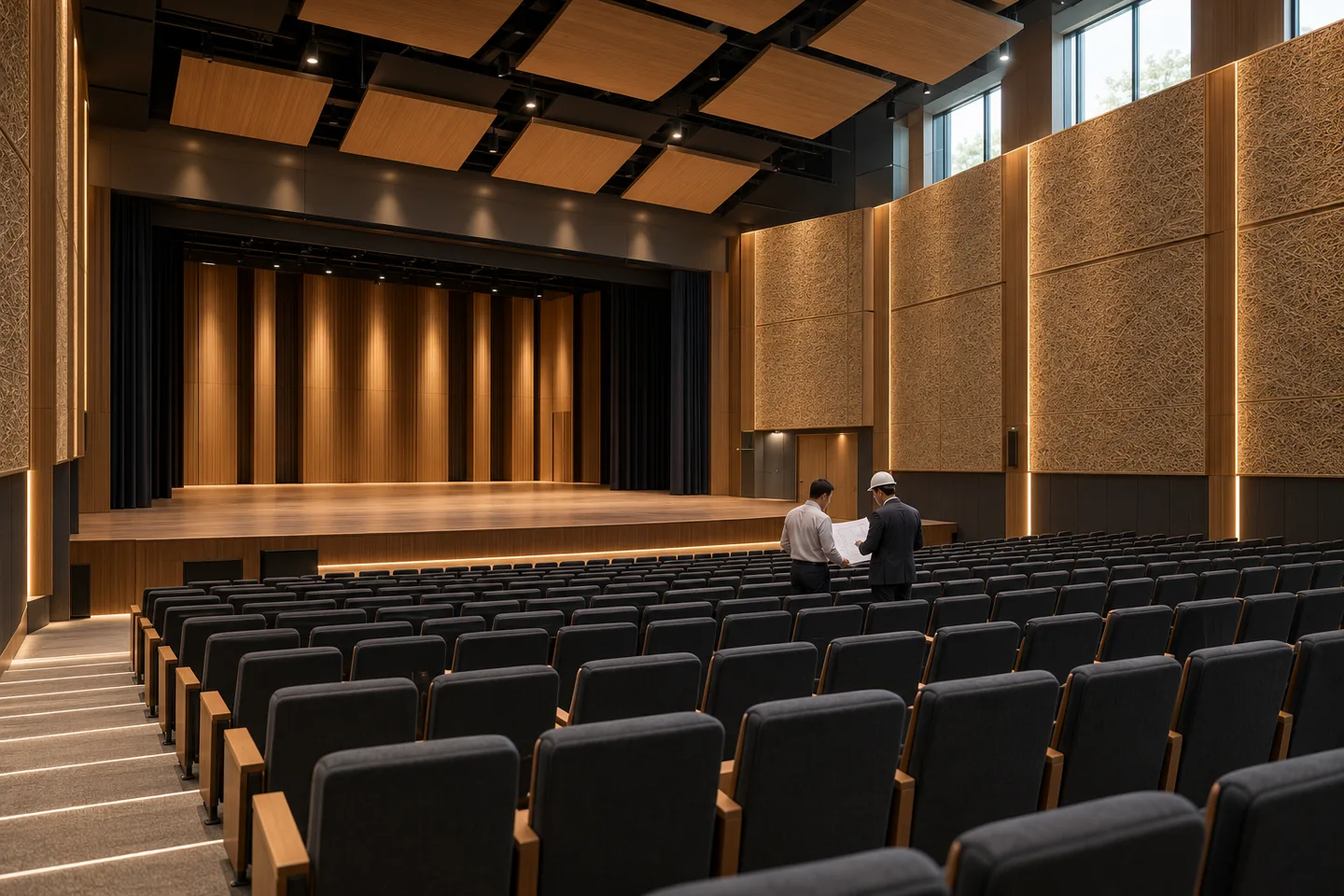
Auditoriums
Auditoriums require more careful treatment than ordinary rooms. See auditorium acoustic panels for application-focused guidance.
Problems may include:
- excessive reverberation
- delayed reflections
- poor speech intelligibility
- uneven sound distribution
The solution may use a combination of:
- wall absorbers
- ceiling treatment
- wooden acoustic systems
- fabric panels
- wood wool products
- clouds
- diffusive or reflective surfaces
The key is balance.
An auditorium should not simply be covered with absorptive material.
Recording Studios
Recording and control rooms require careful management of:
- early reflections
- reverberation
- low-frequency behaviour
- monitoring accuracy
Fabric-covered absorbers, mineral-fibre systems and other acoustic treatments may be used.
However, studios often require more specialized treatment than a standard office or classroom.
Home Theatres
Home theatres commonly need control of:
- side-wall reflections
- rear-wall reflections
- excessive reverberation
- dialogue clarity
See home theater acoustic treatment for application-focused guidance.
Fabric panels and wooden acoustic systems can be integrated into interior designs without making the room look like a technical studio.
Educational Spaces
Classrooms, lecture halls and training rooms depend heavily on speech intelligibility.
Long reverberation times can make it difficult for students to understand teachers, particularly at greater distances. Related reading: What Is RT60? Understanding Reverberation Time in Acoustic Design.
Treatment may include:
- wall panels
- acoustic ceilings
- PET systems
- fabric panels
Restaurants and Hospitality Spaces
Restaurants often contain:
- glass
- tile
- stone
- metal
- hard furniture
These surfaces can create high levels of reflected sound.
Acoustic clouds, wall panels, baffles and decorative acoustic systems may help reduce sound buildup.
Healthcare Spaces
Acoustics can also matter in:
- waiting rooms
- consultation areas
- common areas
- institutional spaces
The design requirement may involve:
- acoustic comfort
- speech control
- reverberation reduction
However, acoustic claims should be limited to what the treatment can actually achieve and should not be presented as medical outcomes.
Industrial Spaces
Industrial noise control is a separate and more complex area.
Ordinary decorative acoustic panels may not be enough to address machinery or high-level industrial noise.
Solutions may instead require:
- barriers
- acoustic enclosures
- silencers
- engineered absorption
- source control
- path control
The first step is identifying where the noise comes from and how it travels.
Wall Panels vs Ceiling Clouds vs Baffles
Choosing between different treatment formats often depends on available space.
Wall panels
Suitable where large reflective wall areas are available.
They are commonly used in:
- offices
- auditoriums
- studios
- meeting rooms
Ceiling clouds
Useful when:
- ceilings are high
- walls must remain visually clean
- more absorption is needed
- ceiling design can support suspended elements
Baffles
Useful for:
- large-volume rooms
- open ceilings
- commercial spaces
- institutional environments
Combined systems
Large rooms often require treatment across multiple surfaces.
Using walls, ceilings and suspended absorbers together may provide better overall control than depending on a single treatment type.
How to Choose the Right Acoustic Panel
For a dedicated walkthrough of this process, see also How to Choose the Right Acoustic Panels for Your Space.
Step 1: Identify the acoustic problem
Before selecting a product, determine whether the problem is:
- echo
- excessive reverberation
- poor speech clarity
- external noise
- sound leakage
- industrial noise
If the main issue is sound passing through walls or doors, acoustic panels alone may not be the correct solution.
Step 2: Understand the room's purpose
A recording studio and classroom do not require the same acoustic response.
Consider whether the room is primarily used for:
- speech
- music
- meetings
- entertainment
- industrial work
- hospitality
Step 3: Assess the room
Review:
- dimensions
- volume
- wall surfaces
- ceiling height
- floor finish
- furniture
- occupancy
- glass areas
- existing absorptive materials
Step 4: Define the required acoustic performance
Determine what needs to improve.
For example:
- reduce reverberation
- increase speech clarity
- control reflections
- reduce perceived noise buildup
Step 5: Review frequency-specific test data
Do not rely only on a single NRC number.
If the project is technically demanding, review absorption performance at individual frequencies.
Step 6: Decide where treatment can be installed
Possible locations include:
- side walls
- rear walls
- ceilings
- suspended systems
- partitions
The available surfaces may influence which panel type is suitable.
Step 7: Consider visual design
Acoustic treatment does not have to look industrial.
Potential design choices may include:
- fabric colours
- wood finishes
- slat patterns
- panel shapes
- suspended designs
- feature walls
Step 8: Check fire-performance documentation
For commercial and institutional projects, material and fire documentation can be important.
Ask the supplier for:
- relevant test reports
- product specifications
- certificates
- installation requirements
Do not rely on unsupported marketing statements.
Step 9: Consider durability
Some environments need stronger or easier-to-maintain surfaces.
For example:
- schools
- corridors
- public spaces
- industrial environments
may require more robust finishes than private studios.
Step 10: Review installation requirements
The same material can behave differently depending on:
- mounting
- air cavity
- backing
- fixing method
- spacing
Installation should therefore form part of the specification.
Step 11: Compare system cost, not only panel price
A low-cost panel may require:
- more units
- additional framing
- extra labour
- more maintenance
A complete comparison should consider:
product + fixing + installation + quantity + required performance
Step 12: Ask for technical documentation
Before finalizing a large order or project, ask for relevant:
- acoustic test reports
- product datasheets
- fire-performance documents
- installation details
- warranty information where applicable
Acoustic Panel Selection by Space
| Space | Main acoustic challenge | Panel systems commonly considered |
|---|---|---|
| Office | Speech buildup, reverberation | Fabric, PET, clouds, baffles |
| Auditorium | Reverberation and clarity | Fabric, wood, wood wool, clouds |
| Studio | Reflection control | Fabric/mineral-fibre systems |
| Home theatre | Dialogue and reflection control | Fabric, wood systems |
| Classroom | Speech intelligibility | Fabric, PET, ceiling systems |
| Restaurant | High reflected sound | Clouds, baffles, fabric, PET |
| Industrial | Equipment/process noise | Engineered industrial solutions |
These are examples, not universal prescriptions.
Acoustic Panel Design Options
Acoustic treatment can become part of the architecture rather than a visual compromise.
Depending on the chosen system, design options may include:
- different fabric colours
- timber veneers
- slat patterns
- perforation designs
- custom panel layouts
- wall feature systems
- ceiling compositions
- suspended elements
The design should not interfere with the intended acoustic performance.
For example, adding a non-permeable decorative covering over an absorptive core could reduce the effectiveness of the system.
Fire Performance and Technical Documentation
When selecting acoustic panels for commercial projects in India, technical documentation should be reviewed carefully.
Depending on the project, useful documents may include:
- acoustic test reports
- fire test reports
- density specifications
- thickness
- material composition
- installation instructions
- dimensions
- mounting details
The test conditions matter.
For example, an acoustic absorption result may have been measured using a specific:
- thickness
- backing
- mounting condition
- air gap
Changing the installation may change the real-world performance.
Common Mistakes When Choosing Acoustic Panels
1. Choosing only by NRC NRC is useful, but it is not a complete acoustic design.
2. Confusing absorption with soundproofing This can result in purchasing the wrong type of product entirely.
3. Choosing by appearance alone A panel that looks suitable may not provide the performance required for the room.
4. Choosing only by price The cheapest product is not necessarily the lowest-cost solution when quantity, installation and performance are considered.
5. Ignoring thickness Thickness can influence frequency performance.
6. Ignoring mounting conditions Panel test results may depend on how the product is installed.
7. Treating every room the same way A classroom, auditorium and industrial area have different requirements.
8. Installing too little treatment A few decorative panels may not significantly change the acoustics of a large room.
9. Installing treatment in the wrong locations Quantity without strategic placement can reduce effectiveness.
10. Accepting unsupported performance claims Request proper documentation instead of relying only on sales descriptions.
11. Ignoring HVAC and background noise Acoustic panels cannot solve every source of unwanted noise.
12. Ignoring professional design in complex projects Large auditoriums, studios and industrial spaces may require proper acoustic assessment rather than product selection alone.
What Should You Ask an Acoustic Panel Supplier?
Before selecting a supplier, ask:
- What acoustic test data is available?
- What frequencies were tested?
- What mounting method was used during testing?
- What is the panel core material?
- What thicknesses are available?
- Are fire-performance reports available?
- What finishes are available?
- Can the panel be customized?
- Is installation support available?
- Can the supplier support project-specific material selection?
- Are comparable completed projects available for review?
These questions help distinguish a genuine acoustic solution from a product chosen only by appearance or marketing claims.
How Much Do Acoustic Panels Cost in India?
There is no single reliable price for acoustic panels across India.
Pricing can vary according to:
- material
- thickness
- density
- panel size
- finish
- acoustic performance
- quantity
- customization
- framing
- mounting system
- installation
- project location
For example, a decorative PET panel and a customized architectural wooden acoustic system should not be expected to have the same pricing.
For commercial projects, it is usually more useful to compare the installed acoustic system cost than the unit price of one panel.
A supplier may need information such as:
- room dimensions
- required treatment area
- application
- product preference
- project location
before providing an accurate quotation.
Do You Need an Acoustic Consultant?
Not every acoustic-panel installation requires a specialist consultant.
For a small meeting room with a straightforward echo problem, product selection and sensible placement may be sufficient.
Professional acoustic design becomes much more valuable when dealing with:
- auditoriums
- recording studios
- large offices
- theatres
- multipurpose halls
- industrial noise
- complex room geometry
- stringent acoustic requirements
In these environments, measurement and modelling can help determine:
- how much treatment is required
- what frequency range needs attention
- where panels should be installed
- whether isolation or other treatments are also required
Acoustic Panels From Thermofriz
Thermofriz provides multiple acoustic product and solution categories for different architectural and acoustic applications.
The range includes systems such as:
- fabric acoustic panels
- wooden acoustic products
- wood wool boards
- synthetic acoustic products
- glasswool-based systems
- acoustic ceiling clouds
- acoustic baffles
- metal acoustic panels
- acoustic doors
- other sound-control solutions
This range allows projects to be approached based on the acoustic requirement rather than forcing every room toward a single material.
Thermofriz also works with acoustic project applications, including spaces such as offices, auditoriums, studios, home theatres and other commercial and institutional environments.
For complex projects, the correct acoustic solution should be selected after understanding the room, the required performance and the design objectives.
Frequently Asked Questions
Which type of acoustic panel is best?
There is no universally best acoustic panel.
The right choice depends on:
- room use
- acoustic problem
- frequency requirements
- architecture
- installation
- budget
- appearance
A fabric panel may be ideal for one room while a wooden system, ceiling cloud or baffle may be more appropriate for another.
Do acoustic panels soundproof a room?
Generally, acoustic panels are primarily designed to control sound reflections inside a room.
Soundproofing requires controlling sound transmission through:
- walls
- ceilings
- floors
- doors
- gaps
- building services
Some projects require both acoustic treatment and sound isolation.
What is a good NRC for an acoustic panel?
A higher NRC generally indicates greater average sound absorption, but it should not be used in isolation.
The correct performance level depends on the room, frequency range, total treatment area and installation.
Frequency-specific test data may be more useful for technically demanding projects.
Are wooden acoustic panels effective?
Yes, engineered wooden acoustic systems can provide useful acoustic performance when designed with suitable:
- grooves
- slots
- perforations
- backing
- cavities
Their performance depends on the complete system.
Are PET acoustic panels suitable for offices?
PET/polyester acoustic panels can be suitable for offices because they can combine absorption with lightweight and decorative designs.
The specific panel should still be selected from its tested acoustic performance and project requirements.
How thick should an acoustic panel be?
There is no universal thickness.
The required thickness depends on:
- material
- frequency range
- mounting
- acoustic target
- available space
Thicker is not automatically better in every situation.
How many acoustic panels does a room need?
The quantity depends on:
- room volume
- surface materials
- panel performance
- use of the space
- existing reverberation
- desired acoustic result
For larger or more demanding rooms, treatment quantity should be calculated instead of estimated visually.
What should I check before buying acoustic panels in India?
Review:
- acoustic test data
- panel construction
- thickness
- mounting
- fire documentation where applicable
- durability
- design options
- installation support
- supplier project experience
Conclusion
Choosing acoustic panels is not simply a matter of finding the highest NRC value or selecting the most attractive design.
A better process is:
Fabric, wooden, wood wool, glasswool, PET, clouds, baffles and perforated systems can all be useful—but they are not interchangeable.
The right solution depends on how the room behaves and what the project needs to achieve.
If you are planning acoustic treatment for an office, auditorium, studio, educational facility, home theatre or commercial project, Thermofriz can help evaluate the requirements and identify suitable acoustic treatment options for the space.
Get Free Consultation
Planning acoustic treatment for an office, auditorium, studio, educational facility, home theatre or commercial project?
Get Free Consultation with Thermofriz to discuss your room, acoustic requirements and suitable panel options before finalising the specification.