Why does one room sound clear and comfortable while another feels echoey, muddy, or tiring even when both have good-quality audio equipment?
One of the key measurements used to understand this behaviour is RT60 . RT60, or reverberation time, describes how quickly sound decays inside an enclosed space after the sound source stops. It is an important parameter in acoustic design because it helps professionals understand whether a room allows sound to linger for too long or decay too quickly for its intended purpose.
For an office, classroom, auditorium, home theatre, recording studio, restaurant, or healthcare facility, the appropriate reverberation characteristics can be very different. This is why RT60 should not simply be reduced as much as possible. The objective is to achieve an acoustic environment appropriate for the room's function.
At Thermofriz , acoustic treatment is approached around the requirements of the space, combining acoustic products, project consultation, custom manufacturing and installation support to help create controlled and comfortable interior environments.
What Is RT60?
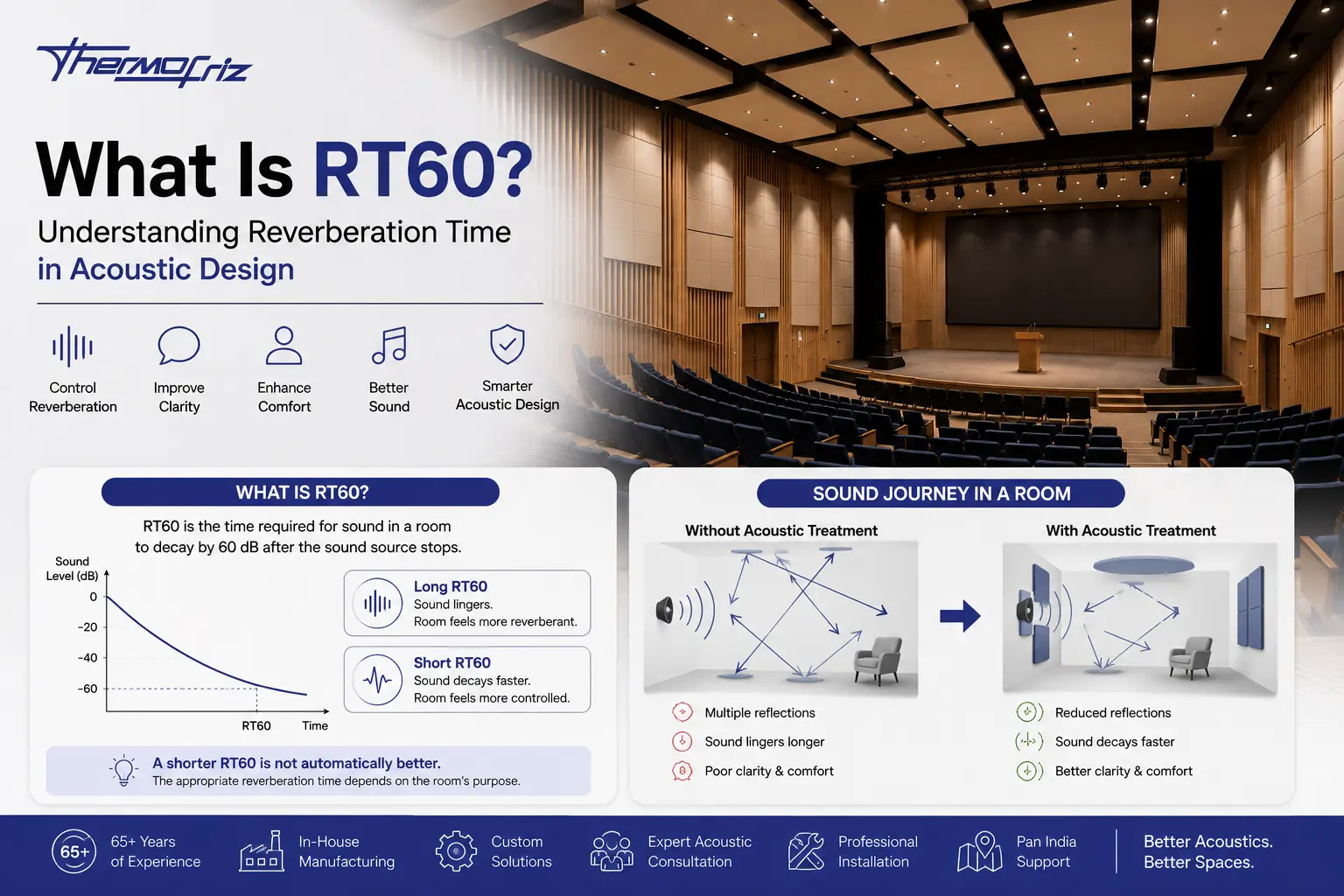
RT60 is the time required for sound in a room to decay by 60 decibels (dB) after the sound source has stopped. It is commonly used to describe the reverberation characteristics of an enclosed space. A longer RT60 generally means sound persists for longer, creating a more reverberant acoustic environment. A shorter RT60 means sound energy decays more quickly and the room generally has a more controlled acoustic response.
For example, imagine someone speaking in an untreated room with many hard surfaces. Their voice reaches the listener directly, but reflections from the walls, ceiling and floor continue arriving afterwards. If those reflections persist for a relatively long period, the speech can become less distinct. Adding appropriate sound absorption can reduce the energy of those reflections and shorten the room's reverberation time.
However, a shorter RT60 is not automatically better . The appropriate reverberation time depends on what the room is designed to do.
Why Is It Called RT60?
The “60” refers to a 60 dB decrease in sound level . The measurement concept is straightforward: a sound is generated in the room, the source stops, and the decay of the resulting sound field is observed. The time required for the sound level to fall by 60 dB is referred to as RT60. In real-world measurement, achieving a clean 60 dB decay can be difficult when background noise interferes with the measurement.
This is one reason related measures such as T20 and T30 are also used in professional acoustic measurement.
Why Does RT60 Matter in Acoustic Design?
RT60 helps describe how long sound remains present in a room after the original sound has stopped. This directly influences how people experience speech, music and other sounds. A room with excessive reverberation can make individual sounds overlap. Speech may become less intelligible, conversations may become more difficult, and background sound can appear more prominent.
On the other hand, a room with very little reverberation may sound excessively dry for applications where some natural acoustic character is desirable. The appropriate acoustic condition therefore depends on the purpose of the space. For example, a classroom generally needs controlled reverberation so students can understand the teacher clearly.
A recording studio requires a carefully controlled and predictable acoustic environment. An auditorium may need to balance speech intelligibility with the acoustic requirements of music or performance. This makes RT60 a design parameter , rather than simply a measurement to minimise.
What Happens When RT60 Is Too High or Too Low?
Understanding both extremes is important when planning acoustic treatment. When RT60 Is Too High An excessively long reverberation time can result in:
- Speech becoming less distinct
- Sound lingering after the original source stops
- Greater overlap between direct and reflected sound
- Increased perceived background noise
- Reduced listening comfort
- Difficulty understanding presentations or conversations. This can be particularly problematic in classrooms, conference rooms, offices, auditoriums and other spaces where speech clarity is important
When RT60 Is Too Low
Very short reverberation is not necessarily desirable in every application. A room designed for music or certain performance environments may require some controlled reverberation to achieve the desired acoustic character. The objective is therefore not: “Make RT60 as low as possible.” It is: “Achieve the appropriate reverberation characteristics for the room's intended use.” That distinction is fundamental to effective acoustic design.
How Is RT60 Calculated?
One of the classic approaches to estimating reverberation time is the Sabine formula : RT60 = 0.161 × V / A where: V = volume of the room in cubic metres A = total equivalent sound absorption in metric sabins The relationship shows two important principles: room volume influences reverberation, while increasing effective sound absorption can reduce reverberation time.
The Sabine equation is useful for understanding the relationship between room volume and absorption, and it can provide an initial estimate in appropriate conditions. However, real rooms can be more complex than the assumptions behind a simple calculation.
What Is the Sabine Formula?
The Sabine formula is a classical relationship used in room acoustics to estimate reverberation time based on room volume and total sound absorption. It is particularly useful for understanding how changes in absorption can influence reverberation. For example, introducing additional absorptive surfaces into a highly reflective room can increase the room's total absorption and potentially reduce its reverberation time.
What Are Sabins?
A sabin is a unit used to express equivalent sound absorption. The total absorption of the room is influenced by the absorption characteristics and surface areas of the materials present. This is why adding acoustic treatment isn't simply about choosing a product with a particular absorption rating. The amount of material introduced into the room also matters.
What Are the Limitations of the Sabine Formula?
The Sabine equation is a useful theoretical tool, but it should not automatically be treated as a complete representation of every real room. Actual acoustic behaviour can be influenced by room geometry, frequency, uneven absorption, sound distribution, furnishings, occupancy and other conditions. For complex auditoriums, recording studios, theatres and other specialised spaces, detailed acoustic modelling and/or on-site measurement may be more appropriate than relying solely on a basic calculation.
Why Does RT60 Vary by Frequency?
RT60 is not necessarily identical across the entire audible frequency spectrum. Different materials absorb different frequencies differently, and the room's construction, furnishings and geometry can also influence frequency-dependent reverberation. This means an acoustic assessment may examine reverberation across multiple frequency bands rather than treating the room as having one universal RT60 value.
Low Frequencies
Lower-frequency sound can present particular challenges because many conventional absorptive treatments are more effective at higher frequencies unless specifically designed for lower-frequency absorption.
Mid Frequencies
Mid-frequency behaviour is particularly relevant to many speech and general room-acoustic applications.
High Frequencies
Many absorptive materials can provide significant absorption at higher frequencies, although actual performance depends on the specific material and installation configuration. This frequency dependence is one reason why a single RT60 value without frequency context can provide an incomplete picture of room acoustics.
What Is the Difference Between RT60, T20 and T30?
RT60, T20 and T30 are related but should not be treated as identical terms. RT60/T60 refers to the time associated with a 60 dB decay. T20 estimates reverberation time from a 20 dB decay range and extrapolates that decay to 60 dB. T30 uses a 30 dB decay range and similarly extrapolates the result to a 60 dB decay. In real rooms, measuring a complete 60 dB decay can be difficult when background noise limits the usable dynamic range.
T20 and T30 can therefore provide practical measurement approaches when a full 60 dB decay cannot be observed reliably. For professional acoustic measurements, the selected method and interpretation should follow the applicable measurement requirements and conditions.
How Is RT60 Measured?
Professional reverberation measurements involve generating sound in the room and analysing how the sound field decays after the source is stopped. The process generally involves several important elements.
A Controlled Sound Source
A suitable sound source is used to generate sufficient acoustic energy throughout the room.
Microphone Measurements
Microphones capture the resulting sound decay at appropriate measurement positions.
Multiple Measurement Positions
Rooms are not acoustically identical at every location. Measurements at multiple positions can therefore provide a more representative understanding of the room.
Frequency Analysis
The decay is evaluated across relevant frequency bands because reverberation behaviour can vary with frequency.
Data Interpretation
The measured results are then considered against the acoustic objectives of the space. Standards such as the ISO 3382 series are associated with reverberation-time measurement. The exact measurement approach depends on the type of room, purpose of the measurement and applicable requirements.
What Is the Ideal RT60 for Different Spaces?
There is no single ideal RT60 that applies to every room. The appropriate reverberation time depends on the room's purpose, volume, geometry, occupancy, frequency range and the type of sound the space is intended to reproduce. A classroom designed primarily for speech needs controlled reverberation so students can understand the teacher clearly.
A performance auditorium may require a different acoustic balance because speech, music and theatrical performances place different demands on the room. The objective of acoustic design is therefore to establish an appropriate reverberation characteristic for the intended use of the space.
RT60 for Auditoriums
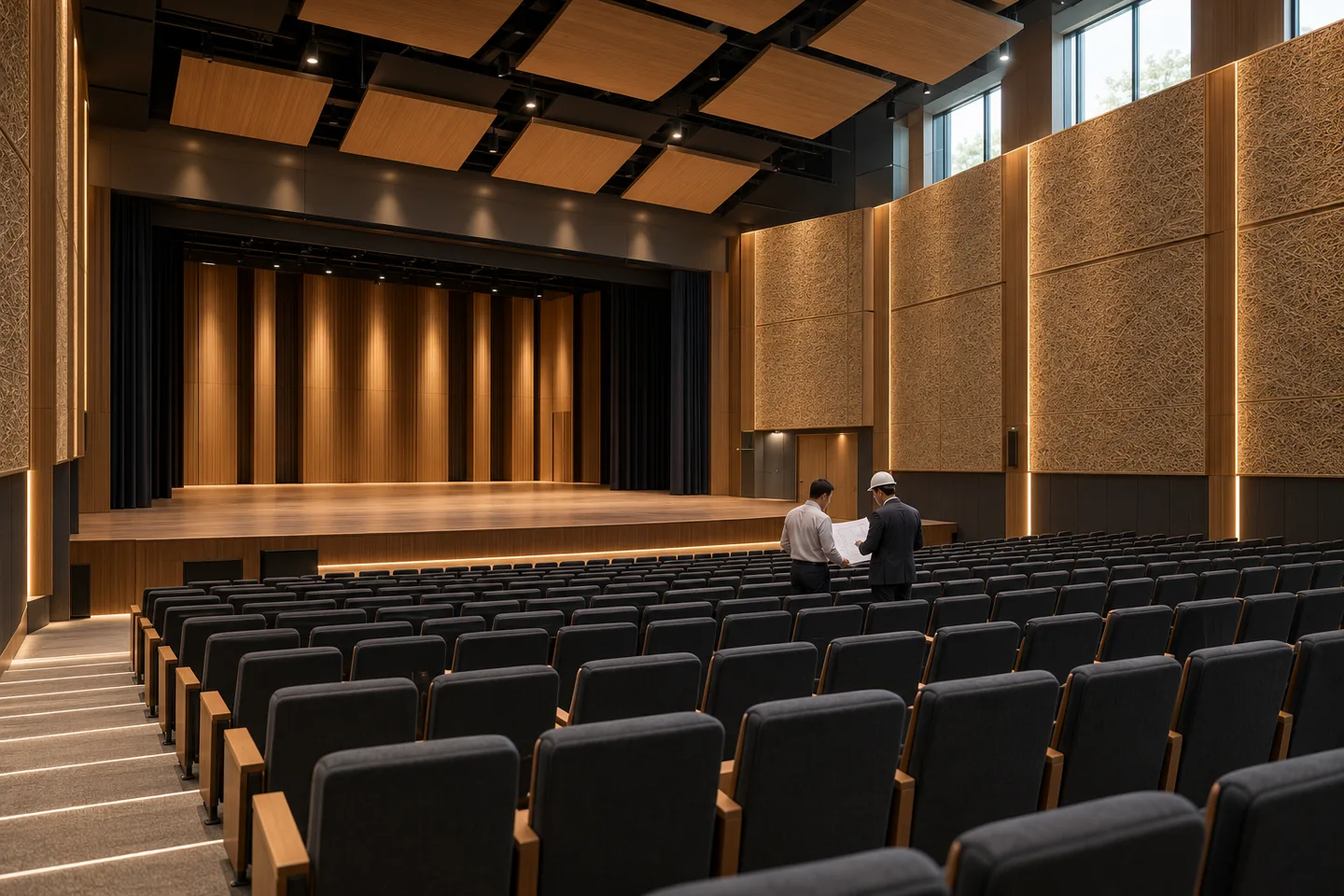
Auditoriums and multipurpose halls require particularly careful consideration because they may be used for speeches, conferences, theatre, music and other events. A speech-focused auditorium generally benefits from controlled reverberation that supports intelligibility, while a music-oriented space may require a different acoustic character.
For multipurpose auditoriums, the acoustic design may need to balance the requirements of speech and music rather than optimising the room for only one use. Room volume, audience capacity, stage configuration, seating, wall construction, ceiling geometry and the distribution of acoustic treatment can all influence the final result.
For existing auditoriums, acoustic measurements can also help determine whether excessive reverberation is caused by particular reflective surfaces or insufficient absorption. Thermofriz provides dedicated Auditorium Acoustic Treatment and Auditorium Acoustic Panels solutions for projects where reverberation control forms part of the wider acoustic design.
RT60 for Home Theatres
A home theatre requires controlled acoustic reflections to support clear dialogue, balanced sound and an immersive listening experience. An excessively reverberant room can allow reflections to overlap with the direct sound from the speakers, potentially affecting clarity. At the same time, completely eliminating reflected sound is not necessarily the objective. The appropriate acoustic treatment depends on:
- Room dimensions and volume
- Speaker and seating positions
- Wall and ceiling construction
- Floor and furniture finishes
- Existing absorption
- Desired listening characteristics Acoustic panels can be strategically positioned to control reflections while allowing the room to retain an appropriate acoustic balance. For dedicated projects, Thermofriz's Home Theater Acoustic Treatment solutions can be considered as part of a broader room-acoustic strategy
RT60 for Recording Studios
Recording studios require particularly controlled acoustic environments because the room itself becomes part of the recording and monitoring chain. The objective is not simply to achieve the lowest possible RT60. Instead, the room needs a controlled and predictable acoustic response appropriate to its intended function.
Different areas within a studio can also have different acoustic requirements. Recording spaces, control rooms and vocal areas may require different combinations of absorption and other acoustic treatments. Frequency-dependent behaviour becomes especially important because an apparently controlled room at mid and high frequencies may still exhibit problematic low-frequency behaviour.
This is why recording studio projects generally benefit from acoustic design and measurement rather than selecting panels based solely on their advertised absorption rating.
RT60 for Offices and Conference Rooms
Offices and meeting spaces typically prioritise speech clarity and acoustic comfort. Excessive reverberation can make conversations, presentations and video conferences more difficult to follow, particularly in rooms containing glass, concrete, exposed ceilings and other reflective surfaces. Acoustic panels can be positioned strategically to reduce excessive reflections and improve the overall acoustic environment.
The appropriate treatment depends on room size, occupancy, furniture, ceiling height and existing finishes. Thermofriz's Office Soundproofing Solutions can be considered where acoustic treatment needs to form part of a wider workplace noise-control strategy.
RT60 for Classrooms
In classrooms, speech intelligibility is particularly important. Students need to distinguish the teacher's voice from reflected sound and background noise. Excessive reverberation can make this more difficult, especially in larger rooms or classrooms with many hard surfaces. Acoustic treatment can help control reflections and create a more suitable environment for teaching and learning.
The appropriate acoustic target should be determined from the classroom's size, use and applicable project requirements rather than applying a universal RT60 value.
RT60 for Restaurants and Hospitality Spaces
Restaurants, cafés, hotels and banquet spaces can experience substantial sound build-up because of conversations, occupancy and hard interior finishes. As the number of people speaking increases, reflected sound can contribute to a progressively louder acoustic environment. Appropriately designed acoustic treatment can help control this reverberant energy while remaining integrated with the interior design.
Fabric-wrapped panels, wooden acoustic systems, ceiling treatments and other solutions can be considered depending on the architectural and acoustic requirements.
What Factors Affect RT60?
RT60 is influenced by more than the acoustic panels installed in a room.
Room Volume
Room volume is one of the fundamental variables in reverberation calculations. Larger spaces can require considerably more absorption to achieve a comparable change in reverberation characteristics. This is one reason why a panel quantity that works for a small meeting room cannot simply be transferred to a large auditorium.
Surface Materials
The surfaces surrounding the room influence how much sound is reflected or absorbed. Concrete, glass, stone, tile and other hard surfaces can contribute substantial reflection, while absorptive finishes reduce the amount of sound energy remaining in the reverberant field.
Amount of Absorption
Adding effective sound absorption increases the total absorption of the room and can reduce reverberation time. However, the result depends on the absorption characteristics of the selected material, the amount installed, its location and its mounting configuration.
Occupancy and Furniture
People, seating, curtains, carpets and furniture can all contribute to the acoustic absorption of a room. Consequently, an auditorium may have different acoustic characteristics when empty compared with when it is fully occupied.
Room Geometry
The shape and geometry of a room influence how sound travels and reflects. Parallel walls, large uninterrupted surfaces, balconies, curved surfaces, ceiling configurations and other architectural features can affect the acoustic response. This is why complex rooms often require more than a basic reverberation calculation.
Frequency RT60 can vary considerably across frequency. A room may appear acoustically well controlled at some frequencies while still exhibiting excessive reverberation at others. Professional acoustic design should therefore consider frequency-dependent performance rather than relying exclusively on a single overall number.
How Do Acoustic Panels Help Reduce RT60?
Acoustic panels work by introducing sound-absorbing surfaces into a room. In a highly reflective space, sound can repeatedly bounce between walls, ceilings and other hard surfaces. This repeated reflection contributes to reverberation. Introducing appropriate absorptive treatment changes that balance: Reflective room → repeated reflections → longer sound decay becomes: Absorptive treatment → reduced reflected energy → faster sound decay → more controlled reverberation However, the objective isn't simply to cover every available surface.
The amount, type, thickness, placement and mounting configuration of acoustic treatment should be selected according to the room's requirements.
Panel Coverage Matters
A panel can have excellent absorption characteristics, but its effect on the overall room depends partly on how much absorptive area is introduced. For example, installing a small number of panels in a large, highly reflective auditorium may produce some local improvement without achieving the desired room-level reverberation characteristics.
This is why acoustic treatment should be considered as a system: Panel performance + treated area + placement + mounting + existing room absorption rather than as an isolated product specification.
RT60 vs NRC: What's the Difference?
RT60 and NRC are related to acoustics but describe different things.
| RT60 | NRC |
|---|---|
| Describes reverberation behaviour in a room | Describes sound absorption characteristics of a material |
| Room-level acoustic parameter | Material/product-level rating |
| Expressed as time | Expressed as a numerical absorption rating |
| Influenced by room volume and total absorption | Derived from absorption measurements at specified frequencies |
| Helps establish acoustic requirements | Helps compare sound-absorbing materials |
This distinction is important when selecting acoustic panels.
NRC can help you evaluate a material. RT60 helps you understand the acoustic behaviour of the room. A high-NRC product does not automatically guarantee that the finished room will have the desired RT60. Coverage, placement, room volume, existing surfaces and installation conditions still matter. For a deeper explanation of NRC, see What Is NRC Rating? A Practical Guide for Acoustic Panel Buyers.
A Practical Guide for Acoustic Panel Buyers.
RT60 vs Echo: Are They the Same Thing?
No. Echo and reverberation are related but different acoustic phenomena. An echo is generally perceived as a distinct delayed reflection that can be heard separately from the original sound. Reverberation is created by numerous reflections that arrive closely enough together that they blend into a continuing decay of sound.
RT60 provides a way to quantify this decay behaviour. This distinction matters because a room can have an uncomfortable reverberant character without producing an obvious discrete echo. Therefore, simply saying that a room “has an echo problem” may not provide enough information to determine the appropriate acoustic treatment.
Common RT60 Mistakes in Acoustic Design
Several mistakes can lead to inappropriate acoustic treatment.
Assuming the Lowest RT60 Is Always Best
Different rooms have different acoustic requirements. The goal is controlled reverberation appropriate to the application.
Using One Target for Every Room
A classroom, recording studio, auditorium and restaurant should not automatically be designed around the same reverberation target.
Ignoring Frequency
A single RT60 value can hide significant differences between low, mid and high frequencies.
Ignoring Occupancy
People and furnishings can contribute meaningful absorption, so the occupied and unoccupied acoustic conditions may differ.
Selecting Panels Only by NRC
NRC describes material absorption characteristics. It does not tell you exactly how a panel will change the RT60 of an entire room.
Treating RT60 as a Soundproofing Measurement
RT60 describes reverberation inside a room. It does not directly measure how much sound passes through a wall, door, ceiling or other building element.
Waiting Until Construction Is Complete
For technically demanding projects, acoustic objectives should ideally be considered during architectural and interior design rather than after all surfaces have already been finalised.
When Should You Get Professional Acoustic Consultation?
Professional acoustic input becomes particularly valuable when the space is large, technically complex or acoustically sensitive. Consider consultation for: Auditoriums and multipurpose halls where speech and music may have different requirements. Home theatres where speaker placement, seating and room treatment need to work together.
Recording studios where predictable acoustic behaviour is essential. Commercial offices with open layouts, glass surfaces and conferencing requirements. Educational facilities where speech intelligibility is a priority. Healthcare projects where acoustic comfort and communication are important. Hospitality spaces where occupancy and conversational noise can create substantial reverberation.
Existing spaces requiring acoustic renovation where measurements can identify the sources of excessive reverberation before treatment is specified. A professional assessment can help determine whether the project requires additional absorption, different panel placement, specialised low-frequency treatment, architectural changes, or a combination of solutions.
How Thermofriz Approaches Reverberation Control
Understanding RT60 is valuable because it turns a vague complaint such as “the room sounds echoey” into a measurable acoustic consideration. But the number itself is only useful when it is connected to the room's purpose, construction, existing finishes and acoustic objectives. At Thermofriz , reverberation control can be approached as part of a broader acoustic solution rather than as a standalone panel-selection exercise.
The objective is to understand the space, identify where excessive reflections are occurring, determine the required level and distribution of sound absorption, and then select suitable acoustic products and installation configurations. With in-house manufacturing, custom manufacturing capabilities, project and acoustic consultation, professional installation support, Pan India supply and turnkey solutions, Thermofriz can support projects where acoustic treatment needs to be coordinated with the wider architectural and construction requirements.
RT60 Should Be Considered During Project Planning
For new construction, acoustic requirements are best considered while the architectural and interior design is still being developed. Wall construction, ceiling height, room geometry, flooring, seating, furniture, glazing and other finishes can all influence the eventual acoustic environment. Planning treatment early can also make it easier to coordinate acoustic panels with:
- Lighting
- HVAC systems
- Electrical services
- Sprinklers
- Ceiling systems
- Doors
- Furniture
- Architectural finishes This is particularly important for auditoriums, theatres, studios, educational facilities and large commercial projects where acoustic treatment may occupy significant wall or ceiling areas. For existing rooms, the approach is different. Acoustic measurements can help establish the current reverberation characteristics before deciding what treatment is required
When Should RT60 Be Measured?
Measurement can be useful when the acoustic requirements are important enough that assumptions are unlikely to be sufficient. For example, measurement may be appropriate when: An existing auditorium has excessive reverberation. The measurement can help establish the existing condition before acoustic renovation. A recording studio requires a controlled acoustic environment.
Frequency-dependent measurements can help identify whether the room behaves consistently across the relevant spectrum. A multipurpose hall has conflicting speech and music requirements. Measurements can support a more informed assessment of the existing acoustic condition. A completed project needs acoustic verification.
Post-installation measurements can help determine whether the finished space is performing as intended. The appropriate measurement procedure should depend on the type of space, project objectives and applicable acoustic requirements.
How to Use RT60 Alongside NRC and Other Acoustic Data
One of the most important concepts for acoustic panel buyers is that RT60 and NRC answer different questions . NRC helps you understand the general sound absorption characteristics of a material. RT60 helps you understand how sound behaves and decays within the room. Neither number should be considered independently when specifying a complete acoustic treatment system.
A practical acoustic evaluation can therefore follow this sequence: Room assessment ↓ Identify acoustic problem ↓ Establish desired acoustic condition ↓ Determine appropriate reverberation characteristics ↓ Evaluate sound absorption requirements ↓ Compare acoustic materials and test data ↓ Determine treatment coverage and placement ↓ Install and, where appropriate, verify performance This is a much more reliable approach than starting with a product catalogue and selecting a panel based only on its NRC.
A Practical RT60 Checklist for Architects and Project Owners
Before finalising an acoustic treatment system, consider the following questions. What is the primary use of the room?
Speech, music, theatre, conferencing, recording, education, hospitality and industrial applications can have very different acoustic requirements. What is the current acoustic problem?
Determine whether the issue is excessive reverberation, poor speech intelligibility, unwanted reflections, background noise or sound transmission. What are the room dimensions?
Record the length, width and ceiling height because room volume is an important part of reverberation calculations. What materials are already present?
Consider walls, flooring, ceilings, glazing, doors, furniture, curtains and existing acoustic treatments. What acoustic condition is required?
The objective should be defined before selecting the product. What absorption is already available?
Existing absorptive surfaces and occupancy can influence the amount of additional treatment required. What acoustic products are appropriate?
Compare product construction, thickness, frequency-dependent absorption, mounting conditions and other relevant technical information. Where should treatment be installed?
Panel placement should respond to the room's acoustic behaviour rather than simply filling available wall space. Is sound isolation also required?
If noise must be prevented from entering or leaving the room, acoustic treatment may need to be combined with a broader soundproofing strategy. Is professional measurement required?
For technically complex or performance-critical spaces, measurement and acoustic modelling may provide greater confidence than assumptions alone.
RT60 and Acoustic Treatment: A Complete Room Perspective
RT60 is most useful when it becomes part of a complete acoustic design process. Consider a large auditorium with concrete walls, a hard floor, a high ceiling and extensive reflective surfaces. Simply installing a few acoustic panels may not be enough to achieve the desired acoustic environment. The project may require an assessment of the room volume, existing absorption, audience area, wall reflections, ceiling behaviour and intended programme.
The same principle applies to a home theatre. The acoustic treatment needs to work with speaker placement, seating, room geometry and other surfaces rather than being selected independently. This room-first approach allows acoustic products to become part of the design rather than an afterthought. Thermofriz's broad portfolio—including Wood Wool Boards, Glasswool, Fabric Acoustic Panels, Wooden Slat Acoustic Panels, acoustic baffles, acoustic clouds and other acoustic systems —allows different treatment approaches to be considered according to the project.
Frequently Asked Questions About RT60
What does RT60 mean in acoustics?
RT60 is the time required for sound in a room to decay by 60 dB after the sound source stops. It is commonly used to describe the reverberation characteristics of an enclosed space.
What is a good RT60 for a room?
There is no universal ideal RT60. The appropriate reverberation time depends on the room's purpose, volume, geometry, occupancy, frequency and acoustic objectives.
Is a lower RT60 always better?
No. Excessive reverberation can reduce speech clarity, but an excessively short reverberation time can make some spaces sound overly dry. The appropriate RT60 depends on the intended use of the room.
How is RT60 calculated?
A common theoretical approach uses the Sabine equation: RT60 = 0.161 × V / A , where V represents room volume and A represents total equivalent sound absorption in metric sabins. Real rooms can require more detailed assessment.
How is RT60 measured?
Professional measurements involve generating sound in the room, recording the decay at suitable microphone positions and analysing the results across relevant frequency bands. The appropriate procedure depends on the space and applicable measurement requirements.
What is the difference between RT60 and NRC?
RT60 describes the reverberation behaviour of a room, while NRC is a single-number representation of a material's sound absorption performance. NRC can help evaluate an acoustic panel, whereas RT60 helps assess the acoustic response of the space.
Can acoustic panels reduce RT60?
Yes. Appropriate sound-absorbing treatment can increase the room's total absorption and reduce reverberation time. The resulting change depends on the panel's acoustic characteristics, amount of treatment, placement, mounting and existing room conditions.
What is the difference between RT60, T20 and T30?
RT60 refers to a 60 dB sound decay. T20 and T30 use shorter measured decay ranges—20 dB and 30 dB respectively—and extrapolate the result to a 60 dB decay. They are useful when background noise makes a full 60 dB decay difficult to measure reliably.
Control Reverberation With the Right Acoustic Strategy
RT60 is not simply a number to minimise. It is a parameter that helps acoustic professionals understand and control how sound behaves within a room. The appropriate reverberation characteristics depend on the space, its purpose, dimensions, materials, occupancy and acoustic objectives. Once those requirements are understood, acoustic treatment can be planned around the appropriate combination of absorption, coverage, placement and installation.
This is also why choosing an acoustic panel based solely on NRC is not enough. The product needs to work as part of the room's overall acoustic strategy. Whether you're planning an auditorium, home theatre, recording studio, office, classroom, healthcare facility, hospitality space or another acoustically sensitive environment, a room-first approach can help avoid unnecessary treatment and improve the likelihood of achieving the desired acoustic result.
Thermofriz supports project teams with acoustic products, in-house and custom manufacturing, acoustic consultation, professional installation, Pan India supply and turnkey solutions.
Get Free Consultation
Not sure what your room's RT60 should be or which acoustic treatment is appropriate?
Get Free Consultation with Thermofriz to discuss your project's acoustic requirements and determine a suitable approach for controlling reverberation.