Wood wool acoustic panels have become an increasingly relevant option for projects where sound absorption needs to work alongside architectural design. Unlike conventional finishes that simply occupy a wall or ceiling, wood wool acoustic panels can become part of the acoustic strategy as well as the visual character of the space.
For architects, interior designers, acoustic consultants, contractors and project owners, the important question is not simply whether wood wool panels absorb sound. It is whether the particular panel, configuration, coverage and installation approach are appropriate for the room. The selection should therefore begin with the acoustic objective, room characteristics and intended application rather than with the appearance of a panel alone.
Thermofriz offers a broad Wood Wool Boards collection with different configurations and finishes, allowing project teams to consider acoustic treatment alongside architectural requirements.
What Are Wood Wool Acoustic Panels?
Wood wool acoustic panels are sound-absorbing panels designed to help manage reflected sound within interior spaces. They can be used as part of an acoustic treatment strategy where excessive sound reflection or reverberation affects the way a room sounds. Instead of allowing all incident sound energy to reflect from hard surfaces, an appropriately designed absorptive panel can interact with the sound and reduce the amount of reflected energy.
This makes wood wool panels relevant to spaces where controlling reverberation, improving acoustic comfort or supporting speech intelligibility is important. However, wood wool acoustic panels should not automatically be considered a complete soundproofing solution. Acoustic treatment primarily addresses sound within a room, while soundproofing is concerned with reducing sound transmission between spaces.
For projects requiring both objectives, the acoustic treatment needs to be considered alongside the appropriate sound-isolation construction.
How Do Wood Wool Acoustic Panels Work?
To understand their role, consider what happens inside a highly reflective room. A person speaks, music is played, or equipment generates sound. The sound reaches the room's surfaces and is reflected back into the space. When there are many hard surfaces, these reflections can continue interacting with the room and contribute to reverberation.
Introducing sound-absorbing treatment changes this balance. Sound source → reflection → acoustic absorption → reduced reflected energy → more controlled room acoustics The overall effect depends on the panel construction, thickness, mounting arrangement, amount of treatment and the characteristics of the room. This is why simply choosing a panel with a particular acoustic rating does not automatically determine the final acoustic performance of a project.
The room itself remains an important part of the equation.
Sound Absorption and Reverberation
Wood wool panels can form part of a strategy for controlling excessive reverberation. If a room has extensive hard surfaces and insufficient absorption, sound can remain audible for longer than desirable. This can affect speech clarity and acoustic comfort. The relationship between absorption and reverberation is why wood wool panels can be considered for auditoriums, classrooms, offices, hospitality environments and other spaces where room acoustics need to be controlled.
For a deeper understanding of this relationship, see What Is RT60? Understanding Reverberation Time in Acoustic Design.
Understanding Reverberation Time in Acoustic Design.
Benefits of Wood Wool Acoustic Panels
The value of wood wool acoustic panels goes beyond simply adding an absorptive surface. Their suitability for a project can come from the combination of acoustic treatment and architectural integration. Sound Absorption The primary reason to consider acoustic panels is their ability to contribute to sound absorption. In rooms with excessive reflections, appropriate absorptive treatment can help reduce reflected sound and support a more controlled acoustic environment.
The actual acoustic result depends on the product configuration, installation, coverage and room conditions, so product-level test data should always be considered when specifying panels for a particular project.
Architectural Appearance
Wood wool panels have a distinctive textured appearance that can become part of the interior design. This can be useful for architects and interior designers who do not want acoustic treatment to appear visually disconnected from the rest of the space. Instead, the acoustic surface can contribute to the overall architectural character of the room.
Design Flexibility
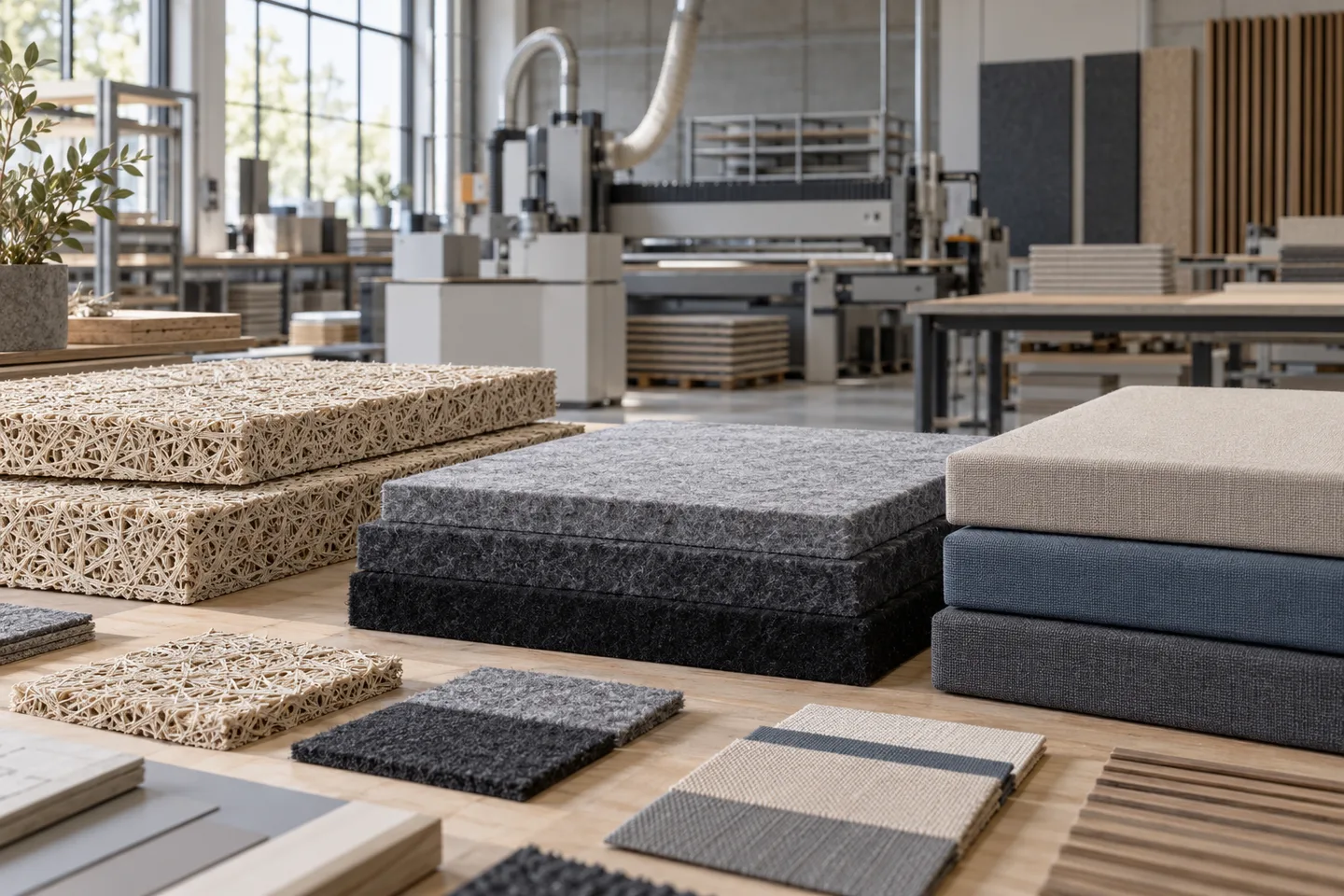
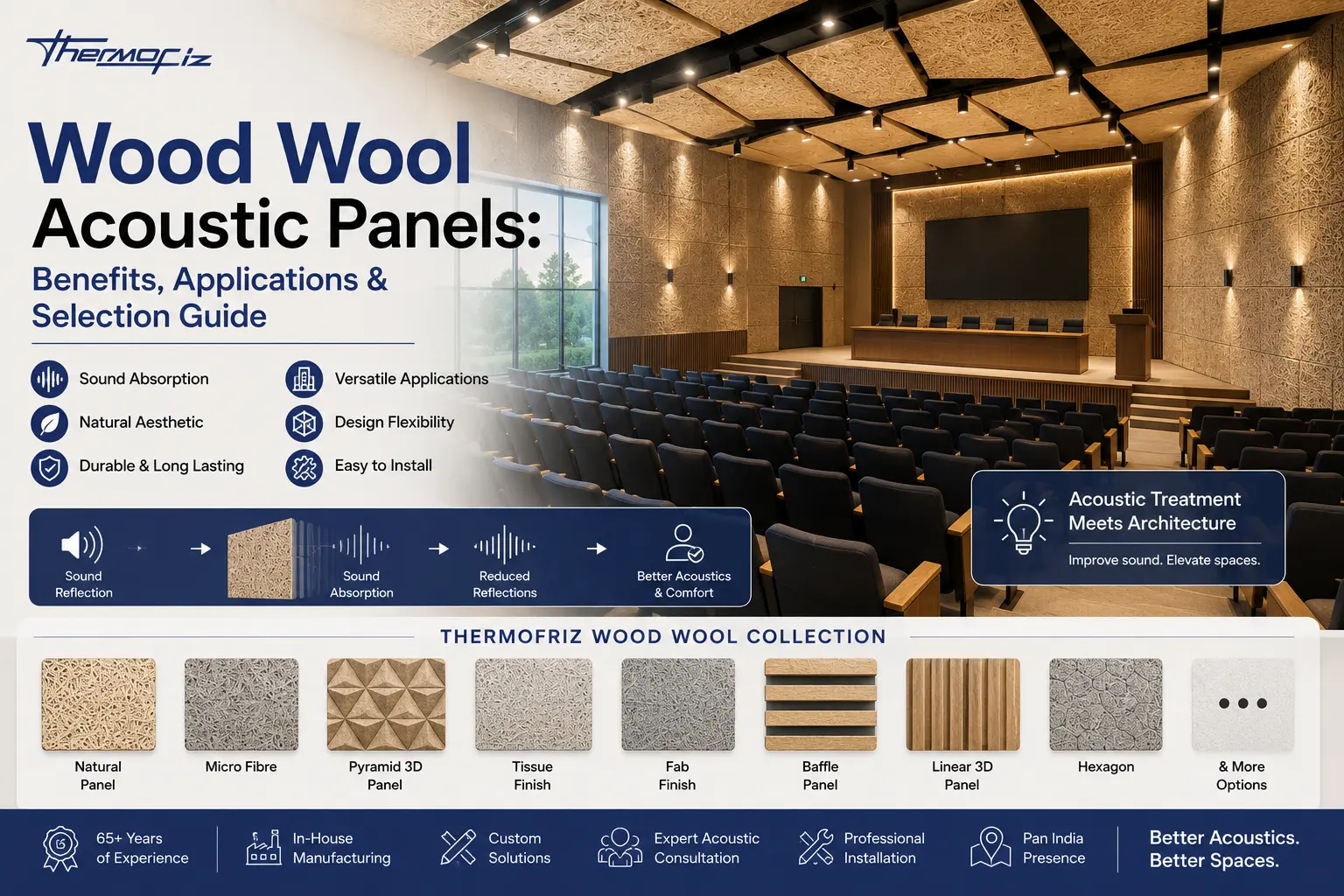
Wood wool acoustic systems can be configured in different forms and finishes depending on the product. The Thermofriz Wood Wool Boards collection includes options such as Natural Panel, Micro Fibre, Pyramid 3D Panel, Tissue Finish, Fab Finish, Baffle Panel, Linear 3D Panel, Burl Finish Panel, Vinyl Finish Panel, Texture Finish Panel, Cement Wood Panel, Gypsum Finish Panel, Acoustic Flooring Tile and Hexagon , among other configurations.
This variety allows project teams to consider acoustic treatment alongside the desired visual language of the interior.
Wall and Ceiling Applications
Depending on the particular product and installation system, wood wool acoustic solutions can be considered for walls as well as overhead applications. This gives designers more flexibility when planning treatment in rooms where wall space is limited or where the ceiling can provide additional absorptive area. Suspended or baffle-style configurations can also be relevant to larger spaces where overhead acoustic treatment forms part of the overall design.
Acoustic Treatment With Architectural Integration
One of the key advantages of considering wood wool for an architectural project is the ability to combine acoustic treatment with the appearance of the interior. Instead of treating acoustic panels as something that has to be hidden, designers can use texture, pattern, geometry and finish as part of the visual design. This can be particularly useful in contemporary commercial, institutional, educational and hospitality interiors.
Where Are Wood Wool Acoustic Panels Used?
The suitability of wood wool panels depends on the acoustic requirements and environmental conditions of each project. They can be considered across a wide range of spaces where sound absorption and architectural integration are both relevant.
Auditoriums and Multipurpose Halls
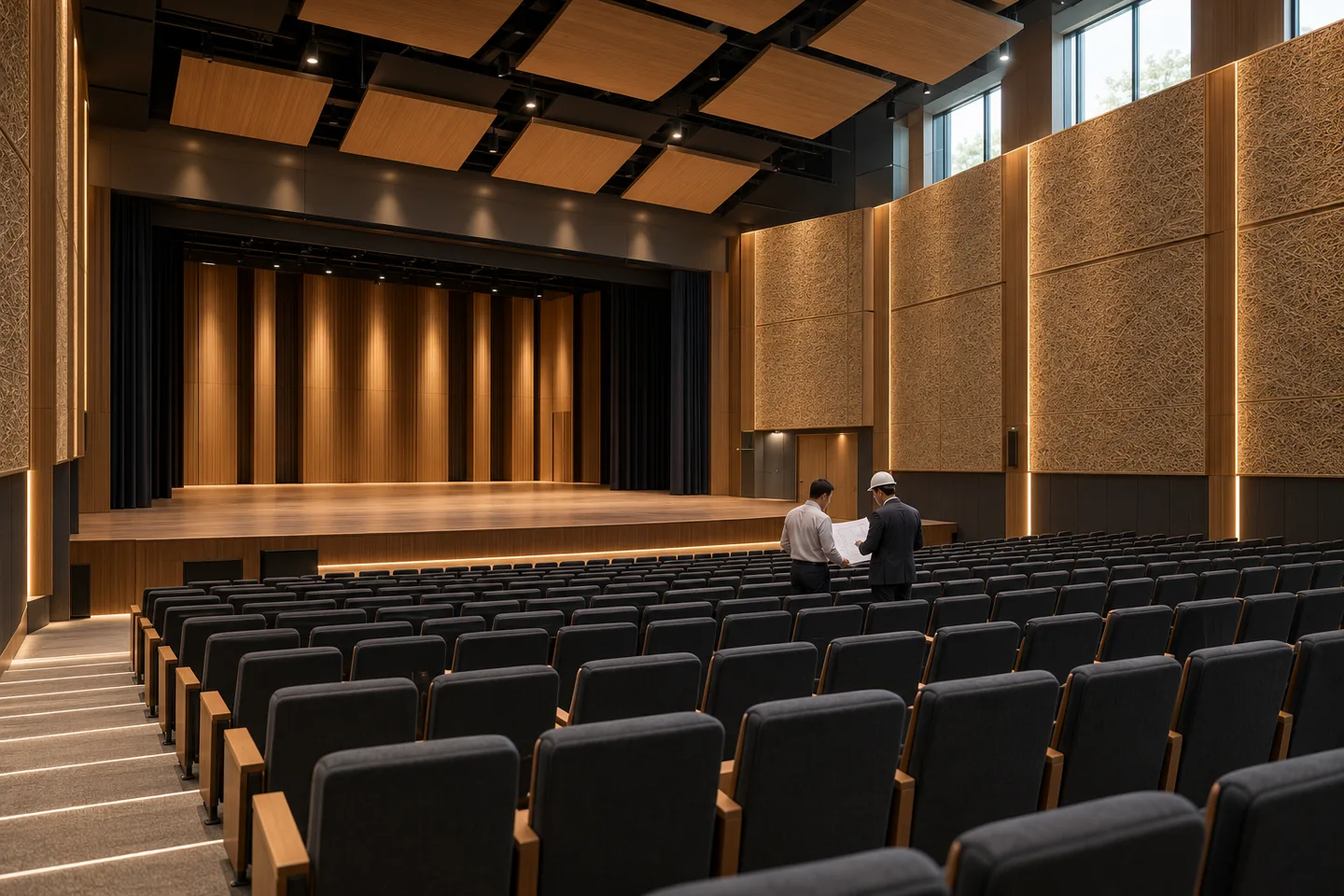
Auditoriums often contain large reflective surfaces and significant room volumes. Without appropriate acoustic treatment, excessive reverberation can affect speech intelligibility and the overall listening experience. Wood wool panels can be considered as part of an auditorium acoustic strategy, including wall and ceiling treatment where appropriate.
However, the final treatment should be based on the room's intended use, dimensions, geometry, seating, existing surfaces and acoustic objectives. For dedicated projects, explore Auditorium Acoustic Panels and Auditorium Acoustic Treatment.
Schools and Educational Institutions
Classrooms and educational spaces depend heavily on clear speech. Excessive reverberation can make it more difficult for students to distinguish spoken words, particularly in rooms with hard floors, walls, ceilings or large reflective surfaces. Wood wool acoustic treatment can be considered as part of a broader strategy for creating more controlled learning environments.
The appropriate quantity and placement should depend on the classroom's dimensions, occupancy and existing acoustic conditions.
Offices and Conference Rooms
Modern offices often incorporate glass partitions, hard flooring, exposed ceilings and other reflective materials. These finishes can contribute to reverberation, particularly in meeting rooms and collaborative spaces. Wood wool panels can provide an acoustic treatment option while also contributing a distinctive architectural texture.
Where the requirement extends beyond room acoustics to broader workplace noise control, the acoustic treatment should be considered as part of the overall solution.
Home Theatres
Home theatres require controlled reflections to support a comfortable and immersive listening environment. Wood wool panels may be considered where their appearance and acoustic characteristics fit the design requirements, but they should not automatically be treated as the ideal solution for every home theatre. Room dimensions, speaker and seating positions, wall construction, existing finishes and the desired acoustic response should guide the selection.
For dedicated projects, see Home Theater Acoustic Treatment.
Hospitality Spaces
Restaurants, cafés, hotels, banquet facilities and other hospitality environments can experience significant sound build-up because of conversations, occupancy and hard interior finishes. Acoustic treatment can help manage excessive reflections while remaining part of the interior design. Wood wool systems may therefore be considered where their acoustic and architectural characteristics align with the project's requirements.
Gyms and Other Large Interior Spaces
Large interior spaces can contain significant reflective surfaces and high occupancy levels. Where acoustic treatment is required, wood wool systems can be evaluated alongside other acoustic products according to the environment, room characteristics, durability requirements and desired finish.
Industrial and Institutional Applications
Industrial and institutional spaces may have different acoustic challenges from conventional offices or classrooms. Here, product selection should consider the source and character of the noise, room construction, environmental conditions, durability and whether the objective is sound absorption, sound isolation or both.
Wood wool treatment can be considered where the product configuration and environmental requirements are appropriate.
How to Select the Right Wood Wool Acoustic Panel
Not every wood wool acoustic panel is suitable for every project. Once the application has been identified, the next step is to evaluate the panel's acoustic characteristics, construction, mounting arrangement, finish and intended location. The selection should ultimately answer a simple question: does this particular configuration address the acoustic and architectural requirements of the space?
Start With the Acoustic Objective
Before comparing Wood Wool Board variants, establish what the treatment needs to accomplish. The requirement could be controlling excessive reverberation, improving speech intelligibility, reducing unwanted reflections, creating a more comfortable acoustic environment, or integrating acoustic treatment into a specific architectural design.
For example, a classroom primarily concerned with speech clarity may require a different treatment strategy from an auditorium designed for both speech and music. The product should follow this objective rather than being selected first.
Consider the Room
Evaluate the characteristics of the space before choosing the panel. Important considerations include: Room volume — Larger rooms can require considerably more absorptive treatment. Existing surfaces — Glass, concrete, stone, tile and other hard finishes can contribute to sound reflection. Occupancy — People and furniture contribute to the room's overall absorption.
Ceiling height — High ceilings can increase room volume and create additional reflective surfaces. Existing acoustic treatment — Existing panels, carpets, curtains and other absorptive finishes affect how much additional treatment is required. Intended use — Speech, music, theatre, conferencing and general occupancy have different acoustic objectives.
This room-first approach is consistent with the broader Thermofriz principle of selecting acoustic treatment according to the application rather than simply choosing the most heavily specified product.
Wood Wool Acoustic Panels vs Other Acoustic Panel Types
Wood wool is one option within a much wider acoustic-product landscape. Comparing it with other panel categories can help buyers understand where it may be appropriate.
| Acoustic panel type | Where it may be considered | Key selection consideration |
|---|---|---|
| Wood Wool | Commercial, institutional, educational and architectural acoustic applications | Acoustic treatment + textured architectural finish |
| Glasswool | Applications requiring sound absorption | Product construction + acoustic test data |
| Fabric Wrapped | Offices, auditoriums, conference spaces and design-led interiors | Acoustic absorption + finish flexibility |
| Wooden Slat | Contemporary commercial and premium interiors | Acoustic treatment + architectural aesthetics |
| Sentetic | Project-specific acoustic applications | Configuration + intended application |
The purpose of this comparison is not to declare one material universally superior.
A wood wool acoustic panel may be an excellent choice for one project while a fabric-wrapped, glasswool, wooden slat or Sentetic solution may be more appropriate for another. The right selection depends on the room, acoustic objective, design requirements and installation conditions.
How Does NRC Apply to Wood Wool Panels?
NRC, or Noise Reduction Coefficient, can help buyers understand the general sound-absorption characteristics of an acoustic material. However, NRC should not be treated as the complete measure of how a Wood Wool Board will perform in a real room. When evaluating a wood wool acoustic panel, consider the available acoustic data alongside:
- Panel construction
- Thickness
- Mounting arrangement
- Air gap
- Treated surface area
- Frequency-specific absorption
- Room characteristics
A panel's laboratory performance is measured under defined conditions. The final acoustic result in a project depends on how the product is actually incorporated into the room. For a deeper explanation, see What Is NRC Rating? A Practical Guide for Acoustic Panel Buyers.
How Does RT60 Relate to Wood Wool Acoustic Panels?
RT60 describes the time required for sound to decay by 60 dB in a room. This makes it a room-level acoustic parameter , while NRC is primarily a material-level absorption indicator . Wood wool panels can contribute to reducing reverberation by increasing the amount of sound absorption within a room. But the change in RT60 depends on much more than the panel's individual absorption characteristics.
It also depends on: Room volume + existing absorption + panel quantity + panel placement + panel performance + installation configuration This is why a product should not be selected simply by asking which Wood Wool Board has the highest NRC. The more useful question is: How will the selected Wood Wool system contribute to the acoustic objective of this particular room?
For more information, explore What Is RT60? Understanding Reverberation Time in Acoustic Design.
Does Thickness Affect Wood Wool Acoustic Panel Performance?
Panel thickness can influence acoustic absorption, particularly across different frequency ranges. However, thickness should not be considered independently. The overall acoustic response can also be affected by the material construction, mounting configuration, air gap and frequency. Therefore, when comparing different Wood Wool Board configurations, look at the available technical and test information rather than assuming that the thickest panel will automatically provide the best acoustic result.
What About an Air Gap?
The space between a panel and the underlying wall can influence acoustic behaviour. Depending on the product and frequency range, an appropriately designed air gap can alter the system's absorption characteristics. However, there is no universal air-gap dimension that should be applied to every wood wool panel. The installation arrangement should follow the manufacturer's recommended or tested configuration for the specific product.
Should Wood Wool Panels Be Installed on Walls or Ceilings?
They can be considered for both wall and ceiling applications, depending on the particular Wood Wool product and mounting system.
Wall Applications
Wall-mounted Wood Wool Boards can be useful where large reflective surfaces are contributing to excessive reverberation. They can also become part of the interior design through texture, pattern and finish.
Ceiling Applications
Ceiling treatment can introduce additional absorptive area without occupying valuable wall space. This can be particularly useful in offices, classrooms, restaurants, large halls and other spaces where the ceiling represents a substantial reflective surface.
Baffle and Suspended Applications
Baffle-style systems can provide another approach to overhead acoustic treatment, particularly in larger or open spaces. The suitability of any particular configuration should be determined from the product's intended application and the requirements of the project.
Wood Wool Panels and Soundproofing: What's the Difference?
This distinction is essential for anyone searching for wood wool acoustic panels for soundproofing . Wood Wool Boards are primarily associated with sound absorption and acoustic treatment . Soundproofing, on the other hand, is concerned with reducing sound transmission between spaces or from external sources. Therefore: Wood Wool acoustic treatment → controls reflected sound inside the room Soundproofing system → reduces sound transmission through building elements A Wood Wool panel may contribute to an overall sound-control strategy, but it should not automatically be described as a complete soundproofing assembly.
Where both requirements exist, acoustic treatment may need to be combined with appropriate walls, ceilings, acoustic doors, insulation, sealing or other sound-isolation measures. For projects specifically concerned with this distinction, see acoustic panels for soundproofing.
How to Choose a Wood Wool Finish
Acoustic performance is not the only consideration. In many commercial and institutional projects, the acoustic treatment becomes a visible part of the interior. Thermofriz Wood Wool Boards collection provides different configurations and finishes, allowing designers to consider the visual character of the treatment alongside its acoustic purpose.
Natural Appearance
A straightforward wood-wool appearance can complement interiors where material texture is part of the design language.
Three-Dimensional Patterns
Options such as Pyramid 3D and Linear 3D configurations can introduce additional visual geometry to walls or ceilings.
Geometric Designs
Configurations such as Hexagon can be considered where a more distinctive patterned appearance is required.
Baffle Configuration
Baffle systems provide a ceiling-oriented treatment approach where suspended acoustic elements are appropriate.
Finish-Based Options
Tissue, Fab, Burl, Vinyl and Texture finish variants provide different visual directions for projects where surface appearance is an important part of the specification. The appropriate choice should ultimately be based on the actual product configuration, technical requirements and architectural design.
Thermofriz Wood Wool Boards: Choosing the Right Configuration
The Thermofriz Wood Wool Boards collection includes multiple configurations rather than one standard panel. The available collection includes Natural Panel, Micro Fibre, Pyramid 3D Panel, Tissue Finish, Fab Finish, Baffle Panel, Linear 3D Panel, Burl Finish Panel, Vinyl Finish Panel, Texture Finish Panel, Cement Wood Panel, Glasswool Sandwich Panel, Gypsum Finish Panel, Acoustic Flooring Tile, Hexagon and Thermocol Sandwich Panel .
This variety can be useful when a project needs acoustic treatment to work with different architectural requirements. However, product selection should not be based solely on the name or appearance of a variant. The selection process should consider: Application — Where will the panel be installed?
Acoustic objective — What acoustic problem needs to be addressed?
Configuration — Is a conventional panel, patterned panel, baffle or another system more appropriate?
Finish — How should the treatment integrate with the interior?
Mounting — What installation configuration is required?
Technical data — What acoustic and product documentation is available for the specific configuration?
This approach prevents a common mistake in acoustic procurement: selecting a visually attractive product first and trying to make it solve an acoustic problem afterwards.
Installation and Specification Considerations for Wood Wool Acoustic Panels
Selecting the right wood wool acoustic panels is only part of the project. The installation configuration can influence the way the finished acoustic system performs, so product selection and installation should be considered together. Before installation, the project team should confirm the substrate, mounting method, panel orientation, required spacing, surrounding architectural elements and any manufacturer-specific installation requirements.
For larger projects, these details should be coordinated during the design stage rather than left until installation begins.
Consider the Mounting Configuration
The acoustic performance of a panel can depend on how it is installed. A product tested in one configuration should not automatically be assumed to deliver identical performance when installed differently. Depending on the product and application, considerations may include:
- Direct wall installation
- Framed installation
- Ceiling installation
- Suspended or baffle systems
- Air gap behind the panel
- Supporting structure
- Panel alignment and spacing The manufacturer's recommended installation configuration should therefore be followed for the specific Wood Wool product being specified
Coordinate With Other Building Services
Acoustic panels are often installed in environments containing lighting, HVAC systems, electrical services, sprinklers, speakers and other architectural elements. This becomes particularly important for ceilings and large auditoriums where treatment may cover substantial areas. Early coordination can prevent conflicts and help maintain the intended acoustic treatment pattern without compromising access to essential services.
Consider the Substrate
The wall or ceiling substrate should be appropriate for the proposed mounting system and installation method. The substrate, fixing method and supporting structure should be evaluated before installation rather than assuming that the same fixing arrangement will work across every project. For large or technically demanding installations, the installation team should follow the relevant product documentation and project specifications.
Common Mistakes When Buying Wood Wool Acoustic Panels
A technically suitable product can still produce disappointing results when the selection process is based on incomplete information.
Choosing Only by Appearance
A visually attractive panel may not necessarily address the room's acoustic requirements. The acoustic objective should be established before the finish and pattern are finalised.
Choosing Only by NRC
NRC is useful for comparing general sound absorption characteristics, but it does not describe the complete acoustic performance of the finished room. Room volume, coverage, mounting, frequency response and existing surfaces also matter.
Ignoring Coverage
Installing a small number of absorptive panels in a large reflective room may not provide sufficient overall treatment. The amount of absorption required should be considered alongside the room's characteristics.
Confusing Acoustic Treatment With Soundproofing
Wood Wool Boards can contribute to sound absorption, but they should not automatically be treated as a complete soundproofing system. If sound transmission is the primary problem, the project may require additional construction-based sound-isolation measures.
Assuming Every Wood Wool Product Is Identical
Different configurations, thicknesses, finishes and mounting arrangements can have different characteristics. The technical documentation for the specific product should therefore be reviewed before specification.
Ignoring Installation Conditions
Laboratory acoustic performance is associated with defined test conditions. Changing the installation configuration can affect how the system performs. This is why the mounting arrangement should be considered during product selection.
Selecting the Product Before Defining the Acoustic Objective
Perhaps the biggest mistake is starting with: “Which Wood Wool panel should I buy?” The better starting point is: “What does this room need to achieve acoustically?” The answer can then guide the choice of panel, configuration, coverage and installation.
When Should You Get Professional Acoustic Consultation?
A professional acoustic consultation can be particularly useful when the project involves complex room geometry, large spaces, multiple acoustic objectives or significant investment in construction and interiors. Consider professional input for: Auditoriums and multipurpose halls where speech, music and performance requirements may need to be balanced.
Home theatres where acoustic treatment needs to coordinate with speaker and seating positions. Recording studios where predictable acoustic behaviour is particularly important. Large offices and conference facilities where speech clarity and background-noise control are priorities. Educational projects where classroom acoustics can influence speech communication.
Healthcare environments where acoustic comfort and communication are important. Hospitality projects where occupancy and reflective finishes can create significant sound build-up. Acoustic renovation projects where the existing room needs to be assessed before treatment is specified. Professional consultation can help determine whether Wood Wool is appropriate and, if so, which configuration, coverage and placement should be considered.
Why Consider Thermofriz for Wood Wool Acoustic Solutions?
Thermofriz brings more than 65 years of experience to acoustic product manufacturing and project support. Its capabilities include in-house manufacturing, custom manufacturing, project and acoustic consultation, professional installation, Pan India supply and turnkey solutions . The Wood Wool Boards collection also provides multiple configurations and finishes, allowing project teams to consider acoustic treatment alongside architectural requirements.
This broader approach is useful for projects where acoustic treatment is not an isolated product purchase but part of a larger architectural or construction programme. Thermofriz can also support projects that require different acoustic product categories, making it possible to consider Wood Wool alongside Glasswool, Fabric Acoustic Panels, Wooden Slat Acoustic Panels and other acoustic systems where appropriate.
The objective should remain the same: Select the right acoustic solution for the room, then select the right product configuration to deliver it.
Frequently Asked Questions About Wood Wool Acoustic Panels
What are wood wool acoustic panels?
Wood wool acoustic panels are sound-absorbing panels used as part of interior acoustic treatment. They can help manage reflected sound and excessive reverberation while also providing an architectural surface.
Are wood wool panels good for sound absorption?
They can be used as sound-absorbing treatment where their acoustic characteristics and installation configuration are appropriate for the project. Actual performance should be evaluated using the technical data for the specific product.
Where are wood wool acoustic panels used?
They can be considered for auditoriums, classrooms, offices, conference rooms, hospitality spaces, home theatres, institutional environments and other interior applications where sound absorption and architectural integration are required.
Are wood wool acoustic panels suitable for ceilings?
Certain Wood Wool configurations can be considered for ceiling applications, including suitable suspended or baffle-style systems. The appropriate product and mounting method depend on the project requirements.
Are wood wool panels suitable for auditoriums?
They can form part of an auditorium acoustic treatment strategy. The appropriate product, coverage and placement should be determined according to the auditorium's size, geometry, intended use and acoustic objectives.
What is the difference between wood wool and other acoustic panels?
Wood Wool, Glasswool, Fabric Wrapped, Wooden Slat and other acoustic systems have different constructions, finishes and application characteristics. The right choice depends on acoustic requirements, architectural design, installation and project conditions.
Does the thickness of a wood wool panel affect its acoustic performance?
Thickness can influence acoustic absorption, particularly across different frequencies, but it is not the only factor. Construction, mounting, air gap and frequency-dependent performance should also be considered.
Can wood wool acoustic panels help reduce reverberation?
Yes. Appropriate sound-absorbing treatment can increase the room's overall absorption and help control reverberation. The resulting effect depends on panel performance, quantity, placement, installation and existing room conditions.
Are wood wool acoustic panels soundproof?
Wood Wool panels primarily provide sound absorption and acoustic treatment. They should not automatically be considered a complete soundproofing solution for preventing sound transmission between spaces.
How do I choose the right wood wool acoustic panel?
Start with the room's acoustic objective, then consider room volume, existing surfaces, required coverage, product construction, acoustic test data, mounting configuration, finish and installation requirements.
Choose Wood Wool Panels Around the Room, Not the Other Way Around
Wood wool acoustic panels can provide a practical way to combine acoustic treatment with architectural design, but selecting the right product requires more than comparing appearances or headline specifications. The strongest selection process starts with the room. Define the acoustic problem → understand the room → establish the acoustic objective → evaluate product data → determine coverage → select the configuration → plan installation.
This approach helps avoid common mistakes such as choosing a product solely because it has a high NRC, treating acoustic panels as soundproofing, or installing insufficient treatment in a highly reflective room. For architects, interior designers, acoustic consultants, contractors and project owners, the right Wood Wool solution should ultimately be the one that fits both the acoustic requirements and architectural requirements of the project .
With its Wood Wool Boards collection, in-house manufacturing, custom manufacturing capabilities, acoustic consultation, professional installation support, Pan India supply and turnkey project capabilities, Thermofriz can support projects from product consideration through implementation.
Get Free Consultation
Planning to use Wood Wool acoustic treatment in an auditorium, office, classroom, home theatre, hospitality space or another project?
Get Free Consultation with Thermofriz to discuss your room, acoustic requirements and suitable Wood Wool solution before finalising the specification.