When a room feels noisy, echoes excessively, or allows too much sound to travel between spaces, the terms acoustic panels and soundproofing often appear in the same search. That can make them seem like two versions of the same solution.
They are not.
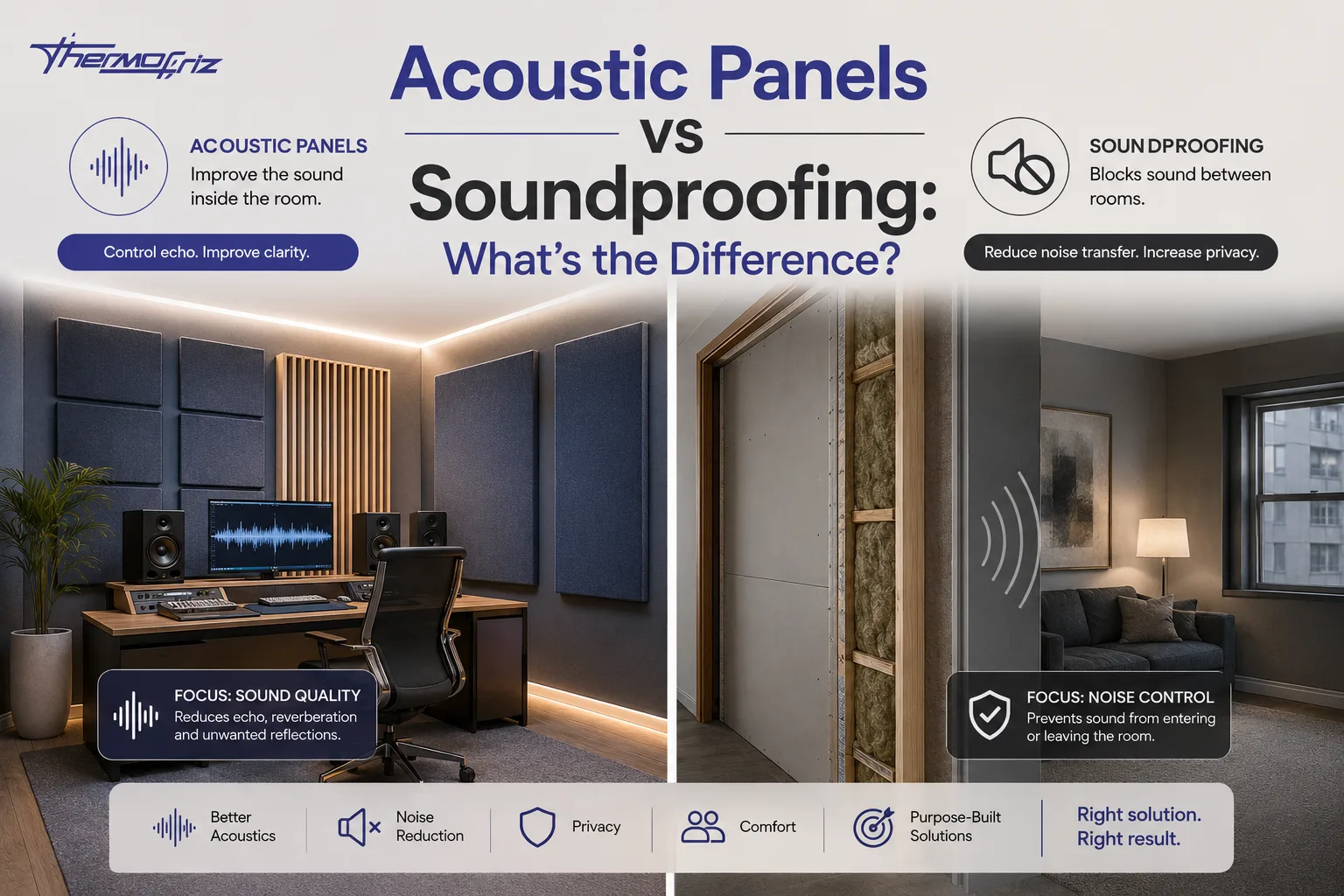
Acoustic panels are primarily used to manage reflected sound inside a room, helping control reverberation, echo, and acoustic clarity. Soundproofing focuses on reducing sound transmission from one space to another.
The distinction matters because installing an effective sound-absorbing panel will not necessarily stop traffic noise entering a room, conversations passing through a partition, or music travelling into an adjoining space.
At the same time, a room can be well isolated from outside noise and still have poor internal acoustics.
Understanding acoustic panels vs soundproofing therefore begins with one question:
Are you trying to improve how sound behaves inside the room, reduce how much sound travels into or out of it, or solve both problems?
This guide explains the difference and how to identify which approach your space actually needs.
Acoustic Panels vs Soundproofing: Quick Answer
Acoustic panels and soundproofing solve different acoustic problems. Acoustic panels absorb a portion of reflected sound within a room to help control echo, reverberation, and clarity. Soundproofing, more accurately described in many technical contexts as sound isolation, aims to reduce sound transmission between one space and another.
If your room sounds excessively echoey, acoustic treatment may be required. If unwanted sound is passing through walls, doors, ceilings, floors, glazing, or other building elements, sound isolation needs to be investigated.
Some spaces experience both problems and may therefore require both strategies.
| Factor | Acoustic Panels | Soundproofing / Sound Isolation |
|---|---|---|
| Primary purpose | Manage sound within a room | Reduce sound transmission between spaces |
| Primarily addresses | Reflections, echo, reverberation, acoustic clarity | Sound entering or leaving a space |
| Typical approach | Add appropriately selected absorptive treatment | Improve the sound-isolating performance of the building assembly |
| Common areas involved | Walls, ceilings, suspended treatment | Walls, doors, floors, ceilings, glazing, junctions and penetrations |
| Example problem | Speech is difficult to understand because the room reverberates | Speech from the next room can be heard through the partition |
| Can one replace the other? | No | No |
That final point is particularly important.
A quieter-sounding room is not automatically a better soundproofed room.
Why Acoustic Panels and Soundproofing Are Often Confused
The confusion is understandable because both are associated with “reducing noise.”
But noise reduction can mean several different things.
Imagine a meeting room where conversations become difficult to understand because speech reflects repeatedly from glass partitions, a hard floor, walls, and the ceiling.
People may describe that room as noisy.
Now imagine another meeting room where conversations inside are clearly audible in the neighbouring office.
That room may also be described as noisy.
The complaints sound similar, but the acoustic mechanisms are different.
The first problem largely concerns sound behaviour inside the room.
The second concerns sound transmission between spaces.
There can also be a third situation: both happen simultaneously. A room may have excessive internal reverberation while also providing inadequate isolation from adjacent areas.
This is why the word noise alone is not enough to diagnose an acoustic problem.
Before selecting any product, determine where the unwanted sound originates, where it travels, and what you want to change about it.
What Are Acoustic Panels?
Acoustic panels are products designed to provide sound absorption as part of an acoustic treatment strategy.
When sound is generated inside a room, the sound energy does not travel only from the source directly to the listener. It also reaches surrounding surfaces such as walls, ceilings, floors, glazing, furniture, and other objects.
Some of that energy is reflected back into the room.
In spaces containing many hard, reflective surfaces, repeated reflections can contribute to excessive reverberation, echoes, reduced speech clarity, or an uncomfortable build-up of sound.
Acoustic panels introduce absorptive surfaces that help manage those reflections.
Depending on the project, acoustic treatment can take different forms, including fabric-wrapped panels, wood wool products, glasswool-based systems, wooden acoustic products, ceiling tiles, baffles, clouds, and other specialised solutions.
The correct choice depends on the acoustic objective, room type, product performance, thickness, placement, available surfaces, aesthetics, and wider project requirements.
For a deeper selection framework, Thermofriz's guide on how to choose acoustic panels explains these factors in detail.
How Do Acoustic Panels Work?
When sound reaches an acoustic panel, part of the incident sound energy can be absorbed rather than being reflected fully back into the room.
The exact behaviour depends on the panel construction and installation.
This is why two products that both carry the label “acoustic panel” should not automatically be assumed to perform identically.
Material, thickness, construction, mounting configuration, and frequency-dependent performance can all matter.
One common metric used when evaluating absorptive products is the Noise Reduction Coefficient (NRC). NRC provides a single-number indication derived from sound-absorption measurements at specified frequencies.
However, NRC should not be interpreted as a soundproofing rating.
A panel with strong absorptive performance can be useful for controlling reflections inside a room without necessarily providing the building-level isolation required to prevent sound transmission into adjoining spaces.
That difference between absorption and isolation is fundamental to this entire comparison.
What Problems Can Acoustic Panels Help Solve?
Appropriately designed acoustic treatment can help address problems such as:
Excessive reverberation. Sound persists within the room longer than desired because of repeated reflections.
Echo or problematic reflections. Reflected sound interferes with how the room is heard or used.
Poor speech clarity. Excessive reverberant energy can make spoken communication harder to understand.
Uncontrolled listening conditions. Recording studios, home theatres, cinemas, and other critical-listening environments may require treatment to manage reflections and improve the acoustic behaviour of the room.
Noise build-up in occupied spaces. Restaurants, offices, classrooms, hospitality environments, and other busy interiors may benefit from appropriately designed absorption where reverberation contributes to acoustic discomfort.
But this does not mean an acoustic panel is a universal solution for every unwanted sound.
What Acoustic Panels Cannot Be Expected to Do
The most important limitation is straightforward:
Acoustic panels should not automatically be expected to soundproof a room.
Suppose road traffic is clearly audible through a window. Adding absorptive panels to an internal wall does not directly address the window as the transmission path.
Similarly, if conversations are passing through an inadequately isolated partition, treating the visible wall surface with absorptive panels does not necessarily resolve the performance of the underlying partition.
The same principle can apply to doors, glazing, ceilings, floors, service penetrations, junctions, gaps, and other paths through which sound may travel.
Acoustic panels can change the acoustic behaviour inside the room. Soundproofing requires attention to how sound gets from one space to another.
What Is Soundproofing?
“Soundproofing” is the familiar term people commonly use when they want to stop unwanted sound from entering or leaving a room.
In practice, it is useful to think in terms of sound isolation or sound transmission control.
Absolute silence between spaces is rarely a useful assumption behind the word “soundproof.” Instead, the goal is generally to reduce sound transmission to an appropriate level for the application.
That requires looking beyond surface finishes.
Walls, ceilings, floors, doors, glazing, structural connections, service penetrations, gaps, and junctions can all form part of the transmission system.
The correct solution therefore depends heavily on identifying how the sound is travelling. You may also visit Thermofriz for commercial acoustic panels for soundproofing.
How Sound Travels Between Spaces
Sound transmission is not always as simple as:
Room A → wall → Room B.
Sound may pass through a separating construction directly, but it can also find other routes depending on the building.
For example, a room may have a substantial partition but a poorly performing door. Another may have gaps around building elements. In some configurations, sound may travel through adjoining construction paths rather than only through the obvious separating surface.
This is why adding a single material to one wall without understanding the transmission path can produce disappointing results.
A sound-isolation strategy should consider the relevant building assembly as a system.
What Does Soundproofing Actually Address?
Soundproofing becomes the more relevant conversation when the main complaint is about sound moving between locations.
Examples include:
- traffic or external environmental noise entering an interior;
- conversations travelling between adjoining rooms;
- music escaping from a studio or entertainment space;
- sound moving between floors;
- inadequate privacy between meeting rooms, offices, or other spaces;
- equipment or activity noise affecting adjacent areas.
The solution will depend on the source, transmission path, frequency characteristics, construction, and performance objective.
This is fundamentally different from choosing a wall panel because a room has too much reverberation.
Sound Absorption vs Sound Blocking: Understanding the Difference
A simple way to understand sound absorption vs soundproofing is to follow the sound.
When sound strikes a surface inside a room, some energy may be reflected, some may be absorbed, and some may contribute to transmission depending on the construction.
Acoustic absorption focuses primarily on controlling the reflected component within the space.
Sound isolation focuses on reducing transmission through or around the separating construction.
Consider a home theatre.
If dialogue and music sound overly reflective inside the theatre, acoustic treatment may be needed.
If the film soundtrack is disturbing someone in the neighbouring bedroom, isolation between the spaces becomes relevant.
If both are happening, treating only one problem leaves the other unresolved.
That leads to one of the most important principles in acoustic design:
Acoustic treatment controls the room. Sound isolation controls transmission between rooms.
Neither should be treated as a substitute for the other.
Do Acoustic Panels Soundproof a Room?
This is one of the most common questions surrounding acoustic treatment, and the short answer is:
Acoustic panels are primarily designed to absorb reflected sound within a room; they should not be treated as a substitute for a properly designed sound-isolation system.
This distinction becomes easier to understand with a simple example.
Imagine a conference room with hard flooring, glass partitions, a reflective ceiling, and minimal soft furnishings. Conversations may sound unclear because speech reflects repeatedly from these surfaces.
Adding appropriately selected acoustic treatment can help control those reflections and reduce excessive reverberation.
Now imagine that people outside the conference room can clearly hear the conversation taking place inside.
That is a different problem.
The second issue involves the ability of the separating construction to control sound transmission. The wall assembly, door, glazing, ceiling interface, gaps, penetrations, and other potential paths may need to be considered.
Adding absorptive panels inside the conference room may improve how the room sounds without necessarily providing the required level of privacy outside it.
This is why the question should rarely be:
“Will these acoustic panels soundproof my room?”
A more useful question is:
“Is my problem caused by reflected sound inside the room, sound transmission between spaces, or both?”
Can Acoustic Panels Reduce Noise?
Yes—but the meaning of “reduce noise” needs to be defined carefully.
If noise refers to excessive reverberation, reflected sound, or acoustic build-up within a room, sound-absorbing treatment can help create a more controlled acoustic environment.
Consider a busy restaurant.
As conversations increase, sound reflects from hard walls, floors, glazing, ceilings, tables, and other surfaces. The room may progressively feel louder and more difficult to communicate in.
Introducing suitable absorption can reduce the contribution of reflected sound to that environment.
But consider a different situation.
If the restaurant is affected by significant traffic noise entering through the building envelope, adding acoustic panels to the interior does not directly address the external-to-internal transmission path.
Likewise, if music from the restaurant is disturbing an adjoining property, the project needs to investigate how that sound is escaping.
So when someone asks whether acoustic panels reduce noise, the technically useful response is:
Acoustic panels can help reduce reflected sound and reverberant build-up within a room. They should not automatically be expected to prevent unwanted sound from entering or leaving through the building construction.
This distinction helps avoid unrealistic expectations from otherwise effective acoustic products.
When Do You Need Acoustic Panels?
Acoustic panels become relevant when the main objective is to improve how sound behaves inside a space.
Several symptoms can indicate that sound absorption should be investigated.
Excessive Echo
An obvious echo is one possible sign of problematic reflections.
Rooms containing large, hard, parallel surfaces can create noticeable reflected sound, particularly when there is little existing absorption.
However, people sometimes use the word echo to describe any room that sounds excessively live.
The actual problem may instead be high reverberation.
Identifying the behaviour correctly helps determine the appropriate treatment.
Long or Excessive Reverberation
Reverberation is the persistence of sound in an enclosed space as reflections continue after the original sound has been produced.
Some reverberation is natural and can even be desirable depending on the room.
The problem arises when the reverberant characteristics do not support the space's intended function.
A lecture room needs speech to remain intelligible. An auditorium needs acoustic conditions appropriate to its programme. A restaurant needs to balance atmosphere with conversational comfort. A recording environment needs controlled conditions suitable for recording or monitoring.
The objective is therefore not:
eliminate reverberation everywhere.
It is:
control reverberation appropriately for the space.
Poor Speech Clarity
Speech-focused environments are particularly sensitive to room acoustics.
When reflected sound persists for too long, parts of speech can overlap acoustically, reducing clarity.
This can become relevant in:
classrooms, meeting rooms, conference facilities, auditoriums, lecture halls, training rooms, offices, and other communication-focused environments.
Appropriately designed absorptive treatment can form part of the strategy for improving these conditions.
Uncontrolled Reflections
In recording studios, home theatres, cinemas, and other critical-listening environments, the problem may be more specific than a generally reverberant room.
Certain reflections can interfere with the listening or recording environment.
Panel selection and placement therefore become especially important.
Simply distributing sound-absorbing panels uniformly across every available wall may not provide the same result as treatment planned around the room geometry, loudspeaker position, listening position, and acoustic objective.
This is one reason Thermofriz (being unmatched acoustic panels manufacturer in India, though) approaches more demanding spaces as complete acoustic treatment projects, rather than assuming that selecting a panel alone completes the acoustic design.
When Do You Need Soundproofing?
Soundproofing or sound isolation becomes relevant when unwanted sound is travelling from one location to another.
The first step should be identifying the source and likely transmission path.
Sound Entering From Another Room
If conversations, television sound, music, or other activities in an adjoining room can be heard too clearly, the separating construction may require investigation.
Do not assume the wall itself is necessarily the only problem.
Doors, glazing, ceiling paths, openings, service penetrations, gaps, and construction junctions can also influence the result.
Sound Escaping Into Adjacent Spaces
Recording studios, home theatres, auditoriums, entertainment spaces, meeting rooms, and other environments may generate sound that should be controlled before it reaches neighbouring areas.
Again, absorptive treatment inside the room and isolation between rooms are different considerations.
A recording studio can have well-controlled internal reflections while still transmitting too much sound through its construction.
Conversely, it can be reasonably well isolated while having poor internal acoustics.
External Noise Entering a Room
Traffic, nearby activities, building services, and other external sources can create intrusive noise.
If unwanted sound originates outside the room, installing absorptive panels inside should not automatically be considered the primary isolation solution.
The relevant transmission paths need to be identified.
That may involve investigating building elements such as glazing, doors, walls, roofs or ceilings, gaps, and other parts of the enclosure, depending on the project.
Inadequate Privacy Between Rooms
Privacy is especially important in offices, meeting rooms, consultation spaces, institutional environments, hospitality projects, and other areas where conversations should not be easily understood outside the room.
If the problem is that speech travels between spaces, improving internal absorption alone may not provide the required privacy.
The performance of the separating construction and associated transmission paths needs to be considered.
When Does a Room Need Both Acoustic Treatment and Soundproofing?
Many real projects cannot be placed neatly into one category.
They need both.
This happens when a room has an internal acoustic problem and an external transmission problem.
A recording studio provides an easy example.
Inside the studio, reflections and reverberation may need to be controlled to support recording and monitoring.
At the same time, external noise may need to be kept out, while internally generated music needs to be sufficiently isolated from surrounding spaces.
These are separate acoustic objectives.
One does not replace the other.
The same principle can apply to home theatres, auditoriums, conference rooms, music rooms, educational facilities, entertainment spaces, and other acoustically sensitive environments.
A useful way to think about the relationship is:
Acoustic treatment asks:
How should sound behave inside this room?
Sound isolation asks:
How much sound should be allowed to travel between this room and somewhere else?
When a project needs answers to both questions, the two strategies should be considered together.
Acoustic Panels vs Soundproofing for Different Spaces
The distinction becomes even clearer when applied to real environments.
Recording Studios
Recording studios are one of the clearest examples of why acoustic treatment and soundproofing should not be confused.
Inside the studio, acoustic treatment may be used to control reflections, reverberation, and listening conditions.
Isolation addresses a different requirement: reducing unwanted sound transmission into or out of the studio.
For example, external traffic or neighbouring activities may interfere with recording. At the same time, music generated inside the studio may need to be controlled so that it does not disturb adjoining spaces.
A studio can therefore require both strategies, but they should be designed for their respective purposes.
For smaller recording environments, the selection and placement of acoustic panels for a home studio should similarly begin with understanding the room rather than simply covering walls with absorptive material.
Home Theatres
Home theatres are another environment where the two terms are frequently mixed together.
Acoustic treatment addresses the listening experience inside the theatre. It can help manage reflections and reverberant behaviour so the room better supports the intended audio experience.
Sound isolation addresses how much soundtrack energy travels to bedrooms, living spaces, neighbouring properties, or other parts of the building—and how much external noise enters the theatre.
A complete home theater acoustic treatment project should therefore begin by identifying which of these objectives the room actually needs rather than assuming they are the same.
Auditoriums
Auditoriums present more complex acoustic requirements because of their scale, geometry, occupancy, architectural finishes, stage configuration, and intended programme.
Internal acoustic treatment may involve carefully selected wall and ceiling treatments designed to control reverberation and support appropriate listening conditions.
Isolation can become a separate consideration where external noise could interfere with events or where auditorium activity could affect adjoining spaces.
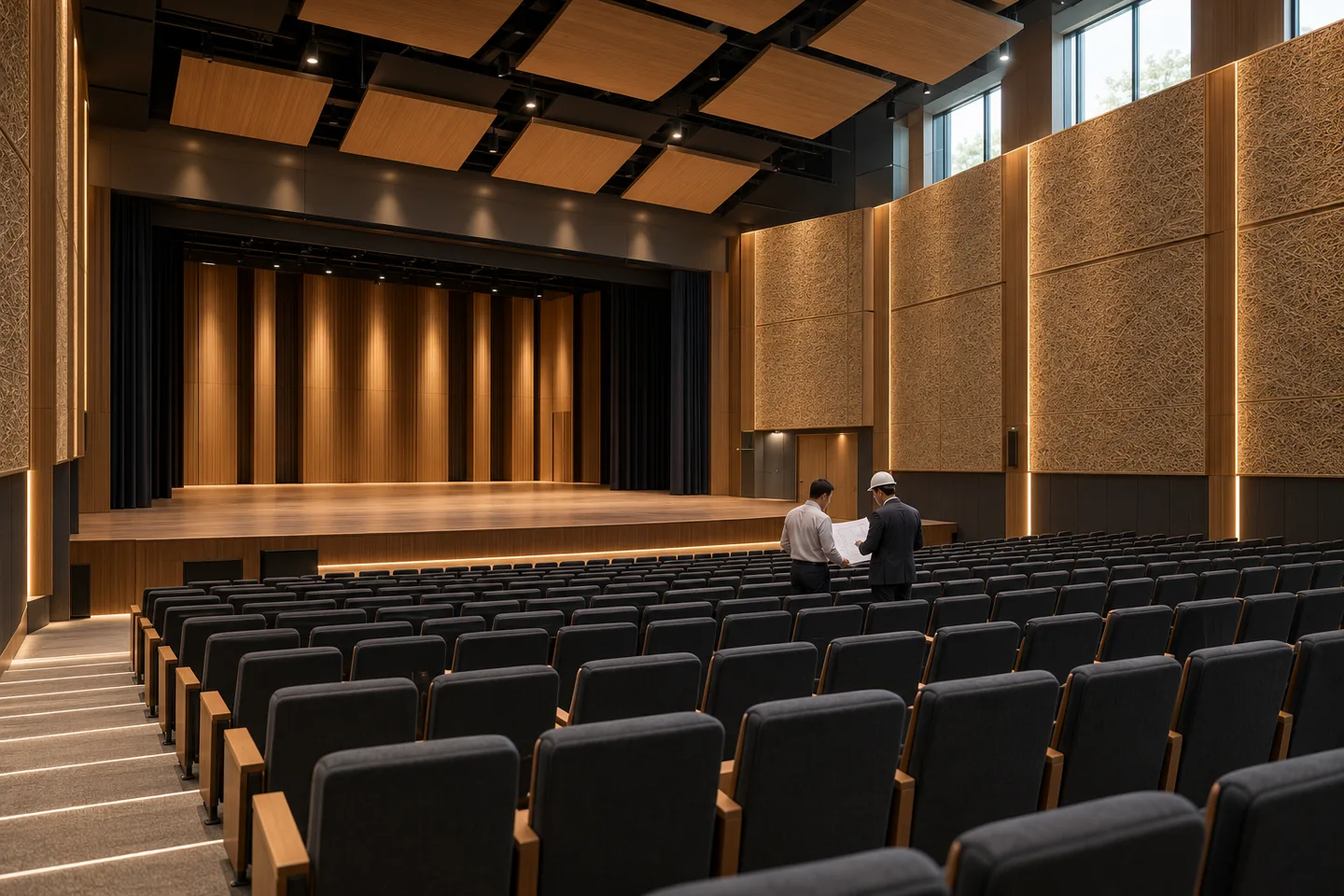
For this reason, selecting auditorium acoustic panels should form part of a broader acoustic strategy rather than being treated as a standalone soundproofing measure.
Thermofriz offers unmatched auditorium acoustic treatment.
Offices and Meeting Rooms
An office can experience several different acoustic complaints at the same time.
An open office may suffer from excessive reflected sound and general acoustic build-up.
A meeting room may have poor speech clarity internally.
That same meeting room may also provide inadequate conversational privacy because sound is transmitted into adjoining areas.
The first two problems can involve room acoustic treatment. The third raises sound-isolation considerations.
Correct diagnosis is therefore especially important in modern offices where multiple acoustic requirements often coexist.
Restaurants and Hospitality Spaces
Restaurants frequently benefit from absorption when hard surfaces and high occupancy contribute to excessive reverberant sound.
But if music or activity noise is affecting hotel rooms, neighbouring properties, or other parts of the building, the problem extends beyond internal absorption.
Again:
reducing reverberation inside the restaurant and reducing sound transmission outside the restaurant are not the same task.
Classrooms and Educational Spaces
Classrooms, lecture halls, training rooms, and educational auditoriums rely heavily on speech communication.
Where excessive reverberation reduces speech clarity, acoustic treatment may be appropriate.
Where noise from corridors, neighbouring classrooms, outdoor activity, or other spaces intrudes into the learning environment, sound isolation may also need investigation.
Educational acoustic design can therefore involve both internal room acoustics and separation from surrounding noise sources, depending on the facility.
Common Mistakes When Trying to Reduce Noise
Once the difference between acoustic treatment and sound isolation is understood, many common mistakes become easier to avoid.
The biggest problem is rarely that people choose a completely ineffective product. More often, they choose a product designed to solve a different acoustic problem from the one they actually have.
Mistake 1: Treating Every Noise Problem With Acoustic Panels
Acoustic panels are highly useful when appropriately selected for sound absorption and room acoustic control. But that does not make them a universal solution for unwanted sound.
If the main complaint is excessive reverberation inside an office, restaurant, auditorium, or classroom, absorptive treatment may be relevant.
If the complaint is traffic noise entering through the building envelope or conversations passing between rooms, the transmission path needs to be investigated.
Before selecting a product, classify the problem.
Inside-room problem → investigate acoustic treatment.
Between-space problem → investigate sound isolation.
Both → both strategies may need consideration.
That simple distinction can prevent an entire project from beginning with the wrong solution.
Mistake 2: Assuming a Quieter-Sounding Room Is Now Soundproof
After adding absorption, a room may immediately feel more controlled.
Reverberation may decrease. Speech may sound clearer. Reflections may become less noticeable.
That improvement can create the impression that the room has also become “soundproof.”
But the two outcomes should not be confused.
A change in the acoustic character inside a room does not, by itself, demonstrate that the separating construction now provides substantially better sound isolation.
If isolation is the objective, transmission between spaces needs to be considered separately.
Mistake 3: Using the Word “Foam” as a Shortcut for Soundproofing
Acoustic foam and other absorptive materials are frequently associated with recording environments, which has contributed to the assumption that adding an absorptive surface automatically prevents sound from escaping.
Absorption and isolation remain different functions.
A product intended to manage reflected sound should be evaluated for that purpose rather than expected to perform a different building-acoustic function simply because it is marketed as an acoustic material.
Mistake 4: Treating Only the Most Obvious Surface
When unwanted sound appears to come through a wall, it is natural to focus entirely on that wall.
However, sound transmission can involve more than the most visually obvious separating surface.
Depending on the construction, doors, glazing, gaps, ceilings, floors, service penetrations, junctions, and adjoining building elements can influence the result.
This is why complex soundproofing problems benefit from investigating the transmission path, not simply applying another material to the surface where the sound seems loudest.
Mistake 5: Buying Products Before Diagnosing the Room
This mistake affects both acoustic treatment and soundproofing.
A homeowner may buy panels before identifying reflection problems. A business may specify a wall treatment before determining whether the complaint is actually transmission through a door. A studio may focus on absorption while overlooking isolation requirements.
The sequence should be reversed:
Product selection comes after the acoustic objective is understood.
How to Identify Which Acoustic Solution Your Space Needs
You do not need to be an acoustic engineer to make the first distinction.
Start by asking where the unwanted sound problem occurs.
Question 1: Does the Problem Exist Primarily Inside the Room?
Examples include:
- conversations sound unclear because the room is highly reverberant;
- clapping or speech produces noticeable reflections;
- a restaurant becomes excessively loud as occupancy increases;
- a studio has uncontrolled reflections;
- a home theatre does not provide the desired listening environment;
- an auditorium has unsuitable reverberation characteristics.
These symptoms point toward room acoustics.
Acoustic panels, ceiling treatment, baffles, clouds, or other absorptive solutions may form part of the treatment strategy.
The next step is determining what type, performance, quantity, and placement are appropriate.
Question 2: Is Sound Entering or Leaving the Room?
Examples include:
- traffic can be clearly heard indoors;
- conversations are audible through an adjoining partition;
- music from a studio disturbs neighbouring spaces;
- activity on another floor is intrusive;
- meeting-room conversations lack privacy;
- outside activity interferes with recording.
These symptoms point toward sound transmission.
The construction and relevant transmission paths should be investigated before assuming that surface-mounted acoustic panels are the solution.
Question 3: Are Both Problems Happening?
This is common in acoustically demanding spaces.
A home theatre may have excessive internal reflections while also disturbing adjacent bedrooms.
A recording studio may have poor internal acoustic control while external noise interferes with recording.
An auditorium may require appropriate internal reverberation control while also needing protection from intrusive external noise.
In these situations, acoustic treatment and sound isolation should be considered as different but complementary parts of the overall acoustic strategy.
Acoustic Treatment or Soundproofing? A Practical Decision Guide
| What Are You Experiencing? | What Should Be Investigated First? |
|---|---|
| Excessive echo inside the room | Acoustic treatment |
| Long or unsuitable reverberation | Acoustic treatment |
| Poor speech clarity caused by room reflections | Acoustic treatment |
| Uncontrolled reflections in a studio or theatre | Acoustic treatment |
| Sound clearly passing through a partition | Sound isolation |
| External noise entering the room | Sound isolation |
| Music disturbing adjoining spaces | Sound isolation |
| Poor conversational privacy between rooms | Sound isolation |
| Echo inside the room and sound travelling outside | Both |
| Unclear source or multiple noise problems | Professional acoustic assessment |
This table is intentionally a starting point rather than a substitute for diagnosis.
Real buildings can have multiple acoustic paths and interacting problems, particularly in larger commercial or institutional projects.
Why a Site Assessment Matters for Complex Acoustic Problems
Descriptions such as “the room is noisy,” “we need soundproof panels,” or “there is too much sound” tell us how someone experiences a problem, but not necessarily what causes it.
A proper assessment starts by understanding the space.
That can include the room's intended use, dimensions, construction, surface finishes, surrounding spaces, sound sources, acoustic symptoms, and the outcome the client needs.
For an acoustic-treatment project, this information helps determine what types of treatment may be appropriate and where they should be considered.
For a sound-isolation problem, the investigation needs to focus on the relevant transmission paths and building elements.
For projects involving both, the two objectives should be coordinated rather than solved independently through unrelated product purchases.
This is also why Thermofriz does not approach complex acoustic projects through a universal package or publicly quoted one-size-fits-all treatment price. The requirements of an auditorium, home theatre, recording studio, office, educational facility, hospitality venue, or industrial environment can differ substantially.
The appropriate solution begins with the space and the problem.
Frequently Asked Questions About Acoustic Panels vs Soundproofing
Are acoustic panels the same as soundproofing?
No. Acoustic panels are primarily used as part of acoustic treatment to manage reflected sound within a room. Soundproofing or sound isolation focuses on reducing sound transmission between spaces.
A room can therefore have good acoustic treatment but inadequate sound isolation, or good isolation but poor internal acoustics.
Can acoustic panels block outside noise?
Acoustic panels should not generally be treated as the primary solution for blocking external noise.
If unwanted sound is entering from outside, the relevant transmission paths need to be identified. Depending on the building, these may involve glazing, doors, walls, roofs or ceilings, gaps, penetrations, or other elements.
Acoustic panels inside the room may improve internal reverberation without addressing the underlying external-noise path.
Do acoustic panels stop sound from leaving a room?
Their primary purpose is sound absorption within the treated space, not building-level sound isolation.
If music, speech, or other activity needs to be prevented from disturbing adjoining spaces, the separating construction and relevant transmission paths should be assessed.
Internal acoustic treatment may still be required, but it addresses a different objective.
Do acoustic panels reduce echo?
Appropriately selected and positioned absorptive treatment can help control unwanted reflections and excessive reverberant sound within a room.
The required product, coverage, and placement depend on the space and acoustic objective, so simply installing an arbitrary number of panels is not necessarily the most effective approach.
What is the difference between sound absorption and soundproofing?
Sound absorption concerns the management of sound energy and reflections within a space. Soundproofing or sound isolation concerns reducing sound transmission from one space to another.
In simple terms:
Absorption changes how a room sounds internally.
Isolation changes how much sound travels between environments.
Does a recording studio need acoustic treatment or soundproofing?
Potentially both, depending on the studio.
Acoustic treatment may be needed to manage reflections, reverberation, and critical listening conditions. Sound isolation may be required to reduce external noise entering recordings or internally generated sound disturbing surrounding areas.
The requirements should be evaluated separately rather than assuming one solution performs both functions.
How do I know whether my room needs acoustic panels or soundproofing?
Start by identifying where the problem occurs.
If the primary problem is echo, reverberation, poor speech clarity, or uncontrolled reflections inside the room, investigate acoustic treatment.
If unwanted sound is entering or leaving the room, investigate sound isolation.
If both conditions exist, the project may require both approaches.
Final Thoughts: Treat the Acoustic Problem, Not Just the Symptom
The difference between acoustic panels vs soundproofing is ultimately a difference in purpose.
Acoustic panels are primarily used to manage sound within a room. They can form part of a treatment strategy for excessive reverberation, problematic reflections, poor speech clarity, and other room-acoustic issues.
Soundproofing or sound isolation addresses sound travelling between spaces. It requires consideration of the relevant construction and transmission paths rather than relying only on absorptive surface treatments.
Some projects need one.
Some need the other.
And many acoustically demanding environments need both.
The most effective approach is therefore not to begin by asking which acoustic product to buy. Begin by determining what the sound is doing, where it is travelling, and what needs to change.
For complex projects, Thermofriz can evaluate the space and help identify whether the requirement involves acoustic treatment, sound isolation, or a combination of approaches.
Experiencing an acoustic or noise-control problem? Get a Free Consultation with Thermofriz to assess your space and determine an appropriate treatment direction.