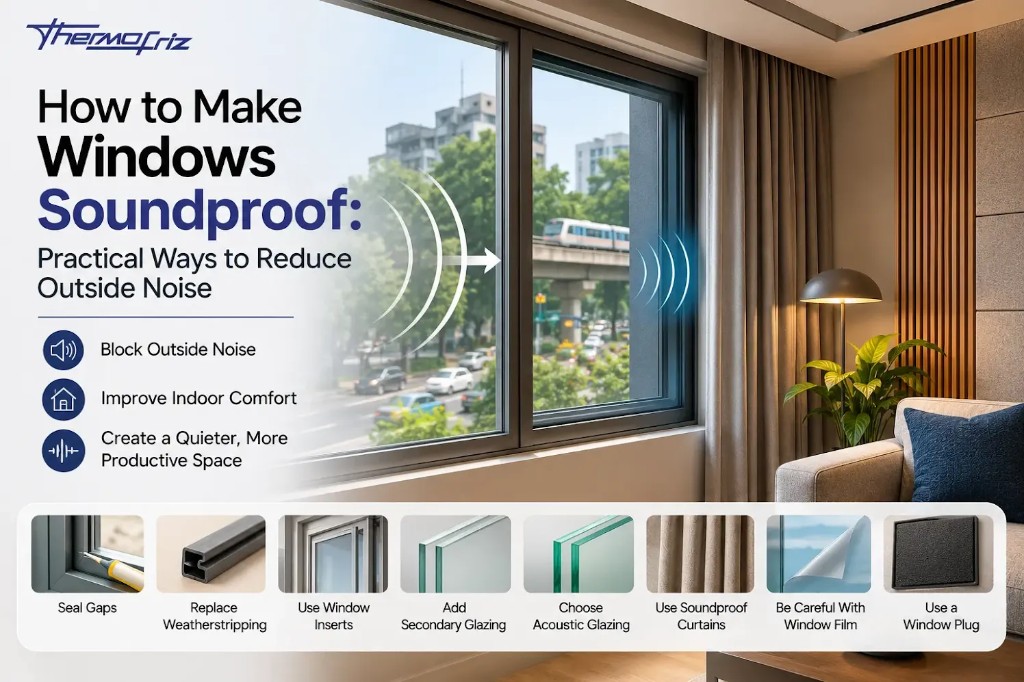
Traffic, horns, construction, trains, aircraft and neighbourhood activity can all become disruptive when outside noise enters through windows.
Windows are often one of the more vulnerable parts of a building envelope because they contain several potential sound paths: the glass itself, opening sections, frame joints, seals and sometimes ventilation openings. Even a relatively good glazing system can perform poorly if air gaps remain around the frame.
For that reason, effective window soundproofing should not begin with curtains, films or buying thicker glass at random. It should begin by identifying where the sound is actually entering.
In many situations, existing windows can be improved without immediate replacement. Sealing gaps, replacing worn weatherstripping, fitting an acoustic window insert or installing secondary glazing may significantly improve the window assembly.
However, no conventional window should be treated as literally “100% soundproof.” The practical objective is to reduce sound transmission to a suitable level for the room and the noise source.
Why Can I Hear Everything Through My Windows?
If outside noise sounds almost as though the window were open, the glass itself may not be the only problem.
Common weak points include:
Gaps Around the Window Frame
Sound can travel through very small air gaps.
Cracks between the window frame and wall, failed sealant or poorly finished installation joints can reduce the overall acoustic performance of the window.
This is why a window with better glass can still perform poorly when its perimeter is not properly sealed.
The Glass and Glazing Federation similarly notes that air gaps around windows can seriously affect noise reduction and that opening windows need effective seals when closed.
Worn or Missing Weather Seals
Opening windows depend on compression seals, gaskets or weatherstripping to create a tight closure.
As these components age, the sash may no longer seal firmly against the frame.
That can create an easy path for traffic or neighbourhood noise.
Thin or Acoustically Weak Glazing
Once leakage has been controlled, the glazing itself may become the dominant sound path.
Thin single glazing generally provides less sound insulation than a properly designed acoustic glazing assembly. Glass thickness, lamination, pane configuration and cavity size can all affect performance.
Poorly Closing Window Sections
Sliding or damaged windows may have gaps around:
- tracks
- meeting rails
- corners
- locks
- sash edges
Improving the glass alone will not correct these leakage points.
Ventilation Openings
Trickle vents or other ventilation openings can create a direct pathway for sound.
They should not simply be blocked without considering ventilation requirements, but they do need to be included in the acoustic diagnosis.
The Noise May Be Entering Somewhere Else
Sometimes the window receives the blame because it is the most obvious opening, while part of the noise is actually travelling through:
- walls
- doors
- façade junctions
- AC penetrations
- ceilings
- ventilation systems
- structural or flanking paths
Thermofriz's Acoustic Flanking Paths guide explains how sound can bypass the element that appears to be the obvious transmission path.
Start by Finding Where the Noise Is Entering
Before spending money on new glazing, inspect the existing window.
Close it fully and check:
- whether the sash closes tightly
- whether there are visible perimeter gaps
- whether the seals are hardened, damaged or missing
- whether the frame-to-wall joint has cracks
- whether the window rattles
- whether the noise seems strongest around the perimeter or across the glazing
- whether vents or AC openings are present nearby
This simple diagnosis can help separate a leakage problem from a glazing-performance problem.
For larger projects or situations where the source is unclear, a structured acoustic site survey may be a better starting point.
8 Ways to Make Windows More Soundproof
1. Seal Gaps With Acoustic Caulk
One of the least expensive places to begin is sealing stationary gaps around the window.
Flexible acoustic caulk or an appropriate acoustic sealant may be used around joints such as:
- frame-to-wall interfaces
- gaps around trim
- small construction cracks
The purpose is to maintain an airtight joint rather than allow sound to leak around the glazing.
However, do not blindly seal:
- drainage holes
- weep holes
- required ventilation
- operating components
The window still needs to function safely and as intended.
Sealing can provide a meaningful improvement when air leakage is the dominant weakness, but it cannot compensate for acoustically weak glazing.
2. Replace Worn Weatherstripping and Improve Window Closure
If the window opens, inspect the seals around the sash.
Old weatherstripping may be:
- compressed
- brittle
- detached
- torn
- missing
Replacing suitable seals and adjusting the hardware can help the window close more tightly.
This matters because the acoustic performance of a window depends on the complete assembly, not only the type of glass. Saint-Gobain also notes that glazing performance depends on the frame, assembly and how the overall window is installed.
For many homeowners, checking seals is a more sensible first step than immediately replacing the glass.
3. Install Soundproof Window Inserts
A soundproof window insert, sometimes called an acoustic window insert, adds a second barrier on the room side of the existing window.
Depending on the system, the insert may use:
- glass
- acrylic
- a separate frame
- compression seals
- magnetic or removable fixing
The acoustic benefit comes from creating an additional barrier with a sealed perimeter and an air cavity between the original window and the insert.
This makes inserts particularly useful when you want to learn how to soundproof windows without replacing them.
The quality of the fit is critical.
A poorly sealed insert can lose much of the potential benefit because sound can still travel around the edges.
Performance also varies according to:
- insert material
- thickness
- air cavity
- existing window
- surrounding wall
- quality of the seals
Avoid universal claims such as “reduces noise by 80%” unless the exact system has test evidence to support them.
4. Add Secondary Glazing
Secondary glazing involves installing a separate internal glazed window or screen while keeping the original external window.
It creates:
existing window + air cavity + secondary glazing
This is one of the more substantial retrofit options when full window replacement is undesirable.
The Glass and Glazing Federation identifies secondary glazing as a method that can improve noise insulation because the additional glass layer and air gap create a more substantial barrier.
Secondary glazing can be particularly useful when:
- the original window must remain
- replacement would be disruptive
- the façade cannot easily be changed
- stronger noise reduction is required than curtains or basic sealing can provide
A larger cavity can help, but only when the overall system is properly sealed. Pilkington similarly stresses that secondary glazing with larger cavity widths can achieve high performance only when air gaps are properly controlled.
For projects where glazing meets surrounding partitions or façades, Thermofriz's Acoustic Glazing Interfaces guide is also relevant.
5. Upgrade to Laminated or Better-Designed Acoustic Glazing
If the existing glass remains the weak point after sealing, upgrading the glazing may be necessary.
Possible options include:
- thicker glass
- laminated glass
- acoustic laminated glass
- double glazing with different pane thicknesses
- specially designed insulating glass units
A common mistake is assuming that double glazing is automatically acoustically superior because it contains two panes.
That is not always true.
Pilkington notes that two panes of identical thickness can experience similar resonant behaviour, while using panes of different thicknesses can improve performance across a wider frequency range.
For noise control, useful design variables can include:
- glass mass
- pane thickness
- asymmetric pane thicknesses
- laminated interlayers
- air cavity
- frame performance
- perimeter sealing
Saint-Gobain likewise identifies wider cavities, different glass thicknesses, thicker glass, effective frames and acoustic laminated glass as factors that can improve window sound insulation.
Therefore, do not select glazing from the number of panes alone.
6. Use Heavy Soundproof Curtains as Supplementary Treatment
Soundproof curtains are frequently marketed as a simple solution for noisy windows.
They can be useful, but expectations should be realistic.
Heavy curtains can help:
- absorb some reflected sound inside the room
- reduce the amount of sound bouncing from the glazing
- add a small additional barrier near the opening
- improve subjective acoustic comfort
For better results, curtains should generally:
- extend beyond both sides of the window
- extend above and below the opening
- use dense, multi-layer fabric
- hang with substantial folds
- close with minimal side gaps
However, curtains should normally be viewed as supplementary acoustic treatment, not as a substitute for airtight sealing, secondary glazing or an acoustically improved window.
If road noise is entering primarily through gaps or thin glazing, a curtain does not correct the actual transmission path.
7. Be Careful With “Soundproof Window Film”
The term soundproof window film is attractive because it suggests that a thin layer can be applied to existing glass and solve a serious noise problem.
That expectation is usually too optimistic.
A thin applied film does not substantially change:
- frame leakage
- worn seals
- gaps around the sash
- façade joints
- ventilation openings
and it adds far less mass than an additional pane or secondary glazing system.
Window films can be valuable for purposes such as:
- solar control
- privacy
- safety
- glare reduction
Some laminated glazing systems also use special interlayers as part of a tested acoustic glass construction.
But that is different from assuming that an ordinary applied film performs like acoustic laminated glass.
For significant noise problems, rely on tested whole-system acoustic performance, not the word “soundproof” in the product name.
8. Use a Removable Window Plug Where Daylight Is Not Important
For spaces such as:
- practice rooms
- temporary studios
- media rooms
a removable window plug can sometimes be useful.
A plug may combine:
- a dense panel
- absorptive material
- perimeter sealing or compression
- removable fixing
Unlike a normal absorptive wall panel, a properly designed plug attempts to add both mass and a tighter barrier across the opening.
The obvious disadvantages are that it may:
- block daylight
- remove the view
- reduce natural ventilation
- interfere with access
Never permanently cover a window that is required for emergency escape, ventilation or another safety function.
How to Soundproof Windows Without Replacing Them
If your existing window is structurally sound, you may be able to improve it significantly without removing the complete unit.
A practical sequence is:
Secondary glazing is particularly relevant here because it preserves the existing primary window while adding a separate inner barrier.
The correct level of intervention should depend on how much noise reduction is needed.
A mildly noisy bedroom beside a residential road may not require the same solution as a recording space beside a railway.
How to Make Windows Soundproof From Outside Noise
For most homes and commercial spaces, the main objective is reducing noise coming from outside to inside.
Common Indian urban noise sources include:
- road traffic
- horns
- metro and railway lines
- construction
- generators
- aircraft
- commercial activity
Different noise sources contain different frequency ranges.
Low-frequency truck or aircraft noise can be more difficult to control than higher-frequency voices or lighter traffic noise.
Pilkington also notes that glazing can behave differently against different noise spectra, which is why identifying the source is important before selecting glass.
The practical strategy remains:
How to Soundproof Windows From Inside Noise
Window soundproofing can work in both directions.
You may want to reduce sound leaving a room if it is used as:
- a home studio
- practice room
- cinema room
- meeting room
- private office
In that situation, the same sound-isolation principles apply.
The window must be considered in terms of:
- airtightness
- glazing mass
- glass configuration
- cavity
- frame
- perimeter seals
- surrounding wall
For music and recording spaces, window performance should be considered as part of the larger room system rather than in isolation.
Thermofriz's Recording Studio Acoustic Design page covers the broader studio requirement, while Home Theater Acoustic Treatment addresses residential entertainment spaces.
Can You Put Soundproof Panels Over Windows?
You can cover a window, but the term soundproof panel needs clarification.
A standard absorptive acoustic panel mainly helps control:
- reflections
- reverberation
- sound within the room
It is not automatically an effective sound-isolation barrier.
This is the same distinction discussed in Thermofriz's guide to Acoustic Panels vs Soundproofing.
If a removable panel is intended specifically to reduce transmission through a window, it usually needs more than absorption. It may require:
- sufficient mass
- a rigid barrier
- a tight perimeter seal
- an appropriate cavity
Simply placing a lightweight foam or fabric acoustic panel over glass should not be expected to block substantial traffic noise.
Which Window Soundproofing Method Is Best?
There is no universally best method because the correct solution depends on the existing weakness.
| Method | Best suited to | Cost level | Relative potential | Main limitation |
|---|---|---|---|---|
| Acoustic caulk / sealing | Small perimeter gaps | Low | Useful first step | Does not improve weak glazing |
| Weatherstripping | Leaky operable windows | Low | Useful first step | Depends on frame condition |
| Heavy curtains | Mild issues / room reflections | Low–Medium | Supplementary | Limited sound isolation |
| Window film | Specific supplementary uses | Low | Limited / variable | Does not correct leakage |
| Acoustic insert | Existing windows | Medium | Good potential | Requires accurate fit and seals |
| Secondary glazing | Strong retrofit requirement | Medium–High | Strong potential | Requires sufficient internal space |
| Acoustic / laminated glazing | Major window upgrade | High | Strong potential | Higher cost and installation |
| Window plug | Studios / blackout acceptable | Low–Medium | Potentially useful | Blocks light and view |
The important principle is:
Treat the weakest sound path first.
If large gaps exist around the frame, expensive acoustic glass may deliver less improvement than expected until those gaps are corrected.
How Much Do Soundproof Windows Cost in India?
There is no single reliable soundproof windows price in India because the term can describe very different levels of work.
A basic window-sealing job and a complete acoustic laminated glazing system are not comparable projects.
Cost depends on factors such as:
- window dimensions
- number of windows
- existing frame condition
- sealing requirements
- glass type and thickness
- laminated interlayer
- double or secondary glazing
- cavity depth
- hardware and frame material
- installation complexity, access and project location
For this reason, price per square foot alone can be misleading.
A useful quotation should state what is actually being supplied and, for serious acoustic requirements, what tested or expected acoustic performance the proposed assembly is intended to provide.
How to Make Windows Soundproof in India
For Indian homes and commercial buildings, a sensible approach is to start with the actual local noise source.
Road Traffic and Horns
Check perimeter sealing, sash closure, frame quality and glazing configuration.
If sealing is already good, secondary glazing or a better acoustic glazing assembly may be required.
Metro or Railway Noise
Rail noise can contain a different frequency profile from ordinary road traffic. A more substantial glazing and cavity design may be needed.
Construction Noise
Construction can contain both airborne and low-frequency components. Window upgrades may help, but walls and other façade elements may also need consideration.
Aircraft Noise
Aircraft noise can be challenging because of its broad frequency range and high sound levels.
A complete façade assessment may be more appropriate than treating the window as an isolated component.
Across all of these situations, the logic is the same:
When Should You Replace the Window?
Retrofitting an existing window can be effective, but replacement may be more appropriate where:
- the frame is damaged
- the sash cannot close tightly
- seals cannot be restored effectively
- the existing glazing is fundamentally unsuitable
- secondary glazing cannot be accommodated
- a major renovation is already underway
- a defined tested acoustic rating is required
Replacement should still be considered as a complete window system, including:
- glass
- frame
- hardware
- seals
- installation
- surrounding junctions
The glass specification alone does not determine real-world performance. Both Saint-Gobain and Pilkington emphasize that acoustic window performance depends on the overall glazing and frame configuration and installation.
What If Noise Is Still Coming In After Treating the Window?
If you have improved the seals and glazing but noise remains, another transmission path may be limiting the result.
Check:
- walls
- external doors
- ceiling voids
- ventilation
- AC penetrations
- façade junctions
- structural flanking paths
This is especially important in commercial buildings where several construction systems meet around the window opening.
Thermofriz's Acoustic Glazing Interfaces guide is relevant where glazing meets surrounding construction, while the Acoustic Flanking Paths guide explains how sound can bypass the element originally being treated.
For difficult cases, an Acoustic Site Survey can help identify the dominant path before further work is specified.
Window Soundproofing With Thermofriz
Effective window soundproofing is rarely about one product.
The window should be assessed together with:
- its frame
- perimeter seals
- surrounding wall
- adjacent doors
- glazing interfaces
- ventilation
- other potential sound paths
Thermofriz works across soundproofing, acoustic treatment and noise-control applications, allowing the problem to be evaluated as part of the complete room or building rather than treating the glass alone.
For broader isolation requirements, explore Thermofriz's Soundproofing Services in India.
Commercial projects can also refer to Office Soundproofing Solutions where window noise interacts with privacy, partitions or other workplace acoustic requirements.
Frequently Asked Questions
How can I soundproof my windows cheaply?
Start by identifying and sealing air gaps.
Check perimeter sealant, weatherstripping, sash alignment, locks and frame joints.
These are often the lowest-cost weaknesses to address.
Heavy curtains can be added as supplementary treatment, but if the glass or frame is the dominant transmission path, stronger measures may still be required.
How can I soundproof my windows to reduce outside noise?
First make sure the window closes tightly and has no significant perimeter leakage.
If sound continues through the glazing, consider acoustic window inserts, secondary glazing, laminated acoustic glass or a properly designed replacement window.
The best choice depends on the source and required noise reduction.
How can I reduce noise coming through my window?
Determine whether the sound is entering through gaps, seals, the frame, the glass, vents or surrounding construction.
Treat the dominant path rather than assuming the glass itself is always responsible.
Can I soundproof windows without replacing them?
Yes.
Depending on the condition of the existing window, options include acoustic caulk, new weatherstripping, hardware adjustment, soundproof window inserts, secondary glazing, and heavy curtains as supplementary treatment.
Secondary glazing is specifically designed to add another internal window while retaining the existing primary unit.
Do soundproof window inserts work?
Properly designed and sealed inserts can improve window noise isolation by adding another barrier and an air cavity.
Their effectiveness depends on the existing window, insert material, spacing and perimeter seal.
Does soundproof window film work?
Do not expect a thin applied film to perform like secondary glazing or acoustic laminated glass.
If a product makes significant noise-reduction claims, request test evidence for the actual window assembly rather than relying on marketing terminology.
Do soundproof curtains work?
Heavy curtains may reduce reflections and provide supplementary noise reduction, but they generally do not correct major air leakage or weak glazing.
They work best as part of a broader strategy rather than as the main sound-isolation measure.
Why can I hear everything through my windows?
Common reasons include air gaps, worn seals, poor sash closure, thin glazing, weak frames, ventilation openings, and sound entering through surrounding construction.
The correct solution depends on which path dominates.
Conclusion
If you want to make windows more soundproof, start with the weakest part of the system rather than immediately replacing the glass.
For some rooms, inexpensive sealing work may make a noticeable difference.
For heavier traffic, railway, aircraft or high-noise environments, stronger solutions such as acoustic window inserts, secondary glazing or properly specified laminated glazing may be required.
Curtains and window film can play supporting roles, but they should not be confused with true sound-isolation construction.
Most importantly, remember that a window is only one part of the building envelope. If noise continues after the window is improved, the walls, doors, ventilation and flanking paths may need to be investigated as well.
For projects where the noise path or required solution is unclear, Thermofriz's Soundproofing Services in India provide the appropriate next step for assessing the problem as a complete sound-control system.