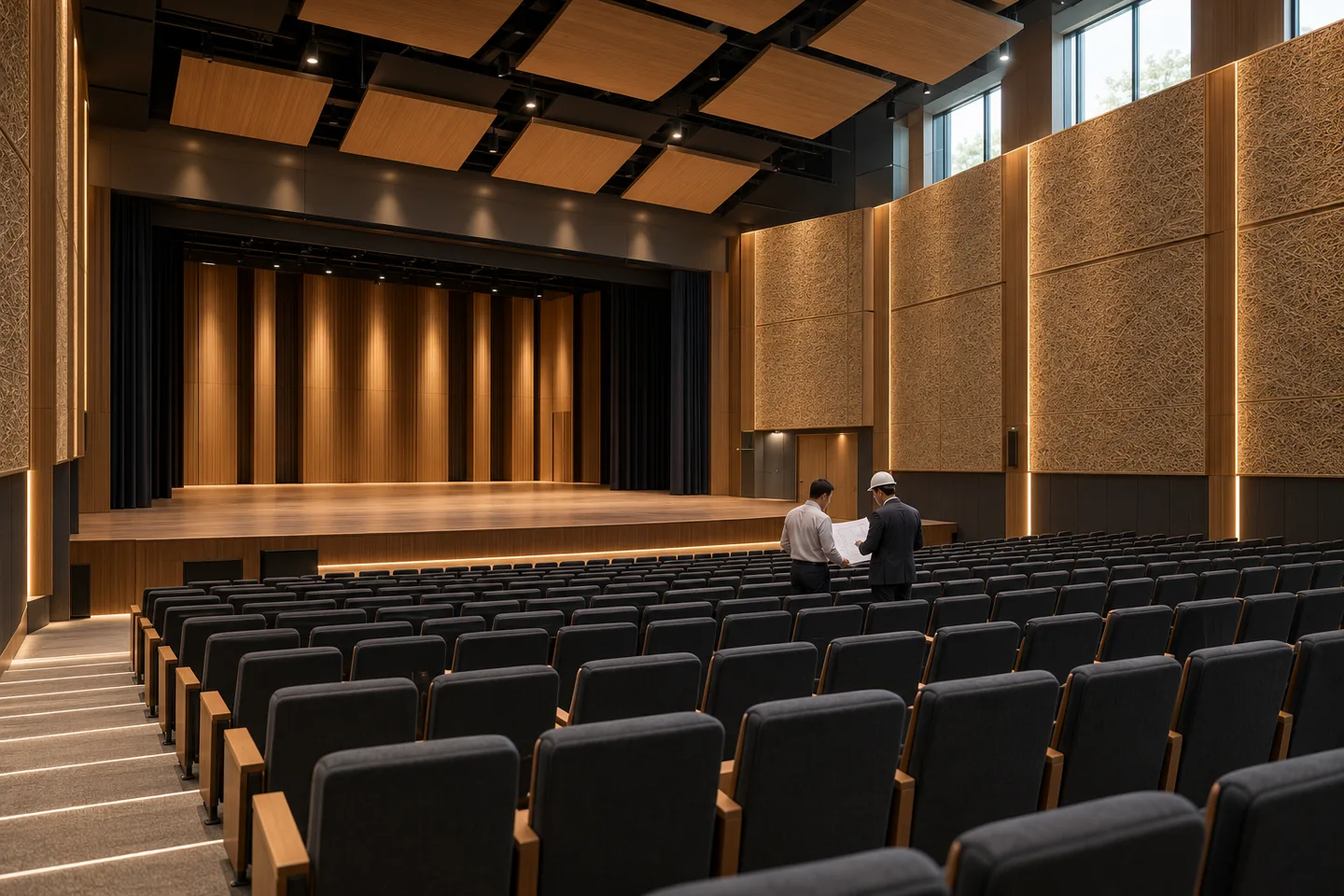
A well-written acoustic tender lets bidders price the same outcome and lets the client verify what was delivered. A weak tender lists panel names and square metres while leaving the backing, mounting, interfaces and acceptance criteria unresolved. The following checklist is intended for architects, consultants, institutions and procurement teams preparing sizeable acoustic works.
1. Describe the room and the problem
State what the space is used for, its approximate dimensions, occupancy and adjacent activities. A lecture theatre, a cinema and a boardroom do not have identical acoustic priorities. Provide drawings showing the room boundaries, doors, glazing, ceiling voids, services and any existing construction that must remain.
Identify whether the brief concerns reverberation, speech intelligibility, transmission between rooms, background noise, equipment noise or a combination. Give the project acoustician responsibility for defining appropriate criteria. Do not copy a single target from an unrelated project simply because it appears in a brochure.
2. Specify the complete assembly
For absorptive finishes, define the facing, thickness, backing, air gap, framing, mounting and coverage assumptions. For isolated rooms, define the wall, ceiling, floor, door, glazing and penetration details together. A bid that supplies only a face panel may exclude substantial parts of the intended construction.
The bill of quantities should identify quantities, units, waste allowances, access equipment, protection and finishing. Where alternatives are permitted, require bidders to demonstrate equivalent suitability through relevant technical information. Similar appearance, material thickness or nominal density does not by itself establish equivalent acoustic performance.
- Name the substrate and mounting method.
- Identify insulation, facing and cavity details.
- Include perimeters, corners, cut-outs and access panels.
- Separate acoustic requirements from fire, structural and environmental requirements.
3. Ask for relevant evidence, not a collection of logos
Request test reports for the proposed system and review whether the laboratory sample resembles the tendered construction. An NRC or other absorption summary should be read with frequency-dependent information and the mounting condition. For sound isolation, review the complete assembly rather than treating an individual material rating as a room guarantee.
Record the report issuer, sample description, test method, date and applicable limitations. Fire documentation should be checked against the project’s required classification and jurisdiction separately from acoustic reports. Avoid wording that implies every product from a company is covered by a single certificate.
4. Allocate responsibility at every interface
Door undercuts, cable routes, HVAC ducts, recessed fittings and unsealed junctions can affect the result. A tender should name who designs, supplies, seals and inspects each interface. List any work excluded from the acoustic contractor’s scope and allocate it to another package before the contract is awarded.
For occupied facilities, also define working hours, dust protection, access routes, storage and sequencing. Moisture problems, incomplete services or unsuitable substrates may have to be resolved before finishes can be installed. A realistic programme states those dependencies and includes inspection hold points.
5. Define acceptance and handover before award
Agree which checks will be performed, by whom, with what instrumentation and under what operating and occupancy conditions. Establish how defects will be recorded and corrected. A visual handover alone is not a substitute for agreed acoustic verification where measured performance forms part of the brief.
Handover information should include approved drawings, product and assembly records, relevant reports, maintenance guidance, access arrangements and warranty responsibilities. Thermofriz can discuss manufacturing, supply and acoustic contracting scopes against a clear tender brief. The first step is to share the drawings and the performance responsibility you need the appointed team to carry.
Sources and further reading
Company information checked in October 2026. Confirm current product details and project responsibilities directly with the proposed supplier.