The term acoustic panel covers a much wider range of products than it may initially suggest. Walk into different auditoriums, recording studios, offices, restaurants, classrooms, home theatres, or commercial spaces, and the acoustic treatment may look completely different.
One project may use fabric-wrapped wall panels. Another may incorporate wood wool boards as part of the interior design. A third may rely on wooden grooved or perforated panels, while another uses ceiling tiles, suspended baffles, or acoustic clouds.
These differences are not purely aesthetic.
Different types of acoustic panels vary in their construction, material, thickness, finish, installation format, acoustic performance, and suitability for different architectural applications. More importantly, the right product depends on what the room actually needs acoustically.
Understanding these differences helps architects, interior designers, consultants, contractors, facility teams, business owners, and homeowners move beyond simply asking, “Which acoustic panel is best?”
A better question is:
“Which type of acoustic treatment is appropriate for this space, this acoustic problem, and this design?”
This guide explores the major acoustic panel types and formats, how they differ, where they can be considered, and what to evaluate before selecting one for a project.
What Are the Main Types of Acoustic Panels?
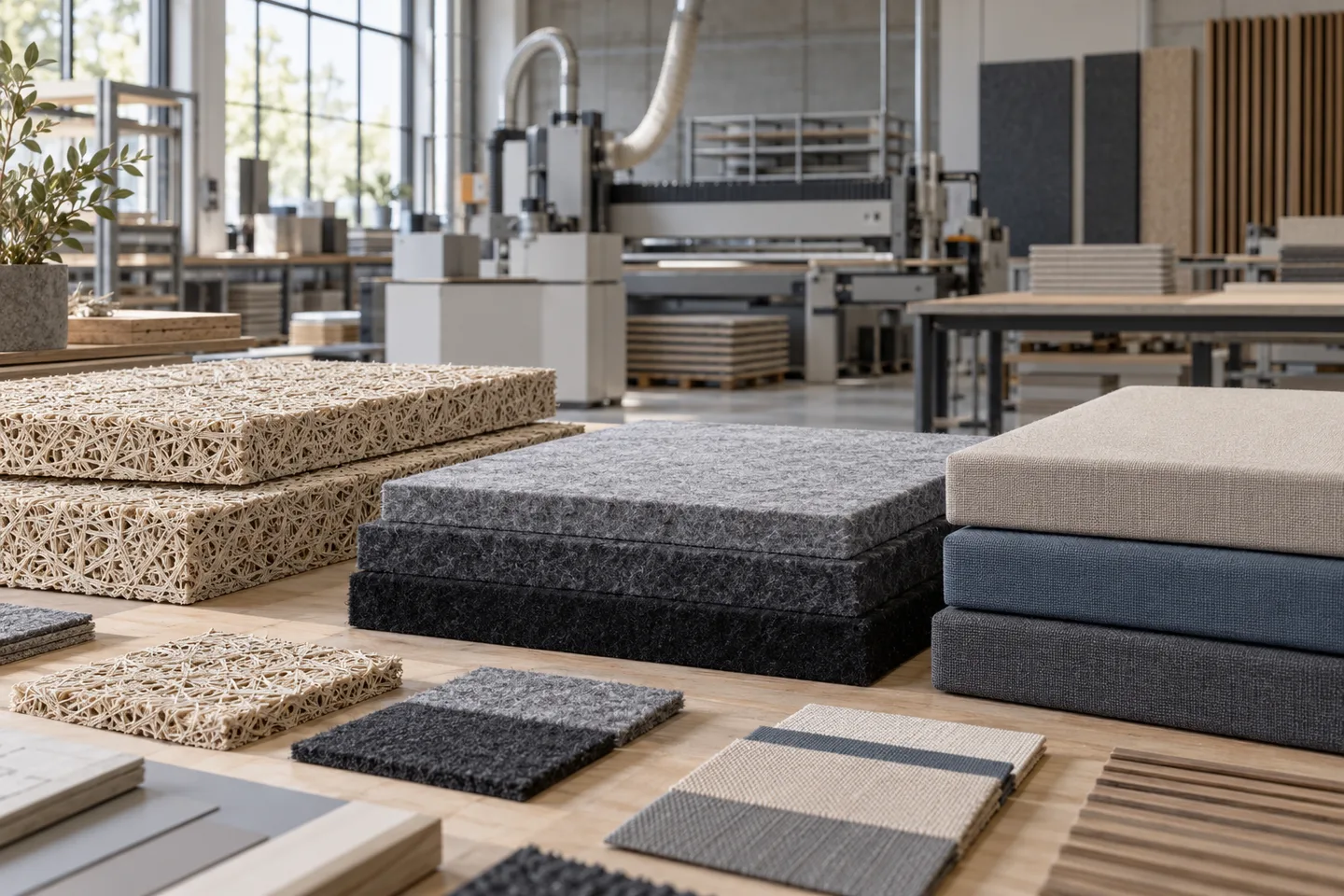
Acoustic panels can be classified according to their material, construction, surface design, and installation format.
Common categories include:
- fabric-wrapped acoustic panels;
- wood wool acoustic panels;
- glasswool-based acoustic panels;
- wooden grooved or perforated acoustic panels;
- synthetic acoustic panels and sheets;
- acoustic ceiling tiles;
- suspended acoustic baffles;
- acoustic clouds.
These categories should not be interpreted as interchangeable products.
A fabric-finished wall panel and a suspended ceiling baffle, for example, can both contribute to sound absorption but may be selected for very different architectural and acoustic reasons.
Similarly, two panels that appear to be made from a similar material should not automatically be assumed to provide identical acoustic performance.
The complete product system matters.
Why Are There So Many Different Types of Acoustic Panels?
There is no universal acoustic panel because there is no universal acoustic space.
Consider an auditorium and a meeting room.
Both may require reverberation control, but they differ significantly in volume, geometry, occupancy, surface area, sound sources, listening distances, architectural design, and performance expectations.
Now compare either of those spaces with a recording studio.
The studio may place much greater emphasis on controlling specific reflections and creating appropriate critical-listening conditions.
A restaurant presents another challenge. Acoustic comfort matters, but so do visual identity, lighting, ceiling services, seating arrangements, and the atmosphere the designer wants to maintain.
This is why different acoustic products exist.
The selection may be influenced by:
The material is therefore only one part of the decision.
As discussed in our guide on how to choose acoustic panels, effective selection should begin by identifying the acoustic problem before comparing products.
1. Fabric-Wrapped Acoustic Panels
Fabric-wrapped acoustic panels are among the most recognisable forms of interior acoustic treatment.
Rather than leaving the absorptive component visually exposed, the panel incorporates a fabric-finished surface that allows it to become part of the interior design.
This makes the format particularly relevant where acoustic treatment occupies prominent wall areas and needs to complement the surrounding architecture.
Thermofriz's fabric category includes Fabrix Wall Panel, which reflects this combination of acoustic treatment and a finished architectural surface.
How Are Fabric-Wrapped Acoustic Panels Constructed?
The exact construction depends on the particular product.
In general, however, a fabric-wrapped system combines an acoustic panel/core with an appropriate fabric-facing arrangement to create a finished interior panel.
It is important not to judge performance simply by looking at the outer fabric.
The acoustic behaviour relates to the complete construction, including the underlying material, panel thickness, facing, mounting arrangement, and tested configuration.
This distinction matters because two products described broadly as fabric acoustic panels may have different specifications and intended applications.
For project selection, the correct approach is therefore to evaluate the specific fabric wrapped acoustic panels being proposed rather than assuming that the category name itself guarantees a particular performance level.
Where Are Fabric-Wrapped Acoustic Panels Commonly Considered?
Their finished appearance makes fabric-wrapped panels particularly useful where acoustic treatment and interior design need to work together.
Depending on the project's acoustic requirements, they may be considered for spaces such as:
offices and meeting rooms, auditoriums, recording environments, home theatres, conference spaces, educational interiors, hospitality environments, and other commercial applications.
The format can be especially useful when a designer wants acoustic treatment to integrate with an existing colour palette or become a deliberate feature of the wall design.
But visual flexibility should not overshadow acoustic suitability.
A fabric-wrapped panel still needs to be selected according to the room's actual acoustic requirements.
What Should You Check Before Selecting Fabric Acoustic Panels?
Start with the acoustic performance data available for the specific product and configuration.
Then consider panel thickness, dimensions, finish options, mounting arrangement, intended application, and relevant project requirements.
For architectural projects, edge detailing and panel layout can also matter because multiple panels may form a substantial visual surface.
And if the underlying problem is sound transmission between rooms rather than excessive reflected sound, remember the distinction established in our guide to acoustic panels vs soundproofing: a sound-absorbing wall panel should not automatically be expected to perform the function of a complete sound-isolation system.
2. Wood Wool Acoustic Panels
Wood wool acoustic panels have a distinctive visual character that sets them apart from smooth fabric-finished systems.
Their textured surface allows them to function not only as an acoustic treatment component but also as an architectural material.
Within the Thermofriz product range, wood wool appears as an established category with products such as Fine Fissured Wood Wool Board, Fibre Fissured Wood Wool Board, Hexagonal Wood Wool Board, Square Fissured Wood Wool Board, and Wood Wool Board.
This variety also illustrates an important point:
even within one material family, acoustic products can differ in format, appearance, dimensions, thickness, and specification.
What Makes Wood Wool Acoustic Panels Different?
Visually, wood wool panels offer a fibrous, textured appearance rather than a concealed fabric finish.
That characteristic can make them useful when designers want the treatment itself to remain visible and contribute to the architectural language of a room.
Thermofriz's supplied product information also shows that its wood wool products are available across different configurations rather than one universal board.
For example, the product materials shared for the website include different shapes and fissured designs within the wood wool family.
That makes the category relevant not only from an acoustic perspective but also from an architectural one.
A designer may therefore consider:
acoustic performance, board format, thickness, surface pattern, colour/finish possibilities where available, installation approach, and how the material relates visually to the surrounding interior.
Where Can Wood Wool Panels Be Used?
The appropriate application depends on the particular product and project specification.
Broadly, wood wool acoustic treatment can be considered in architectural interiors where sound absorption and a distinctive surface finish are both desirable.
Potential environments may include auditoriums, educational spaces, offices, commercial interiors, hospitality environments, multipurpose spaces, and other applications where the relevant product specifications suit the project.
However, it would be misleading to say that wood wool is automatically the best choice for all of these spaces.
An auditorium may use one acoustic strategy while an office with the same wood wool aesthetic may require a different coverage, thickness, location, or combination of products.
The room remains the starting point.
Thermofriz's existing article on the benefits of wood wool acoustic panels can support readers who want to explore this material family in greater depth.
Design and Specification Considerations
One of wood wool's strongest architectural characteristics is that it does not necessarily need to disappear into the background.
Different board shapes, surface designs, and layouts can allow acoustic treatment to participate in the visual composition.
But product selection should still be technically grounded.
Architects, consultants, and contractors should evaluate the relevant product documentation rather than specifying wood wool solely because its texture suits the design concept.
Depending on the project, considerations can include:
the acoustic performance of the selected product, available thicknesses, dimensions, installation requirements, surface finish, relevant fire-performance information, and other technical specifications.
This becomes especially important for auditoriums, institutional buildings, commercial projects, and other specification-led environments.
3. Glasswool-Based Acoustic Panels
Glasswool-based products form another important part of the acoustic-treatment ecosystem represented on the Thermofriz website.
The supplied Thermofriz product material shows glasswool used across several product formats rather than only one conventional wall panel.
The category includes products such as Fibtex Acoustic Tile, Fibtex Baffle, Fibtex Ceiling Panel, Fibtex Cloud, Fibtex Fabric Wall Panel, and Fibtex Glasswool Board.
That range demonstrates why categorising acoustic products only by core material can be limiting.
The same broad material family can appear as:
The installation format can therefore be just as important as the material itself.
How Do Glasswool-Based Acoustic Systems Differ?
A glasswool-based acoustic product should be evaluated as a complete system.
Its performance cannot be inferred accurately from the word glasswool alone.
Thickness, density where specified, facing or finish, dimensions, installation configuration, mounting, and the tested product assembly may all be relevant.
For example, a ceiling tile and a suspended cloud may use related acoustic materials but interact with the room and architecture in different ways because they are installed differently.
This is why technical comparisons should be made between specific products and configurations, not merely between generic material names.
Where Can Glasswool Acoustic Products Be Considered?
Their range of available formats can make glasswool-based solutions relevant to different wall and ceiling applications, subject to the specifications of the particular product.
A project with usable wall area may consider a wall-panel format.
Another project may have extensive glazing or limited wall space but a large ceiling zone available for treatment. Ceiling panels, tiles, clouds, or baffles may then become more relevant options.
Large commercial interiors may also use suspended elements as part of the ceiling architecture.
The decision therefore returns to the same principle:
Where does the room need treatment, and which product format can provide it appropriately?
Why Product-Level Data Matters
A common mistake when comparing acoustic panel materials is assuming that every product made from the same broad material category performs similarly.
That is not a safe basis for specification.
When technical performance matters, project teams should review the data for the actual product being proposed.
This includes relevant acoustic test information, dimensions, thickness, construction, installation requirements, and applicable project documentation.
As Thermofriz's technical evidence library grows, product-specific test reports and documentation can make this comparison even more useful for architects, acoustic consultants, and institutional buyers.
For now, the key principle remains:
Choose acoustic panels according to the tested product system and project requirement—not according to material name alone.
4. Wooden Acoustic Panels
Wooden acoustic panels occupy an important position where acoustic performance and architectural design need to coexist.
Unlike a conventional fabric-finished panel, wooden acoustic systems can become a prominent part of the interior. This makes them particularly relevant to spaces where designers want acoustic treatment to complement wood finishes, linear geometries, or premium architectural detailing.
The Thermofriz product range includes multiple wooden acoustic formats rather than treating “wooden acoustic panels” as a single product type. The supplied website materials show solutions including grooved, perforated, and slatted wooden systems, each with its own construction and visual character.
This distinction matters because the visible wood surface alone does not explain how an acoustic system works.
The panel design, openings or grooves where applicable, backing construction, absorptive components, installation arrangement, and overall assembly can influence acoustic performance.
Grooved Wooden Acoustic Panels
Grooved acoustic panels use a deliberately designed surface pattern rather than a conventional solid decorative board.
From an architectural perspective, the grooves create a linear appearance that can integrate naturally into walls and other designed interior surfaces.
From an acoustic-selection perspective, however, the important consideration is the complete system behind that appearance.
A project team should review the actual product specification, acoustic performance data, panel dimensions, installation arrangement, finish, and applicable technical requirements before selection.
Grooved wooden systems can be particularly relevant when an interior calls for a visually structured wood finish while also requiring acoustic treatment.
Perforated Wooden Acoustic Panels
Perforated wooden acoustic panels take a different visual approach.
Instead of continuous grooves, the visible surface incorporates a pattern of openings as part of the panel construction.
Again, the perforations should not be considered decorative features alone. Their relationship with the panel construction and supporting acoustic system is what makes the complete product relevant to room acoustics.
For architects and consultants, this means two perforated wooden products should not be assumed to perform identically simply because they appear visually similar.
The actual technical data matters.
When Should Wooden Acoustic Panels Be Considered?
Wooden acoustic systems can be considered where the project requires a combination of architectural finish and acoustic functionality, subject to the specifications of the selected product.
Potential applications can include auditoriums, conference facilities, institutional interiors, performance spaces, offices, hospitality environments, and other design-led projects.
But wooden acoustic panels should not automatically be selected simply because the room is premium or because wood suits the interior palette.
The selection still needs to answer:
What acoustic problem is being addressed?
What performance is required?
Where will the panels be installed?
What panel construction is appropriate?
How will the treatment interact with the rest of the room?
What technical and project requirements apply?
That keeps architecture and acoustics aligned.
5. Synthetic Acoustic Panels and Sheets
Not all acoustic treatment needs to rely on conventional mineral-fibre, wood-based, or fabric-wrapped panel formats.
The Thermofriz website also includes a dedicated Sentetic product family, demonstrating another approach to acoustic treatment.
Within the supplied product information, this range includes products such as Sentetic Acoustic Sheet, Sentetic Acoustic Wadding, Sentetic Baffle, Sentetic Cloud, Sentetic Soffit, Sentetic Tile, Sentetic Trapezoidal Baffle, and Sentetic V Groove.
The variety is significant.
It shows that synthetic acoustic solutions can extend beyond a simple flat wall panel into ceiling, suspended, shaped, and architectural treatment formats.
Where Can Synthetic Acoustic Solutions Fit?
The answer depends on the individual product.
A sheet or wall-oriented treatment may serve a different design purpose from a suspended baffle. A cloud interacts with the ceiling zone differently from a soffit treatment. A V-groove or trapezoidal format introduces different architectural possibilities again.
This gives designers another reason not to approach acoustic products through material categories alone.
A more useful selection hierarchy is:
This is particularly relevant for contemporary commercial interiors, where large expanses of glazing, open ceilings, exposed services, and limited conventional wall area can influence where acoustic treatment can practically be introduced.
6. Acoustic Ceiling Tiles and Panels
When people think about acoustic panels, walls often receive most of the attention.
Yet the ceiling can represent one of the largest available surfaces in a room.
This becomes particularly important in offices, classrooms, commercial spaces, hospitality environments, institutional buildings, and other interiors where wall space may be occupied by glazing, doors, displays, furniture, equipment, or architectural features.
Acoustic ceiling products allow the treatment strategy to use this overhead surface.
Thermofriz's supplied product range includes ceiling-oriented solutions such as Fibtex Acoustic Tile, Fibtex Ceiling Panel, Sentetic Tile, and other products designed around ceiling or suspended applications.
When Does Ceiling Treatment Make Sense?
Ceiling treatment may deserve consideration when the ceiling contributes significantly to the room's reflective environment or when usable wall area is limited.
It can also be integrated into the design from the beginning of a project rather than introduced later as a corrective measure.
This is especially useful for architects.
Instead of designing the complete ceiling first and asking where acoustic treatment can be added afterwards, the acoustic strategy can become part of the ceiling concept itself.
However, ceiling treatment should not be specified merely because ceiling area is available.
The acoustic objective, room geometry, ceiling height, services, installation system, required coverage, and product specifications should guide the decision.
7. Acoustic Baffles
Acoustic baffles differ visibly from conventional wall-mounted panels.
They are suspended within the ceiling zone, allowing the treatment to occupy open overhead space rather than being fixed flat against a wall.
The supplied Thermofriz range includes both Fibtex Baffle and several Sentetic baffle formats, including Sentetic Baffle and Sentetic Trapezoidal Baffle.
This gives baffles particular relevance when ceiling design and acoustic treatment need to work together.
Why Use Acoustic Baffles?
Baffles can provide an alternative where wall treatment is restricted or where the architectural concept favours suspended acoustic elements.
For example, a commercial interior may have extensive glazed walls and an exposed ceiling. Covering the glazing with wall panels would conflict with the design, while suspended acoustic elements may provide another treatment opportunity.
Baffles can also contribute visually through repetition, spacing, orientation, and geometry.
However, their quantity and layout should not be determined solely by appearance.
Ceiling height, suspension arrangement, room volume, acoustic target, panel performance, orientation, spacing, and other project conditions can influence the design.
The result should be an acoustic ceiling composition, not simply decorative objects hanging overhead.
8. Acoustic Clouds
Acoustic clouds are another suspended treatment format, but they should not automatically be treated as another name for baffles.
The supplied Thermofriz portfolio includes products such as Fibtex Cloud and Sentetic Cloud.
Clouds are typically conceived as suspended acoustic elements within the ceiling plane, creating opportunities to combine treatment with architectural ceiling design.
Acoustic Clouds vs Baffles
At a simple conceptual level, the difference is primarily in their form and orientation within the suspended treatment strategy.
Baffles are generally treated as vertically oriented suspended elements, while clouds are commonly arranged as broader horizontal suspended elements.
The exact product construction and installation should always be checked rather than relying solely on these general descriptions.
Both formats can be useful where conventional wall-mounted treatment is undesirable or insufficient, but they create different visual and spatial effects.
This means the choice between a baffle and a cloud should consider:
room geometry, ceiling height, available suspension area, architectural concept, acoustic objective, installation constraints, and the performance of the actual product.
Acoustic Wall Panels vs Ceiling Panels vs Baffles vs Clouds
These formats are easier to understand when compared by where and how they become part of the room.
| Acoustic Treatment Type | Typical Location | Key Design Consideration | When It May Be Considered |
|---|---|---|---|
| Wall panels | Vertical wall surfaces | Wall availability, reflections and interior design | Where suitable wall area can form part of the treatment strategy |
| Ceiling panels/tiles | Ceiling plane | Ceiling system, services, coverage and room geometry | Where overhead surface area can contribute to treatment |
| Baffles | Suspended ceiling zone | Height, orientation, spacing and suspension | Where suspended vertical treatment suits the room and design |
| Clouds | Suspended ceiling zone | Layout, dimensions, suspension and ceiling composition | Where broader suspended treatment can integrate with the architecture |
There is no requirement that a project must choose only one.
A larger acoustic design may use different treatment formats in different areas because walls and ceilings perform different architectural and acoustic roles.
That leads to a broader principle:
The best type of acoustic panel is not always a single product. Some rooms benefit from a coordinated combination of acoustic treatments.
How Acoustic Panel Materials Affect Performance
Material matters, but it should never be considered in isolation.
The performance of an acoustic panel can be influenced by the complete system, including its construction, thickness, facing, surface design, mounting arrangement, backing, and installation configuration.
This is why statements such as:
“Material A is always better than Material B”
are usually too simplistic to guide a serious project.
A wood wool board, fabric-wrapped panel, glasswool-based product, wooden acoustic system, or synthetic product should be evaluated using the relevant performance information for the specific product being proposed.
Thickness
Thickness can influence acoustic behaviour, particularly across different frequencies, but thicker should not automatically be interpreted as better in every application.
Product construction and installation matter as well.
Density
Density may be an important technical parameter for certain acoustic products, but it should not be used as a standalone quality score.
Two products with different constructions cannot necessarily be ranked simply by comparing density figures.
Surface Construction
Fabric, grooves, perforations, fissures, and other surface treatments can form part of the overall acoustic system.
Their role needs to be understood in relation to the complete product rather than judged visually.
Mounting and Installation
How a panel is installed can also influence the system being specified.
A product tested in one configuration should not automatically be assumed to deliver identical performance when its construction or installation is materially changed.
For professional projects, the safest approach is to review product-specific technical documentation and the intended installation configuration.
Does the Type of Acoustic Panel Affect NRC?
Yes, different acoustic products can have different sound-absorption characteristics and therefore different NRC values where NRC testing is applicable.
But this does not mean that acoustic panel types should be ranked through NRC alone.
NRC is a useful single-number indicator of sound absorption under specified test conditions. It does not tell the entire story about frequency-dependent behaviour, room suitability, architecture, installation, fire requirements, durability, or whether the product addresses the actual acoustic problem.
A panel with a higher NRC is therefore not automatically the best product for every room.
For example, an architect specifying an auditorium may need to consider acoustic performance alongside wall and ceiling design, product configuration, technical documentation, installation requirements, and the wider room-acoustic strategy.
A restaurant designer may need a solution that provides appropriate absorption while integrating successfully with a highly visible interior.
A recording environment may have more specific reflection and frequency-control requirements.
For readers comparing performance specifications, Thermofriz's existing guide to understanding NRC ratings explains why this number should be interpreted in context rather than used as the sole selection criterion.
Which Type of Acoustic Panel Is Best for Different Spaces?
There is no single acoustic panel type that is automatically best for an auditorium, studio, office, classroom, or home theatre.
Even two rooms serving the same purpose can require different treatment because their dimensions, geometry, finishes, ceiling heights, occupancy, acoustic problems, and design requirements differ.
The more useful approach is to identify the acoustic priority of each space and then select the product—or combination of products—that supports it.
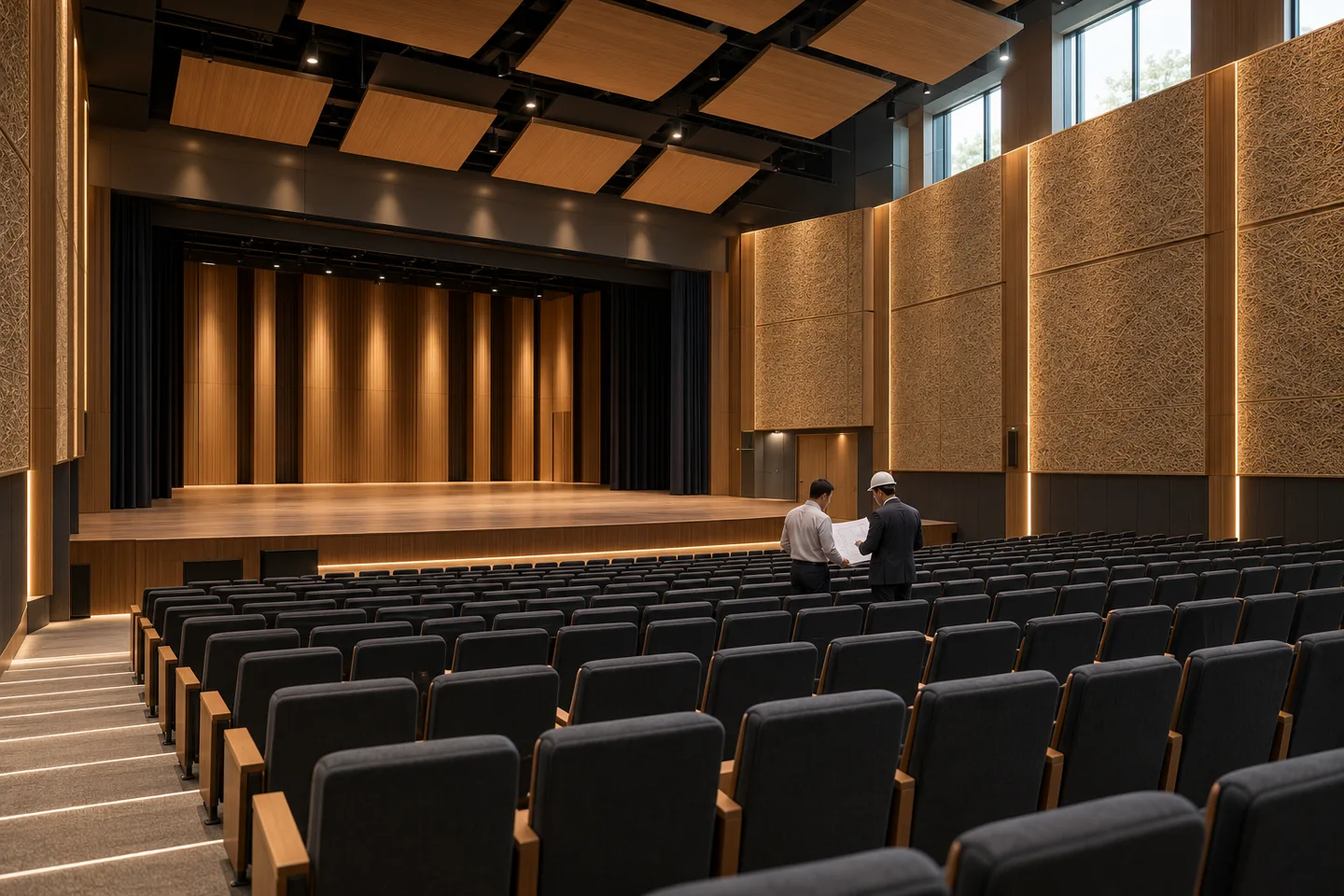
Acoustic Panels for Auditoriums
Auditoriums are among the more demanding environments for acoustic design because sound needs to work effectively across a comparatively large volume and audience area.
Depending on the auditorium's purpose, important considerations may include reverberation control, speech clarity, wall and ceiling reflections, architectural finishes, seating areas, room geometry, and the relationship between the stage and audience.
This makes it difficult to recommend one universal type of auditorium acoustic panel.
A project may consider wall-mounted absorptive products, wooden acoustic systems, wood wool boards, ceiling treatment, suspended elements, or a coordinated combination of solutions where appropriate.
The correct choice depends on what the auditorium is designed to do.
A speech-focused auditorium, multipurpose hall, and performance venue should not automatically be assumed to require identical acoustic conditions.
For this reason, Thermofriz's dedicated auditorium acoustic panels and auditorium acoustic treatment pages should serve different user needs: the first supports product selection, while the second addresses the broader treatment strategy.
Acoustic Panels for Recording Studios
Recording studios require greater attention to how sound behaves at specific locations within the room.
Rather than simply trying to make the space less reverberant, treatment may need to address reflections and listening or recording conditions according to the room's function.
A studio may therefore use different forms of treatment depending on:
room dimensions, recording purpose, monitor and listening positions, existing surfaces, frequency-related requirements, and available treatment areas.
Fabric-wrapped panels or other absorptive systems may be considered where suitable, but material selection alone does not determine whether the room will perform well.
Placement is equally important.
This is also where the distinction between acoustic treatment and soundproofing becomes critical. Internal treatment manages the room's acoustic behaviour; preventing external noise from entering a studio or music from escaping requires separate consideration of sound isolation.
Acoustic Panels for Home Theatres
Home theatres share some characteristics with other critical-listening spaces but have their own practical requirements.
The treatment needs to work around loudspeaker positions, seating, room geometry, wall and ceiling surfaces, interior finishes, and the desired listening environment.
Depending on the design, wall panels, ceiling treatment, or other acoustic solutions may form part of the room.
A common mistake is choosing panels primarily because they create the familiar appearance associated with a cinema or studio.
An acoustic panel should not be installed merely because it looks acoustic.
Its performance, construction, thickness, location, and contribution to the complete home theater acoustic treatment strategy should justify its use.
Acoustic Panels for Offices and Meeting Rooms
Modern offices create a different acoustic challenge.
Open layouts, glass partitions, hard floors, exposed ceilings, and contemporary interior finishes can create reflective environments. Meeting rooms and conference spaces may also depend heavily on speech clarity.
Depending on the problem, treatment might include wall panels, ceiling panels, tiles, baffles, clouds, or a combination of formats.
For example, an office dominated by glazed walls may offer relatively little suitable wall area. The ceiling zone could therefore become more important for introducing absorption.
In another office, fabric-wrapped wall panels may integrate naturally into meeting-room interiors.
The best product type follows the space available for treatment and the acoustic objective, rather than an office-specific material rule.
Acoustic Panels for Classrooms
Classrooms are predominantly speech-focused spaces.
The ability of students to hear spoken information clearly makes reverberation and reflected sound important considerations.
Wall or ceiling treatment may be appropriate depending on room geometry, dimensions, surface finishes, and the existing acoustic conditions.
Larger lecture halls, training rooms, and educational auditoriums require a different level of planning from conventional classrooms, even though all are educational environments.
This illustrates why application labels alone are not enough.
“Acoustic panels for schools” can describe several substantially different requirements.
Acoustic Panels for Restaurants and Hospitality Spaces
Restaurants, cafés, hotels, banquet facilities, and other hospitality interiors often need to balance acoustic comfort with strong architectural identity.
This can make visually integrated acoustic products especially useful.
Fabric-wrapped treatments, wood wool surfaces, wooden systems, ceiling products, baffles, clouds, or other formats may be considered depending on the project.
In a restaurant with extensive glazing and limited wall area, suspended ceiling treatment may offer possibilities that conventional wall panels do not.
In another space, visible textured or wooden acoustic surfaces may complement the interior concept.
The acoustic treatment should support the environment without appearing to have been added as an afterthought.
Acoustic Panels for Commercial and Institutional Projects
Commercial and institutional projects often introduce additional specification requirements.
Beyond acoustic performance and appearance, project teams may need to consider installation, durability, available technical documentation, relevant fire-performance information, maintenance, dimensions, finish, and compatibility with architectural systems.
This is where selecting a product from an image or headline NRC value becomes particularly risky.
Architects, acoustic consultants, contractors, and institutional buyers need enough product-level information to determine whether a system is appropriate for the actual specification.
As Thermofriz's technical evidence library develops, test reports, technical datasheets, installation information, and project documentation should become an increasingly important part of this decision process.
How to Compare Different Types of Acoustic Panels
With so many types of acoustic panels available, comparison becomes easier when performed in a consistent order.
Start with the acoustic problem—not the material.
Then evaluate the product systematically.
1. Identify the Acoustic Objective
Determine whether you are trying to control:
reverberation, echo, problematic reflections, speech clarity, listening conditions, or another room-acoustic issue.
If the main problem is sound travelling between spaces, investigate sound isolation rather than assuming another absorptive panel is required.
2. Understand the Room
Consider:
room size, volume, geometry, ceiling height, occupancy, surface finishes, sound sources, and intended use.
These factors provide context for every subsequent product decision.
3. Review Acoustic Performance
Look at the available performance information for the actual product.
Where NRC is relevant, use it as one piece of the evaluation rather than the sole measure of quality.
4. Compare Product Construction
Determine what you are actually comparing.
Is it:
- a fabric-wrapped absorptive panel?
- a wood wool board?
- a glasswool-based ceiling product?
- a grooved or perforated wooden system?
- a synthetic acoustic product?
- a suspended baffle?
- a cloud?
The category name should lead to technical evaluation, not replace it.
5. Evaluate Thickness and Configuration
Compare the thickness and construction available for the intended application.
Do not assume the thickest panel is automatically the best option.
6. Determine Where Treatment Can Be Installed
Assess walls, ceilings, and suspended ceiling zones.
The best product on paper is of little practical value if it cannot be integrated appropriately into the room.
7. Consider Architecture and Aesthetics
Evaluate finish, colour, texture, geometry, module size, layout, and how visibly the treatment will influence the interior.
8. Check Project Requirements
For commercial, public, institutional, or specification-led environments, review the relevant technical documentation and project requirements before finalising a product.
This gives us a much stronger comparison framework:
That is more reliable than asking which material is “best.”
Common Mistakes When Comparing Acoustic Panel Types
Choosing by Material Name Alone
“Wood wool,” “glasswool,” “fabric,” or “wooden” tells you something about a product, but not everything required to specify it.
Products within the same broad material family can differ in construction, thickness, format, installation, and performance.
Assuming Similar-Looking Products Perform the Same
Two panels can look almost identical while having different underlying constructions.
Visual similarity should never replace technical comparison.
Comparing Only NRC
NRC is valuable for understanding sound absorption, but the highest number does not automatically identify the most appropriate panel for every application.
The room and project requirements remain essential.
Ignoring Installation Format
A wall panel, ceiling tile, baffle, and cloud interact with the architecture differently.
The installation format should be considered early rather than after the material has already been selected.
Ignoring the Ceiling
A project with limited wall area may still have substantial ceiling-treatment opportunities.
This is particularly relevant in commercial interiors with glazing, open layouts, or architectural wall features.
Confusing Acoustic Panels With Soundproofing Products
Absorptive treatment should not automatically be expected to prevent sound transmission through walls, floors, ceilings, doors, or glazing.
If the problem involves sound entering or leaving the space, the transmission paths require separate investigation.
Selecting for Appearance Before Diagnosing the Room
A visually impressive acoustic product can still be the wrong product for a particular problem.
Architecture matters—but diagnosis comes first.
Can Different Types of Acoustic Panels Be Used Together?
Yes. In appropriate projects, using multiple treatment formats can be more logical than forcing one acoustic product across every surface.
Consider a large auditorium.
The wall treatment may need to integrate with the architectural finishes, while the ceiling presents different geometric and installation requirements. Different areas may therefore call for different acoustic products or treatment formats as part of one coordinated design.
A commercial interior may combine wall absorption with suspended baffles.
Another space may use ceiling treatment where glazing prevents substantial wall coverage.
A project could also combine absorptive treatment with separate sound-isolation measures where both internal acoustics and transmission control are required.
The important word is coordinated.
Using multiple products does not automatically create better acoustics. Each element should have a reason to exist within the overall treatment strategy.
Frequently Asked Questions About Types of Acoustic Panels
What are the main types of acoustic panels?
Common types include fabric-wrapped panels, wood wool panels, glasswool-based acoustic products, grooved or perforated wooden panels, synthetic acoustic solutions, ceiling tiles, baffles, and acoustic clouds.
The appropriate type depends on the room, acoustic objective, required performance, installation location, architecture, and project specifications.
Which acoustic panel material absorbs the most sound?
There is no reliable universal answer based solely on the material name.
Sound absorption depends on the specific product construction, thickness, installation configuration, and frequency-dependent performance. Available test data for the actual product should therefore be used when comparing acoustic performance.
Are wood wool panels better than fabric-wrapped acoustic panels?
Neither category is universally better.
Wood wool and fabric-wrapped panels offer different constructions and architectural characteristics. The appropriate choice depends on acoustic requirements, available product performance, thickness, finish, installation, interior design, and project specifications.
What is the difference between acoustic wall panels and ceiling panels?
The most obvious difference is their installation location, but that affects how they become part of the treatment strategy.
Wall panels use vertical surfaces, while ceiling panels or tiles use overhead areas. Depending on the room, one or both may be appropriate.
What are acoustic baffles used for?
Acoustic baffles are suspended treatment elements used within the ceiling zone. They can be considered where suspended absorption suits the acoustic and architectural design, particularly when conventional wall area is limited or the ceiling is intended to become part of the treatment strategy.
What is an acoustic cloud?
An acoustic cloud is a suspended acoustic element typically arranged within the ceiling zone. It can introduce absorption while becoming part of the architectural ceiling composition.
The specific performance and installation requirements depend on the product.
Which type of acoustic panel is best for an auditorium?
There is no universal best panel for every auditorium.
Selection depends on auditorium volume, geometry, intended programme, reverberation requirements, wall and ceiling design, acoustic performance, product construction, installation, and other project specifications.
Larger auditorium projects may use more than one acoustic treatment format.
Can different acoustic panel types be used together?
Yes, where the acoustic design calls for it.
Wall panels, ceiling systems, baffles, clouds, wooden treatments, or other acoustic products can potentially be combined when each performs an appropriate role within the overall treatment strategy.
Final Thoughts: Choose the Acoustic System, Not Just the Material
Understanding the different types of acoustic panels is useful, but recognising their names is only the beginning.
Fabric-wrapped panels can provide a finished wall-treatment format. Wood wool can introduce a distinctive textured architectural surface. Glasswool-based products can appear across wall, ceiling, baffle, cloud, and board configurations. Wooden systems can combine acoustic function with grooved or perforated architectural finishes. Synthetic products provide further wall and suspended-treatment possibilities. Ceiling tiles, baffles, and clouds allow the treatment strategy to extend beyond conventional walls.
None of these categories is automatically superior.
The right decision begins with:
What acoustic problem does the room have?
Then:
What does the room need to achieve?
Only after those questions are answered should material, performance, thickness, format, placement, appearance, and technical requirements determine the product selection.
For complex spaces, Thermofriz can evaluate the project as a complete acoustic environment rather than recommending a product based solely on its material category.
Planning an auditorium, studio, home theatre, office, educational facility, hospitality space, or commercial acoustic project? Get a Free Consultation with Thermofriz to identify an appropriate combination of acoustic products and treatment strategies for your space.